[Asia Economy Reporter Kang Nahum] Since the establishment of China's Great Firewall, the splintering of the internet across countries, which had been gradually deepening over decades, is intensifying due to the European Union's (EU) Digital Markets Act (DMA) initiative and the cyberwarfare between the United States and Russia triggered by the Ukraine war. Concerns are rising that borders are being established on the previously borderless internet, and furthermore, major countries will censor and use the internet primarily within their own national networks.
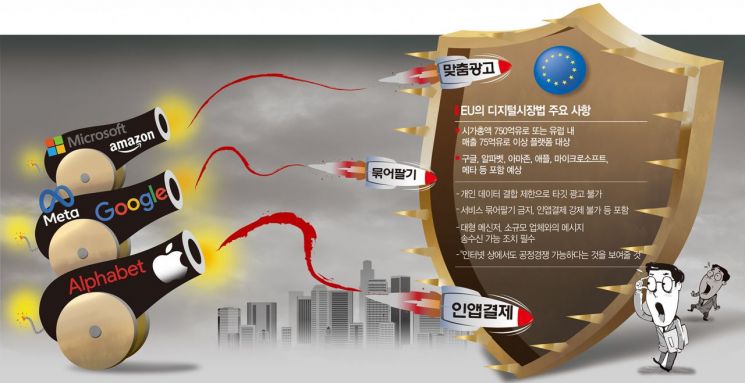
◆ EU Digital Markets Act Agreement = According to foreign media on the 28th, the European Union (EU) agreed on the 24th (local time) on the Digital Markets Act, which aims to curb the market dominance of American big tech companies such as Google and Meta.
This legislation focuses on restricting monopolistic practices by global big tech companies. Specifically, Google and Facebook Messenger must take measures to be interoperable with other messengers within Europe, and data must also be exchanged. When purchasing smartphones, the use of third-party app stores other than app stores like Apple's App Store and Google Play Store must be allowed. Practices such as Amazon ranking its own products higher to gain an advantage on the platform are fundamentally prohibited. If American big tech companies do not agree, their services will become unavailable within Europe.
These regulations on big tech companies in Europe have significant implications as they may encourage similar policies in non-European countries. If such agreements continue by country and region, it is analyzed that instead of a global network uniting the world as one, its limits may be determined by physical boundaries. This means the realization of a ‘splinternet’ is possible.
◆ China and Russia Establish Borders on the Internet = Since the early 2000s, China has built an internet surveillance and censorship system called the ‘Great Firewall.’ It has blocked access to Twitter, Facebook, YouTube, Instagram, and others within its territory.
Moreover, the recent Ukraine war has accelerated this phenomenon. After Russia's invasion, Meta, the operator of Facebook and Instagram, blocked access to Russia’s state-owned broadcaster ‘Russia Today’ and news agency ‘Sputnik’ on the grounds that they could be used for Russian propaganda and agitation. YouTube also blocked access to channels related to Russian state media and deleted about 1,000 channels and 15,000 pieces of content covering the Ukraine invasion. Google, Apple, Netflix, and others have also suspended or restricted various services in Russia.
In response, the Russian government retaliated by blocking its citizens’ access to Facebook, Twitter, and Instagram, and is considering blocking YouTube access as well. Additionally, under the pretext of protecting its information infrastructure, Russia ordered all websites, portals, and services of the Russian federal administration and related agencies to switch to domestic DNS servers.
◆ Sharp Increase in Internet Shutdown Cases Over the Past Five Years = Signs of the splinternet are becoming increasingly evident. According to Access Now, a nonprofit digital rights organization, there have been 850 cases of internet shutdowns by governments worldwide over the past decade, with 768 of those occurring in the last five years. Google recently revealed that government requests for content removal have increased fivefold since 2015, reaching 50,000 requests annually.
This trend of internet de-globalization raises concerns as users are unable to enjoy the value of ‘freedom of information.’ Professor Byungjun Yoo of Seoul National University’s Business School said, "Big tech companies representing the United States aim to uphold the traditional value of 'freedom of information,' but given the current international political climate, the splinternet is an unavoidable reality. Even with the same situation, the amount of information provided differs, leading to varying interpretations and causing each country and its citizens to develop different worldviews."
© The Asia Business Daily(www.asiae.co.kr). All rights reserved.
![Clutching a Stolen Dior Bag, Saying "I Hate Being Poor but Real"... The Grotesque Con of a "Human Knockoff" [Slate]](https://cwcontent.asiae.co.kr/asiaresize/183/2026021902243444107_1771435474.jpg)
















