[Public Servant Salaries in the 100 Trillion Won Era] Moon Administration's Rapid Increase in Public Servant Positions... National Financial Burden Including Salaries Intensifies
Ministry of Employment Staff Up 48.7%, Ministry of Gender Equality and Family Also Up 11.2% Amid Survival Crisis... Only Ministry of Health and Welfare Decreases After Disease Control Agency Separation
National Assembly Budget Office Projects Public Servant Pension Deficit to Rise from 2.1 Trillion Won in 2020 to 31.1 Trillion Won by 2090
[Asia Economy Sejong=Reporters Kim Hyewon and Kwon Haeyoung] Since the Moon Jae-in administration ushered in the era of annual public servant personnel expenses exceeding 100 trillion won, concerns have grown over the fiscal burden that the state and citizens must bear. For President-elect Yoon Seok-yeol, who advocates a "small government," streamlining the rapidly expanded government organization over the past five years under the Moon administration has emerged as an urgent task to address.
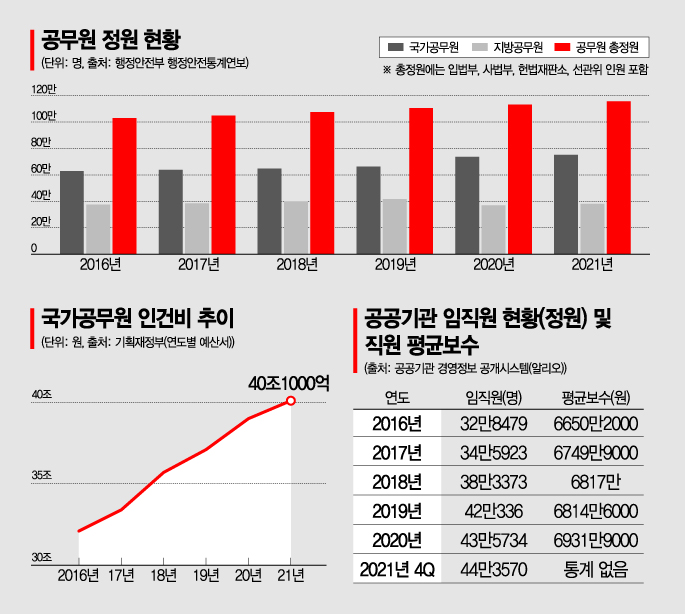
◆Personnel expenses for public servants and public institutions easily surpass 100 trillion won= Last year, the government’s expenditure on personnel costs for national and local public servants and public institutions far exceeded 100 trillion won. According to the Ministry of the Interior and Safety’s Administrative Safety Statistical Yearbook and the Government Organization Management Information System as of the end of last year, the total number of public servants was 1,156,952, of which 750,824 (64.9%) were national administrative public servants and 380,819 (32.9%) were local public servants. Based on the 2020 average monthly standard income of all public servants (5.35 million won), a simple calculation shows that personnel expenses for these public servants alone approached 75 trillion won last year. For the first time ever, national public servant personnel expenses exceeded 40 trillion won last year, and the budget for local public servant-related expenses has continued to rise since breaking the 30 trillion won barrier in 2019 during the Moon administration.
Adding the average compensation of public institution executives and employees, which has increased annually under the Moon administration, nearly 110 trillion won in fiscal resources are being spent on personnel costs for public servants and public institutions. An analysis of the Public Institution Management Information Disclosure System (ALIO) shows that as of the fourth quarter of last year, the number of public institution executives and employees was 443,570, a 35% increase compared to 328,479 in 2016. Estimating their average compensation amounts to 31 trillion won. However, the financial soundness of public institutions is deteriorating. Public institution debt increased from 500.3 trillion won in 2016 to 544.8 trillion won in 2020, and local public enterprises hold 54.4 trillion won in debt amid net losses in the 2 trillion won range.
As the number of public servants increases, the pension burden the state must bear in the future has also grown. Since the government is responsible for paying public servant pensions, similar to military pensions, it must support the deficit amount from the national budget. The National Assembly Budget Office projected that the public servant pension deficit will increase from 2.1 trillion won in 2020 to 32.1 trillion won by 2090, equivalent to 0.8% of the Gross Domestic Product (GDP). Professor Sung Taeyoon of Yonsei University’s Department of Economics pointed out, "The public servant pension system already has many problems," adding, "(The expansion of public servants) is structurally necessary to resolve because it is linked not only to massive immediate personnel expenses but also to pension funding issues that future generations will have to bear."
◆Ministry of Employment and Labor increased staff by 50% over five years= According to Rep. Lee Myungsoo of the People Power Party, among the 18 ministries under the Moon administration, the Ministry of Employment and Labor increased its number of public servants the most over the past five years. The number rose from 5,837 at the end of 2016 to 8,682 at the end of 2021, a 48.7% increase. Next were the Ministry of the Interior and Safety (37.7%), Ministry of Environment (34.9%), Ministry of Oceans and Fisheries (16.7%), Ministry of SMEs and Startups (15.4%), Ministry of Foreign Affairs (12.8%), Ministry of Agriculture, Food and Rural Affairs (12.7%), and Ministry of Economy and Finance (12.4%). All these increases exceeded the Moon administration’s five-year average growth rate of 12.4%.
The Ministry of Gender Equality and Family, which faces an uncertain future in the new government’s organizational restructuring, saw an 11.2% increase in public servants during the current administration. The Ministry of Health and Welfare was the only ministry to reduce its staff by 18.8%, but this was due to the separation of the Korea Disease Control and Prevention Agency in 2020. The Ministry of Employment and Labor explained that the increase was related to the National Employment Support System, which provides cash and other support to encourage employment among youth and low-income unemployed individuals, leading to increased hiring. The Ministry of Environment stated that its staff increased due to the transfer of water management personnel from the Ministry of Land, Infrastructure and Transport and the expansion of organizations addressing climate change.
© The Asia Business Daily(www.asiae.co.kr). All rights reserved.
![Clutching a Stolen Dior Bag, Saying "I Hate Being Poor but Real"... The Grotesque Con of a "Human Knockoff" [Slate]](https://cwcontent.asiae.co.kr/asiaresize/183/2026021902243444107_1771435474.jpg)
















