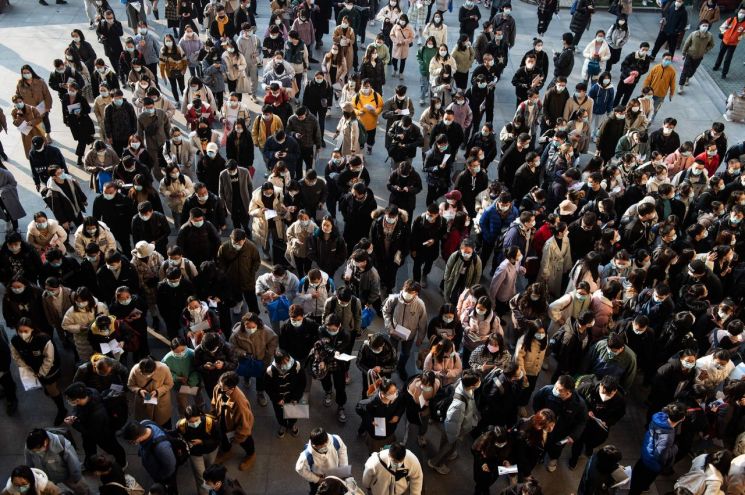
 Examinees are gathered at the civil servant recruitment exam venue in Wuhan, Hebei Province, China. [Image source=Yonhap News]
[Asia Economy Reporter Hwang Sumi] A dispute has arisen between China and India over which country has the largest population in the world.
According to the South China Morning Post (SCMP) in Hong Kong on the 27th, the controversy began earlier this month when posts spread on social networking services (SNS) claiming that India's total population reached 1.415 billion, surpassing China.
The media explained that this figure is based on the 'India Population Clock' estimated by an Indian medical information site, medindia. It is not based on a specific population survey but rather an estimate considering the population growth rate.
According to official records, China still leads India in population. According to the National Bureau of Statistics of China announced in January, China's population was estimated at 1.4126 billion at the end of last year. This result is based on the decennial population census conducted by China last year.
According to the United Nations, India's population is 1.393 billion. India was unable to conduct its decennial population census last year due to COVID-19. Therefore, the media added that the claims about India's population circulating on SNS lack official evidence and have been criticized.
China and India have been compared since the 1950s in terms of population, land area, and development goals. The United Nations projected in a 2019 report that India's population could surpass China's around 2027.
China's population is still increasing, but low birth rates and aging are intensifying. Last year, China's birth population was 10.62 million, the lowest since 1961. Also, the birth rate (number of births per 1,000 people) was 0.752% (7.52 births per 1,000 people), the lowest since the founding of the People's Republic of China in 1949.
India's population growth has also begun to slow. According to the National Family Health Survey (NFHS) 2019?2021 released in November last year, India's total fertility rate dropped below 2.1 for the first time, recording 2.0, which is the threshold needed to maintain the current population level.
The total fertility rate refers to the number of children a woman is expected to have in her lifetime, and if this number falls below 2.1, the population will gradually decline. India's total fertility rate was 2.2 in the 2015?2016 survey conducted five years ago.
© The Asia Business Daily(www.asiae.co.kr). All rights reserved.
![Clutching a Stolen Dior Bag, Saying "I Hate Being Poor but Real"... The Grotesque Con of a "Human Knockoff" [Slate]](https://cwcontent.asiae.co.kr/asiaresize/183/2026021902243444107_1771435474.jpg)















