"Under the National Finance Act and Constitution, the government must submit a supplementary budget proposal... No sharp options for the transition team"
Supplementary budget likely to be prepared after the new government takes office
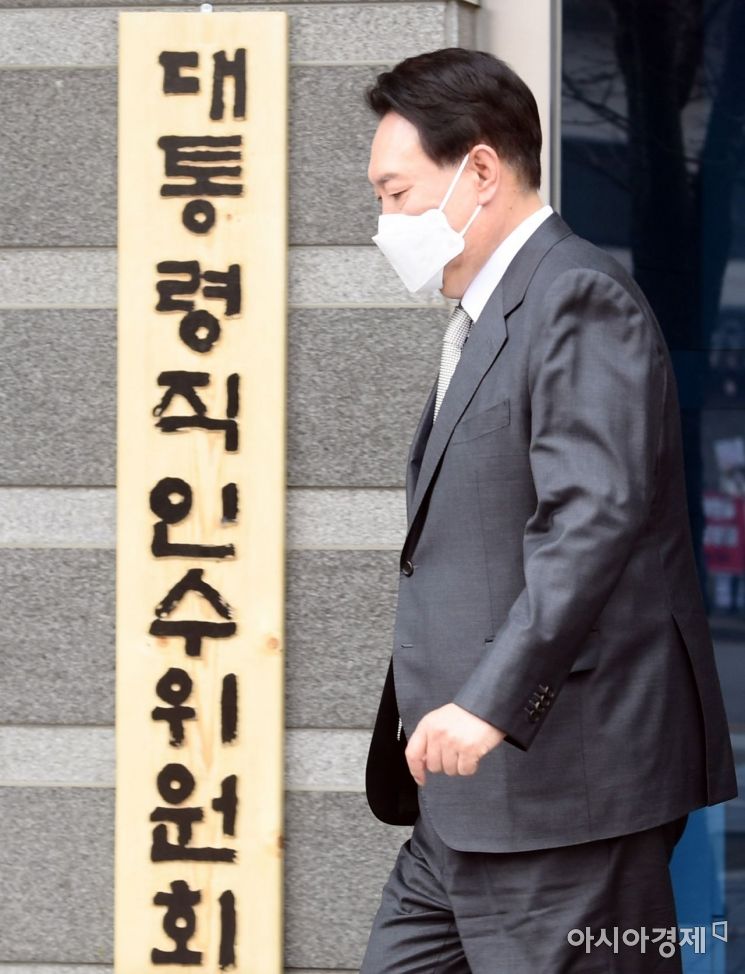 President-elect Yoon Suk-yeol is leaving the transition office in Tongui-dong, Jongno-gu, Seoul, for lunch on the 25th. Photo by Kim Hyun-min kimhyun81@
[Asia Economy Sejong=Reporter Kwon Haeyoung] With President Moon Jae-in and President-elect Yoon Seok-yeol scheduled to meet on the 28th, 19 days after the presidential election, attention is focused on whether discussions on the second supplementary budget (supplementary budget) can make progress. The Presidential Transition Committee has stated that the current administration should actively cooperate in the preparation of the second supplementary budget.
According to the Transition Committee on the 27th, President-elect Yoon plans to meet with President Moon the following day without setting an agenda, aiming for an open and frank conversation. It is expected that during this meeting, both sides will discuss the issue of preparing a supplementary budget of around 50 trillion won, which President-elect Yoon pledged during his campaign.
A Transition Committee official said, "To prepare a supplementary budget, under the National Finance Act and the Constitution, the government must approve the supplementary budget proposal at a Cabinet meeting and submit it to the National Assembly. Even if the Transition Committee prepares the supplementary budget, if the current administration does not cooperate in drafting the proposal, there is no effective way forward."
Earlier, the Democratic Party of Korea expressed willingness to cooperate in the supplementary budget discussions. On the 22nd, Yoon Ho-jung, co-chair of the Democratic Party’s Emergency Response Committee, said at a National Assembly floor strategy meeting, "If the People Power Party truly intends to realize the April supplementary budget as stated, they should promptly discuss funding measures and the scale of the supplementary budget." However, the current administration remains negative about preparing the supplementary budget.
A Transition Committee official added, "The key to securing funds for the supplementary budget is expenditure restructuring, which requires cutting the current administration’s budget. But the government, with only about 50 days left in its term, is resisting any budget cuts," adding, "The Transition Committee has no authority to enforce this." The official further pointed out, "The conflict over the supplementary budget is similar to issues like the presidential office relocation, where old and new powers clash."
In particular, the Transition Committee criticizes the current administration’s lack of cooperation on the supplementary budget as inconsistent. Previously, Lee Jae-myung, the Democratic Party’s presidential candidate, promised to secure 50 trillion won immediately after election either through a second supplementary budget or an emergency financial order to fully compensate losses of small business owners and self-employed individuals. In this context, the government and ruling party should cooperate with President-elect Yoon’s intention to prepare the supplementary budget.
Initially, both inside and outside the government anticipated that preparing the supplementary budget would be difficult. During the awkward coexistence period between the current administration and the Transition Committee before the new government’s official launch, the prevailing view was that the current administration would not cooperate in preparing the supplementary budget. The fact that Hong Nam-ki, Deputy Prime Minister and Minister of Economy and Finance, has clashed with the National Assembly over the size of this year’s first supplementary budget due to concerns about fiscal deterioration also contributed to this expectation. Furthermore, the Transition Committee insists on securing funds through expenditure restructuring, but it was predicted that the Ministry of Economy and Finance would find it difficult to cut budgets for large-scale projects driven by the current administration, such as the Korean New Deal.
As the second supplementary budget becomes another example of conflict between old and new powers, there is growing speculation that the new government will begin preparing the supplementary budget after President-elect Yoon’s inauguration on May 10. However, since the meeting between President-elect Yoon and President Moon is scheduled, the possibility of progress in discussions related to the supplementary budget cannot be completely ruled out.
© The Asia Business Daily(www.asiae.co.kr). All rights reserved.
![Clutching a Stolen Dior Bag, Saying "I Hate Being Poor but Real"... The Grotesque Con of a "Human Knockoff" [Slate]](https://cwcontent.asiae.co.kr/asiaresize/183/2026021902243444107_1771435474.jpg)















