LG Energy Solution and SK Announce New Factory Construction in North America and Europe
Samsung to Invest Following R&D Aligned with Market Growth Rate
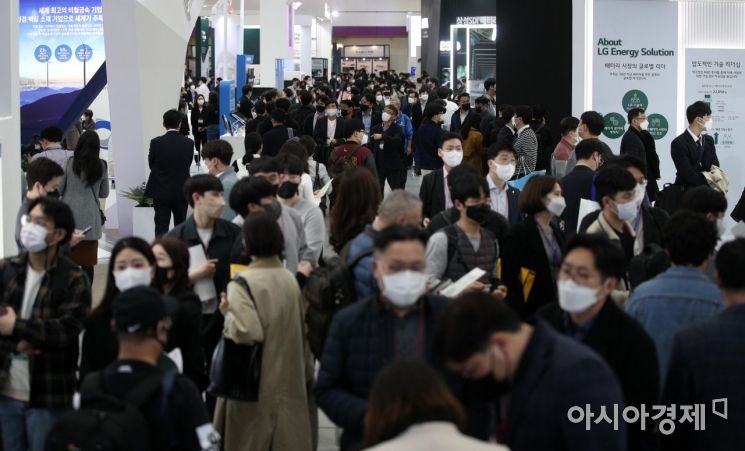 On the first day of the 'InterBattery 2022' exhibition held at COEX in Samseong-dong, Gangnam-gu, Seoul, the venue was bustling with visitors on the 17th./Photo by Hyunmin Kim kimhyun81@
[Asia Economy Reporter Moon Chaeseok] The three major domestic battery companies are deliberating over expanding overseas production facilities and strengthening profitability. LG and SK are relatively focused on growth, while Samsung is known for prioritizing profitability in its management.
According to industry sources on the 27th, LG Energy Solution decided on the 24th to jointly invest a total of 4.8 trillion KRW with the U.S. automaker Stellantis to build a battery joint venture factory (annual capacity of 45GWh) in Canada. In Arizona, USA, they plan to invest 1.7 trillion KRW to establish a battery-only factory (11GWh). Including the existing LG Energy Solution standalone factory in the U.S., three joint venture factories with General Motors (GM), and factories in Poland, China, Indonesia, and domestically, they will have a minimum battery production capacity of 447GWh by 2025. This capacity is enough to equip approximately 5.6 million high-performance pure electric vehicles capable of driving over 500 km on a single charge.
SK On announced on the 15th that it will establish an electric vehicle battery joint venture factory (30GWh) in Turkey with the U.S. automaker Ford. Although the exact investment amount was not disclosed, it is estimated to be at least several trillion KRW. Adding this to SK On’s existing standalone factory in the U.S., the joint venture factory with Ford being built in the U.S., and battery factories in China, Hungary, and domestically, SK On’s electric vehicle battery production capacity will increase to 220GWh by 2025.
Samsung SDI operates electric vehicle battery production bases in three locations: Ulsan in Korea, Xi’an in China, and G?d in Hungary. Samsung SDI has not disclosed its current production capacity or expansion plans. The industry estimates Samsung SDI’s battery production capacity to be around 114GWh by 2025. This is one-quarter of LG Energy Solution’s target and about half of SK On’s capacity.
Samsung SDI has maintained independent management without joint ventures with automakers. Although it announced at the end of last year that it would establish a joint venture factory with Stellantis in the U.S., the last among the three domestic companies, the site for the joint venture factory has yet to be decided. Summarizing North American market investment plans, Samsung SDI’s production capacity in 2025 (23GWh) is significantly lower than LG Energy Solution (over 205GWh) and SK On (150GWh). As a result, SK On, a latecomer last year, surpassed Samsung SDI in battery market share for the first time. According to market research firm SNE Research, Samsung SDI’s global electric vehicle battery market share fell from 5.8% in 2020 to 4.5% last year, dropping from 5th to 6th place. Meanwhile, SK On increased its share from 5.5% to 5.6%, rising from 6th to 5th place, overtaking Samsung SDI. With SK On’s faster production capacity growth, the gap with Samsung SDI is expected to widen further.
Some view this as Samsung SDI focusing on research and development investment to secure battery technology leadership instead of facility investment. According to each company’s 2021 business report, Samsung SDI invested a total of 877.6 billion KRW in research and development last year, the largest expenditure among the three domestic battery companies. LG Energy Solution’s R&D expenditure was 654 billion KRW, and SK On’s parent company SK Innovation spent 364.1 billion KRW. The ratio of R&D expenditure to sales was also highest for Samsung SDI at 6.5%, compared to LG Energy Solution’s 3.7% and SK Innovation’s 0.78%.
Regarding technology development, Samsung SDI is accelerating research and development of next-generation all-solid-state batteries, called a "game changer." Samsung SDI recently started construction of a 6,500㎡ (approximately 2,000 pyeong) all-solid-state battery pilot line (S line) at its SDI Research Center in Suwon, Gyeonggi Province. Samsung SDI is conducting all-solid-state battery research centered on this pilot line, aiming to begin mass production in 2027. On the 17th, at the shareholders’ meeting, Samsung SDI CEO Choi Yoon-ho told reporters, "Samsung SDI’s business is not a short-distance race but a long-term competition," adding, "We will first secure a super-gap technological competitiveness and pursue qualitative growth with the best quality and profitability advantage." Regarding future investment policy, he emphasized, "Whether it is aggressive or conservative depends on the perspective, but we will invest at least to match the market growth speed."
© The Asia Business Daily(www.asiae.co.kr). All rights reserved.
![Clutching a Stolen Dior Bag, Saying "I Hate Being Poor but Real"... The Grotesque Con of a "Human Knockoff" [Slate]](https://cwcontent.asiae.co.kr/asiaresize/183/2026021902243444107_1771435474.jpg)
















