[Asia Economy Reporter Lim Hye-seon] Since the COVID-19 pandemic, the number of companies adopting remote work has increased. We examine the potential social value created by the implementation of remote work from an ESG perspective through the case of SK Telecom.
According to SK Telecom on the 26th, SKT was the first large corporation to implement remote work for all employees at the early stage of the COVID-19 outbreak. Along with this, the company introduced 'Work From Anywhere,' allowing employees to work freely without being restricted by the location of the office or hub offices.
Remote Work Increased 12-Fold in 2 Years
According to Statistics Korea, the number of people utilizing flexible work arrangements increased from 2.215 million in August 2019 to 3.534 million in August last year, about 1.6 times growth. Types of flexible work include flexible working hours, remote and telecommuting, selective working hours, staggered commuting, and reduced working hours. In particular, the number of workers engaged in remote and telecommuting increased 12-fold from 95,000 in August 2019 to 1.14 million in August last year.
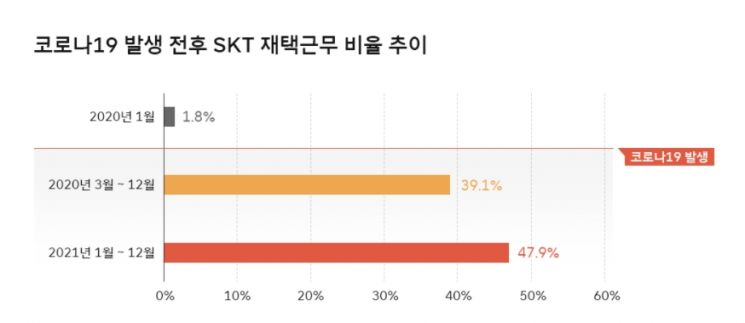
Looking at SKT's remote work ratio, only 1.8% of the total workforce chose remote work in January 2020 before the COVID-19 outbreak. However, the average remote work ratio from March to December 2020 after the outbreak was 39.1%, and last year it reached 47.9%. Nearly half of the entire workforce is choosing remote work.
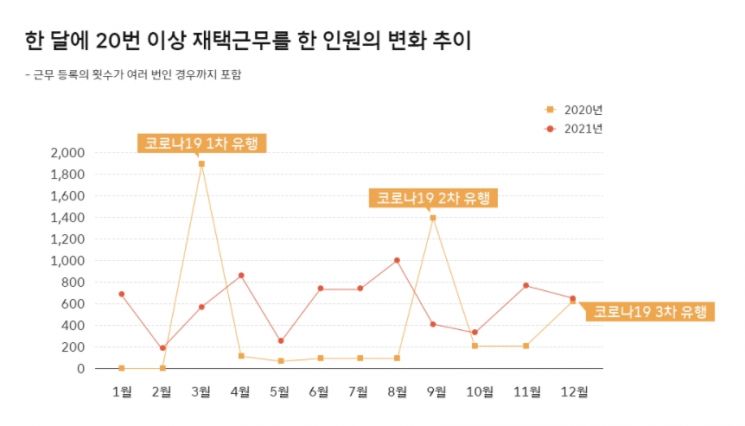
How many employees worked remotely more than 20 times a month? In 2020, the number of remote workers fluctuated significantly depending on the waves of the COVID-19 pandemic. In contrast, last year showed a more moderate fluctuation compared to the previous year. This confirms that remote work is becoming the new normal at SKT as the pandemic prolongs.
Greenhouse Gas Reduction, Contribution to Individual Happiness
According to the Population and Housing Census data released by Statistics Korea, the average commuting time and commuting population of Koreans are on the rise. The average one-way commuting time increased by about 2.4 minutes from 28.4 minutes in 2000 to 30.8 minutes in 2020. According to statistics published by the Organisation for Economic Co-operation and Development (OECD), Koreans spend 58 minutes commuting round-trip, the longest among member countries. This is 18 minutes longer than the commuting times in Japan and Turkey, which are tied for second place. Compared to the OECD average, it takes more than twice as long.
The costs of commuting not only burden individuals but also cause social costs such as air pollution and traffic congestion. According to 2018 data provided by the Korea Transport Emission Management System (KOTEMS), the transportation sector accounts for 13.54% of greenhouse gas emissions. Of this, 95.86% is generated from road transportation. Efforts to reduce greenhouse gas emissions from road traffic are urgently needed.
Analyzing the social value that can be created when SKT employees work remotely, the energy consumption (fuel costs) saved amounted to 41,765,409 KRW. The greenhouse gas cost savings reached 7.2 million KRW. Commuting time could be reduced by approximately 1.08 million hours. This is a simple assumption converted into social value, considering that 3% of the total 5,043 employees work remotely an average of 2 days per week, taking into account the parking capacity at T Tower.
While remote work may have pros and cons depending on the nature of the business and corporate culture, it is important to focus on its ESG value in terms of contributing to employee happiness and reducing greenhouse gases. SKT plans to foster an internal culture based on autonomy and performance rather than being restricted by the work location.
© The Asia Business Daily(www.asiae.co.kr). All rights reserved.
![Clutching a Stolen Dior Bag, Saying "I Hate Being Poor but Real"... The Grotesque Con of a "Human Knockoff" [Slate]](https://cwcontent.asiae.co.kr/asiaresize/183/2026021902243444107_1771435474.jpg)

















