Institute of Production Technology, Successful Localization of 3KW High-Power Fiber Laser Source
Hanwha Plans to Use for Explosive Disposal and Anti-Aircraft Weapons
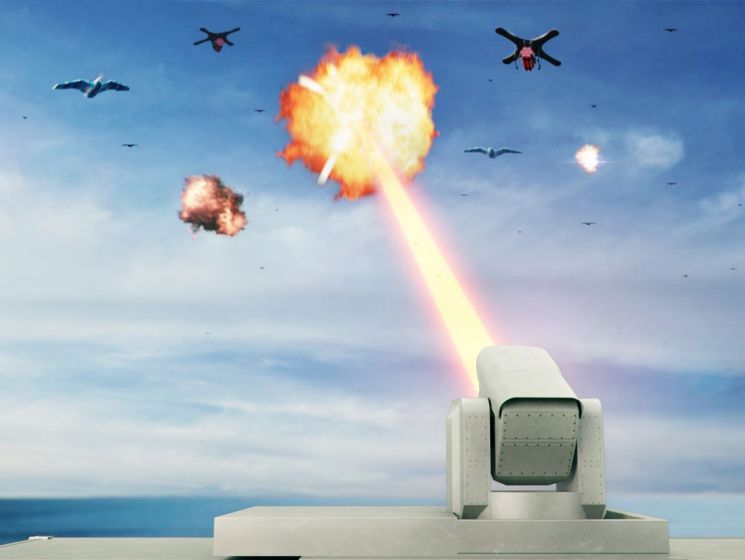
[Asia Economy Reporter Kim Bong-su] A high-power anti-aircraft laser weapon capable of shooting down unmanned drones at close range has been domestically developed.
The Korea Institute of Industrial Technology announced on the 23rd that it has developed the country's first '3-kilowatt (kW) class fiber laser light source' capable of producing powerful laser output strong enough to shoot down flying unmanned drones at close range.
Unmanned drones, which are cheap and can be made by anyone, have recently gained attention as new weapons that can neutralize tanks, known as the "kings of ground warfare," in successive wars. Since they can also be used as means of terrorism, it is essential to have countermeasures to protect key facilities. Missiles costing tens to hundreds of millions of won are not cost-effective. Accordingly, laser weapons that can be operated quickly and accurately at a lower cost than missile defense systems are gaining attention as next-generation air defense systems.
Laser weapons mainly use fiber-based lasers that can emit beams at the speed of light by total internal reflection of light, because they have excellent beam quality and almost no energy loss due to external interference, making them advantageous for high power output. In particular, kW-class high-power laser processing machines are already one of the 100 core strategic items in the materials, parts, and equipment sector, used in various manufacturing fields such as semiconductors, displays, automobiles, and shipbuilding for cutting, welding, and drilling. The problem is that the light source module, a core component that ultimately determines laser performance, relies solely on imports from advanced countries such as the United States, Germany, and Japan, making domestic development of light source technology urgently needed for manufacturing innovation and self-reliant national defense.
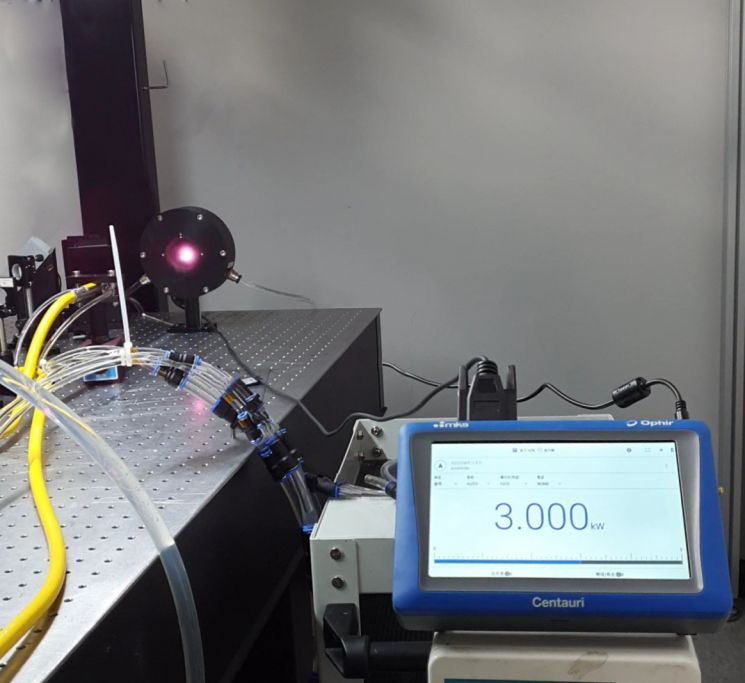 Successful Development of Domestic Anti-Aircraft Laser Weapon Components - Achieved 3 kW in Light Source Output Test. Photo by Korea Institute of Industrial Technology
Also, generally, as the output of fiber lasers increases to the kW level, they demonstrate powerful performance capable of cutting steel several millimeters thick. However, as laser output increases, nonlinear problems such as overheating of the fiber or generation of unwanted laser light limit the laser output and cause fiber damage. Therefore, for single-channel single-mode lasers using a single fiber as the light source, commercially available output has so far remained around 2 kW.
In February, the research team succeeded in developing a fiber laser light source that can increase single-channel single-mode output up to 3 kW and delivered a prototype to Hanwha. This is the highest output among fiber laser light sources developed domestically, and considering that all overseas commercial products have outputs within 3 kW, it is evaluated as significantly narrowing the gap with global technology.
Based on theoretical analysis to reduce nonlinear phenomena of the laser and improve beam quality, the research team completed an effective heat dissipation structural design and was able to achieve an output exceeding the target of 3 kW. Once commercialized, the developed technology can increase productivity in laser cutting and welding processes in industrial fields and be applied to mobile anti-aircraft defense laser weapons and long-distance explosive disposal in the defense sector. It is also advantageous for the 'Spectral Beam Combining (SBC)' method, which merges two or more fiber laser channels into one, and is expected to be used for higher outputs exceeding 100 kW and missile defense.
Dr. Jeong Hoon of the research team said, “The developed light source technology is at a stage where it can be immediately applied to industry through simultaneous optimization research, and we plan to increase the single output to 10 kW in the future,” adding, “Research on domestic production of related components such as special optical fibers, laser diodes, and signal light and pump light combiners is also being conducted in parallel with companies.”
Meanwhile, Hanwha plans to use the results of this research to develop explosive disposal devices and small anti-aircraft laser weapons.
© The Asia Business Daily(www.asiae.co.kr). All rights reserved.
![Clutching a Stolen Dior Bag, Saying "I Hate Being Poor but Real"... The Grotesque Con of a "Human Knockoff" [Slate]](https://cwcontent.asiae.co.kr/asiaresize/183/2026021902243444107_1771435474.jpg)
















