KCCI Surveys 302 of Top 1,000 Companies
80% of Firms Say Employment Market Recovers to Pre-COVID Levels This Year
Top 3 Keywords: Continuous Hiring, Job Experience, Expertise
65% of Companies Say Conditions Are Not Ready to Provide Youth Work-Experience Opportunities
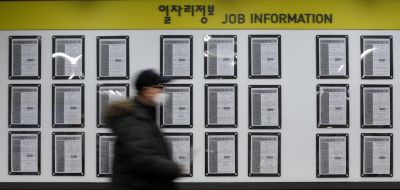 The Seoul Western Employment Support Center as of the 16th of last month. Photo by Hyunmin Kim kimhyun81@
[Asia Economy Reporter Moon Chaeseok] Major companies expect the hiring market this year to recover to pre-COVID-19 levels, but anticipate that irregular hiring and the concentration on STEM fields will intensify. Two out of three companies responded that they do not have the capacity to promote the government's key employment policy of providing 'work-experience opportunities.'
On the 22nd, the Korea Chamber of Commerce and Industry (KCCI) surveyed 302 of the top 1,000 domestic companies by sales and released the '2022 Corporate Hiring Trends' report with these findings. While employment recovery is expected, the core point is that irregular hiring and STEM field concentration will worsen.
First, 79.8% of surveyed companies answered that the employment market outlook for this year is either 'employment scale will recover to pre-COVID levels' (69.2%) or 'will increase further' (10.6%). Regarding the college graduate entry-level hiring market, 80.1% of companies said they have 'hiring plans.' Among them, 71.9% plan to maintain a similar level as last year, and 20.7% plan to increase hiring. A KCCI official stated, "The employment market, which had contracted due to COVID-19, is showing signs of improvement with major large companies expanding their hiring scale," but added, "Due to recent geopolitical risks and supply chain crises, management uncertainties are increasing, making dramatic improvements difficult."
Notably, companies foresee that irregular hiring and STEM field concentration will intensify. Regarding this year's hiring trends, 62.6% of companies identified 'an increase in the proportion of irregular hiring over large-scale open recruitment' as the key trend. This was followed by 'expansion of STEM personnel hiring' (54.9%), 'preference for experienced hires over new graduates' (52.1%), 'introduction and continuation of non-face-to-face hiring processes' (44.7%), and 'increase in hiring talent in future industry sectors' (36.6%). The most important factor when hiring new college graduates was 'job-related experience' (64.9%), followed by 'job-related knowledge' (57.0%), 'attitude and personality' (53.6%), and 'relevant certifications' (12.3%). The importance of 'language skills' (3.6%) and 'academic background/grades' (3.6%) significantly decreased. The ideal talent companies desire is someone with 'expertise' (52.6%) and 'communication and cooperation' skills (44.7%). Traits like 'diligence' (26.5%), 'passion' (15.6%), and 'challenging spirit' (13.6%) were less emphasized. Professor Song Heonjae of Seoul City University commented, "As large-scale open recruitment, which valued grades and language scores, fades and job-centered irregular hiring expands, practical experience such as internships has become more important," advising, "Students should enhance diverse job-related experiences and job competencies during their undergraduate years."
Although job competencies are becoming increasingly important, opportunities for job seekers to gain experience in the hiring market are unlikely to increase. Regarding the role of providing work-experience opportunities to youth, 64.2% of companies responded, "We agree with the purpose but lack the conditions." In contrast, only 35.1% of companies answered that it is 'necessary as a social contribution' (28.1%) or that 'companies should actively take the lead' (7.0%). Some (0.7%) said, "It is not the role of companies." Only 29.8% of responding companies currently provide work-experience opportunities such as internships to youth. Among the work-experience programs offered by companies, 'internship programs linked to hiring' accounted for 68.9%, followed by 'experiential internships' (22.2%), 'work-study dual system' (11.1%), and 'university student field training programs' (10.0%).
KCCI is preparing the 'University Student Work-Experience Platform Project' together with companies that have committed to expanding youth work-experience opportunities. This project provides university students with chances to directly participate in corporate field projects to enhance job competencies and explore career paths. Yoo Ilho, head of KCCI's Employment and Labor Policy Team, emphasized, "The changing hiring trends will accelerate in conjunction with low-carbon and digital transitions," adding, "To respond to these changes, measures are needed to increase labor market flexibility and reduce mismatches between corporate workplaces and educational institutions."
© The Asia Business Daily(www.asiae.co.kr). All rights reserved.

















