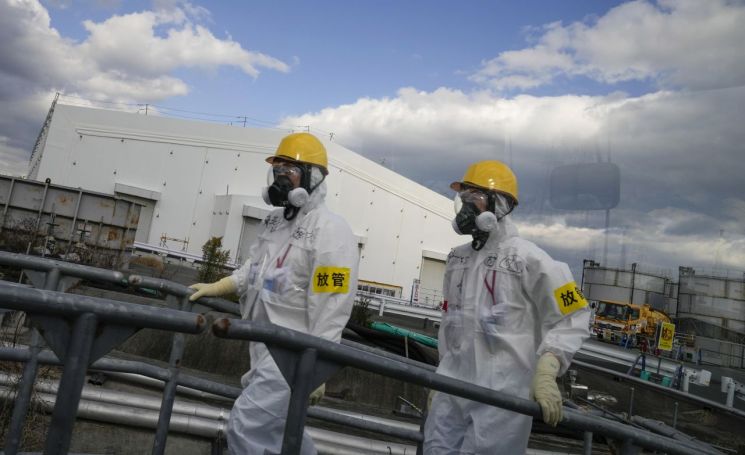
 Workers wearing protective suits are passing by the Advanced Liquid Processing System (ALPS), a contaminated water treatment facility, at the Fukushima Daiichi Nuclear Power Plant in Omae, Fukushima Prefecture, Japan, in November last year.
 The International Atomic Energy Agency (IAEA) will verify the review process conducted by the Japanese nuclear regulatory authority regarding the discharge of contaminated water from the Fukushima Daiichi Nuclear Power Plant into the ocean over five days starting from the 21st, according to reports by Kyodo News and NHK.
According to the reports, the IAEA delegation, consisting of Gustavo Caruso, Coordinator of the IAEA's Nuclear Safety and Security Department, along with 13 experts from the United States and Australia, visited the Japanese Nuclear Regulation Authority on the same day during their visit to Japan.
The Japanese Nuclear Regulation Authority has been reviewing the plan submitted by Tokyo Electric Power Company (TEPCO), the operator of the Fukushima Daiichi Nuclear Power Plant, for the ocean discharge of contaminated water since December of last year.
Coordinator Caruso stated at the meeting with the Nuclear Regulation Authority, "We will scientifically verify whether the authority's review complies with IAEA safety standards."
Since the hydrogen explosion accident at the Fukushima Daiichi Nuclear Power Plant during the Great East Japan Earthquake in March 2011, contaminated water has been generated daily at a scale of 130 to 150 tons. TEPCO purifies this water using the Advanced Liquid Processing System (ALPS) and stores it in tanks on the plant site. However, radioactive substances such as tritium, a radioactive isotope of hydrogen contained in the contaminated water, are not removed by ALPS purification.
The Japanese government announced in April last year its plan to dilute the purified contaminated water with seawater to reduce the tritium concentration below regulatory limits and discharge it into the sea in front of the Fukushima nuclear plant starting next spring.
© The Asia Business Daily(www.asiae.co.kr). All rights reserved.
![Clutching a Stolen Dior Bag, Saying "I Hate Being Poor but Real"... The Grotesque Con of a "Human Knockoff" [Slate]](https://cwcontent.asiae.co.kr/asiaresize/183/2026021902243444107_1771435474.jpg)















