Adding Myeonumae and Gisanmae, Namsa Yedamchon 7 Mae in Full Bloom
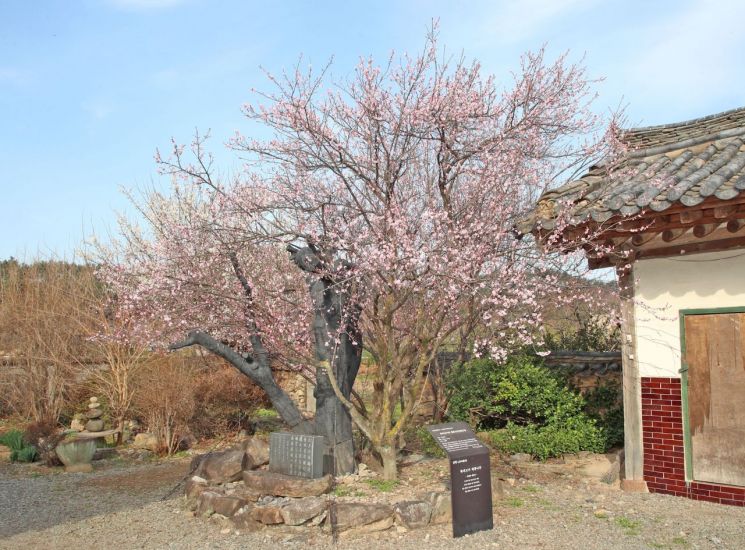
[Asia Economy Yeongnam Reporting Headquarters Reporter Choi Soon-kyung] As the long winter passes and the season of spring’s charm is felt, how about taking a spring outing to Namsa Yedamchon in Sancheong, where the scent of plum blossoms is rich?
Namsa Yedamchon in Danseong-myeon, Sancheong-gun, whose main mountain is Jirisan Cheonwangbong, is filled with the deep fragrance of plum blossoms when winter passes and spring arrives. This is because each house in Namsa Yedamchon has plum trees that have been preserved for many years.
The plum trees representing the five clans of Ha, Park, Lee, Choi, and Jung are called the “Five Plums” of Namsa Yedamchon, and they are said to embody the scholarly character of these clans’ ancestors.
They are called ‘Omae Bulmang (五梅不忘)’ and remain in the memories of those who visit this place.
Along with the ‘Omae Bulmang (五不梅忘)’ plums, recently, the Myeonumae and Gisanmae have been added to honor Myeonwoo Gwak Jong-seok and Gisan Park Heon-bong, further enhancing the dignity of Namsa Yedamchon’s seven plums with their rich fragrance.
Among the three plums of Sancheong, the plum tree of the Ha family’s old house (Jinyang Ha clan) is called ‘Wonjeongmae (元正梅).’ It was planted by Ha Jeup of the Sajikgong branch, and the name Wonjeongmae comes from his posthumous name, Wonjeong. Wonjeongmae is a red plum blossom tree; although the original tree died in 2007, its successor is currently growing from the roots.
The plum tree of Isajae (尼泗齋), called ‘Park’s Plum,’ was planted based on the story that Admiral Yi Sun-sin found comfort in the plum tree while staying at the house of Park Ho-won, a farmer under his command, during his time as a common soldier. It is currently being cultivated as a successor tree.
Isajae, designated as Gyeongnam Cultural Heritage Material No. 328, is where Admiral Yi Sun-sin stayed during his time as a common soldier. It has a front width of five kan and a side width of two kan, with a single-eaved hipped roof. It is a typical architectural style of the late Joseon period. It was also used as a place of study to honor the ancestor Park Ho-won of the Park clan, known as Songwoldang.
The plum tree of Namhojeongsa, called ‘Lee’s Plum,’ is a white-flowered plum tree. The white plum (Baekmae) is loved for its pure white flowers, subtle fragrance, and dignified appearance, symbolizing the integrity of a scholar.
The Lee clan’s plum tree planted in Namhojeongsa, their study, is the only white plum tree and is tall and robust, resembling a strong gentleman.
The plum tree of the Choi family’s old house, called ‘Choi’s Plum,’ is a successor tree planted after the 400-year-old plum tree next to the gate of the Choi family’s old house died. When the plum blossoms bloom, the scent adds to the charm of the pavilion.
Designated as Gyeongnam Cultural Heritage Material No. 117, the Choi family’s old house is a hanok built in 1920, featuring practical structures throughout that reflect the wisdom of ancestors.
The plum tree of Seonmyeongdang, called ‘Jung’s Plum,’ is the latest blooming plum tree in Namsa Yedamchon. Visitors to the Choi family’s old house stop in their tracks, captivated by the beauty of Jung’s Plum seen beyond the wall before entering the gate.
The ‘Myeonumae’ planted inside the Yurim Independence Movement Memorial Hall was established to honor Myeonwoo Gwak Jong-seok (1846?1919), a Yurim independence activist who advocated for Korea’s independence to the international community.
Myeonwoo Gwak Jong-seok, from Sawol-ri, Danseong-myeon, Sancheong-gun, was a leader of the Yeongnam Yurim who inherited the thoughts of Nammyung Jo Sik. He devoted himself to restoring national sovereignty and independence through writing and activism and also led opposition against the Eulsa Treaty.
The Gisanmae (岐山梅) at Gisan Gugakdang was planted to honor Gisan Park Heon-bong, who dedicated his life to the development of modern and contemporary Korean traditional music and national arts, living a scholarly life.
Since ancient times, Wonjeongmae has been recognized for its historical value as one of the ‘Sancheong Three Plums’ along with ‘Nammyungmae’ and ‘Jeongdangmae.’
© The Asia Business Daily(www.asiae.co.kr). All rights reserved.
![Clutching a Stolen Dior Bag, Saying "I Hate Being Poor but Real"... The Grotesque Con of a "Human Knockoff" [Slate]](https://cwcontent.asiae.co.kr/asiaresize/183/2026021902243444107_1771435474.jpg)















