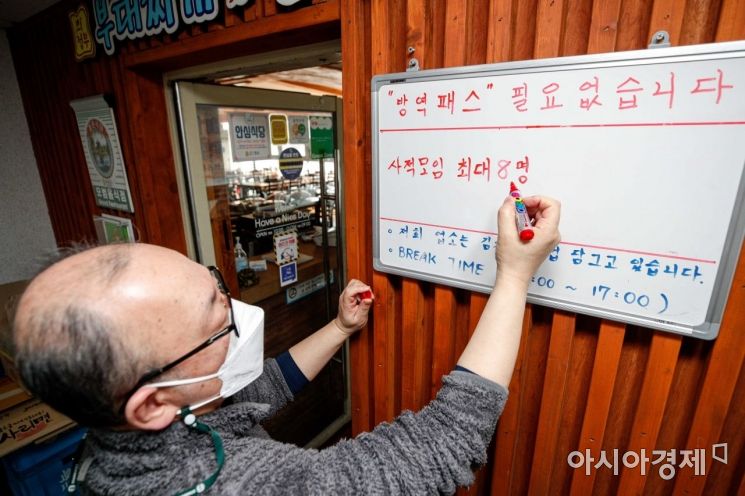
 On the 21st, when the government's new 'social distancing' measures were implemented, a merchant at a restaurant in Seoul is writing a notice stating 'Gatherings of up to 8 people allowed.' Photo by Kang Jin-hyung aymsdream@
As the housing market plunges into an unprecedented transaction freeze, the proportion of transactions involving commercial and office buildings has reached an all-time high. This is due to a balloon effect caused by stringent housing regulations, which has driven investment demand toward commercial and office properties, as well as growing expectations for the end of COVID-19 boosting optimism for commercial property investments.
According to the Korea Real Estate Board on the 21st, last year, the total number of commercial and office building transactions nationwide was 380,849. This accounted for 18.01% of the total building transactions of 2,114,309, marking the highest ratio since related statistics began in 2006. Meanwhile, the transaction ratio for apartments fell to 55.64%, the lowest ever recorded. In terms of investment returns, office buildings showed a particularly high yield of 8.34%, the highest since the 2008 global financial crisis.
Furthermore, with the successive easing of quarantine measures and expectations for the resumption of travel, investor interest in non-residential properties has significantly increased. A real estate seminar focused on income-generating properties held on the afternoon of the 18th in Songpa-gu, Seoul, was lively for the first time in a while. There was strong interest in commercial properties, residential-type lodging facilities, and officetels that can generate periodic rental income. Mr. Park Hong-gwan (63), met at the venue, said, "Although the vacancy rate of commercial properties has increased, I believe these real estate products have long-term investment value."
In the fourth quarter of last year, the vacancy rate for medium-to-large commercial properties in Seoul was around 10%, but investment returns showed an upward trend. According to the Korea Real Estate Board’s commercial real estate rental trend survey, the investment yield for medium-to-large commercial properties in Seoul was 2.06% in the fourth quarter of last year, up 0.53 percentage points from 1.58% in the same period the previous year. Small-scale commercial properties recorded a vacancy rate of 6.7%, while their investment yield (1.76%) rose by 0.4 percentage points compared to the previous year. During the same period, the investment yield for collective commercial properties also increased to 1.76% compared to the previous year.
Mr. Kwon Il, head of the research team at Real Estate Info, explained, "The number of investors turning their attention to commercial real estate, which is relatively free from loan restrictions, has increased." Ms. Yoo Kyung-hee (56, female), who attended the seminar, also said, "Compared to the significant increase in taxes related to housing, the situation for commercial real estate is relatively better." In fact, acquisition tax for multi-homeowners ranges from 8% to 12%, whereas for commercial properties, acquisition tax is fixed at 4.6% regardless of how many properties are owned.
However, some voices warn that the rising prices of commercial properties could lead to overheating. The KB Management Research Institute, in its recently published ‘2022 KB Real Estate Report,’ forecasted, "There are concerns about price bubbles as asset prices have risen excessively compared to basic capital, including increased vacancy rates." They pointed out that the price increase is steeper than the recovery of the self-employed business sector, which could pose long-term investment risks.
© The Asia Business Daily(www.asiae.co.kr). All rights reserved.
![Clutching a Stolen Dior Bag, Saying "I Hate Being Poor but Real"... The Grotesque Con of a "Human Knockoff" [Slate]](https://cwcontent.asiae.co.kr/asiaresize/183/2026021902243444107_1771435474.jpg)











