"Highly contagious but mild symptoms" perception raises concern over weakened vigilance
Confirmed cases "Experienced high fever, dizziness, and body-rending pain"
Experts "Cannot be compared to Omicron flu"
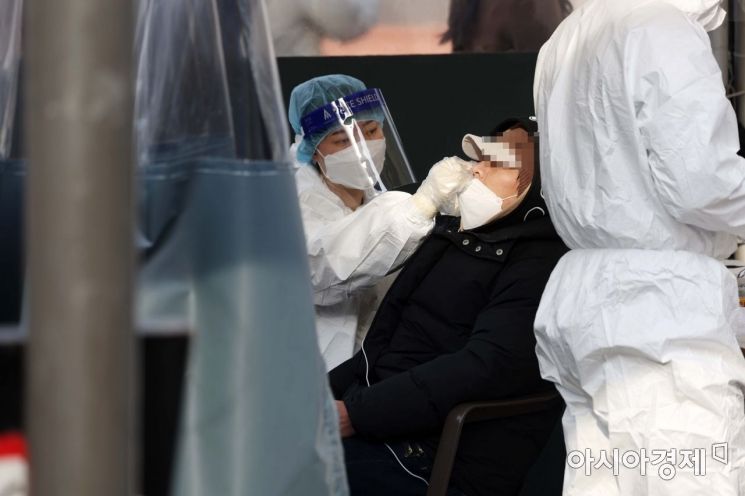 Citizens are undergoing rapid antigen tests at the temporary screening clinic in front of Seoul Station.
 Photo by Moon Honam munonam@
[Asia Economy Reporter Kang Joo-hee] "I thought it was just a cold...", "It was hard to even swallow water for three days."
Although the Omicron variant is known for its high transmissibility and relatively mild symptoms, some confirmed cases have reported experiencing severe pain to the extent that they could not sleep. While health authorities are easing quarantine guidelines, considering the fatality rate of Omicron to be at the level of seasonal flu, experts warn that infectious diseases should never be taken lightly.
Lee (28), an office worker who tested positive for COVID-19 on the 16th, said he had a very difficult time for about 3 to 4 days after symptoms appeared, to the point where he could not move at all. Lee said, "I rarely caught colds before, but this was the most painful time in my life. Symptoms appeared on the 15th, and I thought it was just a cold, but from midnight that night, I had a fever and my whole body ached as if it was being torn apart."
He added, "I had norovirus before, but that was nothing compared to this pain. Five days after testing positive, the symptoms have weakened, but I still feel nauseous and have a slight fever. Still, compared to before, I feel better now," he confessed.
Kim (30), who tested positive for COVID-19 in early March, also recalled the experience as a "nightmare." Kim said, "From the day after symptoms appeared, I had headaches, nausea, an extremely dry throat, and phlegm that caused coughing so severe I couldn't sleep. They say it's like the flu, but COVID is COVID. It's an experience I never want to go through again."
 Citizens are getting tested at a screening clinic set up in Independence Park, Seodaemun-gu, Seoul. / Yonhap News
There are quite a few confirmed cases who underestimated Omicron symptoms as mild and ended up suffering greatly. This perception spread because, although highly contagious, it was considered not fatal enough to require hospitalization and manageable with home treatment. The government has emphasized that despite the surge in Omicron cases, the fatality rate is at the level of seasonal flu. Son Young-rae, head of the Social Strategy Division at the Central Disaster and Safety Countermeasures Headquarters, said at a regular briefing on the 15th, "The fatality rate over the past four weeks has been lower than 0.1%, so the short-term fatality rate is currently similar to that of seasonal flu (0.05?0.1%)."
Health authorities also announced in early last month that they would consider managing the Omicron variant with a quarantine and medical system similar to that for seasonal flu. Based on this judgment, social distancing measures were partially eased starting on the 21st. From that day, the government increased the limit on private gatherings from 6 to 8 people.
However, experts point out that such government messaging may weaken public vigilance against COVID-19 infection and hinder efforts to control the spread. Professor Lee Jae-gap of Hallym University Kangnam Sacred Heart Hospital's Infectious Diseases Department criticized the government's quarantine policy on Facebook, saying, "Has the flu ever had 400,000 confirmed cases per day? Stop the nonsensical wordplay comparing the fatality rate of the flu and Omicron."
Recently, new COVID-19 cases in South Korea have continued to surge, reaching 300,000 to 600,000 daily, with deaths and critically ill patients also increasing. As of midnight on the 21st, the death toll was 329, the second highest since 429 on the 17th. The severity of Omicron symptoms varies by individual, but in severe cases, patients may suffer from extreme aftereffects, so caution in quarantine is advised.
Professor Eom Jung-sik of Gachon University Gil Medical Center's Infectious Diseases Department told Asia Economy in a phone interview, "Symptoms vary by person, but many experience severe pain, and recently, hospitalizations have increased. While the fatality rate can be said to be at the flu level, the transmissibility is extremely high. Careful attention must be paid to messaging regarding infectious diseases. The flu does not cause over 300 deaths per day. Omicron and the flu cannot be compared at all," he said.
© The Asia Business Daily(www.asiae.co.kr). All rights reserved.
![Clutching a Stolen Dior Bag, Saying "I Hate Being Poor but Real"... The Grotesque Con of a "Human Knockoff" [Slate]](https://cwcontent.asiae.co.kr/asiaresize/183/2026021902243444107_1771435474.jpg)
















