Local Tax Research Institute 'Analysis of Housing Capital Gains Tax Burden and Policy Implications' Report
"Differentiated Taxation by Number of Owned Houses, System Overhaul Needed After Examining Side Effects"
[Asia Economy Sejong=Reporter Kwon Haeyoung] In South Korea, multi-homeowners are subject to a capital gains tax of up to 75% on income generated from selling houses, but it has been found that two out of three OECD countries provide tax exemption or income deduction benefits on primary residences regardless of the number of houses owned. As President-elect Yoon Seok-yeol has pledged a temporary two-year suspension of the increased capital gains tax on multi-homeowners and a review of the system, there is growing criticism that a complete overhaul of the current differential capital gains tax based on the number of houses is urgently needed.
According to the report "Analysis of Housing Capital Gains Tax Burden and Policy Implications" released on the 21st by the Korea Local Tax Research Institute, among 40 OECD countries (37 member countries and countries scheduled to join), 26 countries (65%) do not tax capital gains on primary residences.
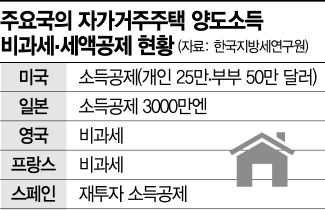
Most countries provide tax exemption or income deduction benefits on capital gains from primary residences regardless of how many houses the owner holds. Countries offering tax exemption benefits include the United Kingdom and France. In the UK, even multi-homeowners can receive tax exemption on their main residence, and taxpayers can choose which house to apply the exemption to. France also allows tax exemption on one house.
In Spain, capital gains from the sale of a primary residence are exempted proportionally if the reinvested amount is used to purchase a new house within two years.
The United States and Japan provide income deduction benefits when selling a primary residence. The US allows tax deductions up to $250,000 for individuals and $500,000 for couples, while Japan permits tax credits up to 30 million yen. Although capital gains above a certain level are taxed, they do not adopt a punitive tax system based on the number of houses like South Korea.
On the other hand, South Korea currently enforces increased capital gains tax on multi-homeowners. This system was introduced in 2004, suspended in 2009, abolished in 2014, and revived under the Moon Jae-in administration. Until 2016, the capital gains tax rate was up to 40% regardless of the number of houses, but now it reaches up to 75%, or 82.5% including local taxes. The government has attributed the continuous surge in housing prices to speculation by multi-homeowners, but instead of lowering prices, the increased capital gains tax has led multi-homeowners to choose gifting or holding onto properties, worsening the "transaction cliff" where real estate transactions disappear.
Accordingly, there are calls in the market to ease the increased capital gains tax on multi-homeowners to open up transactions, encourage listings, and stabilize housing prices.
Ha Neungsik, Vice President of the Korea Local Tax Research Institute, stated, "South Korea excessively imposes increased capital gains tax on multi-homeowners in certain areas, causing side effects. It is necessary to carefully examine the actual policy effects and side effects of differential taxation based on the number of houses and comprehensively reform the system reflecting the characteristics of individual tax items."
© The Asia Business Daily(www.asiae.co.kr). All rights reserved.
![Clutching a Stolen Dior Bag, Saying "I Hate Being Poor but Real"... The Grotesque Con of a "Human Knockoff" [Slate]](https://cwcontent.asiae.co.kr/asiaresize/183/2026021902243444107_1771435474.jpg)















