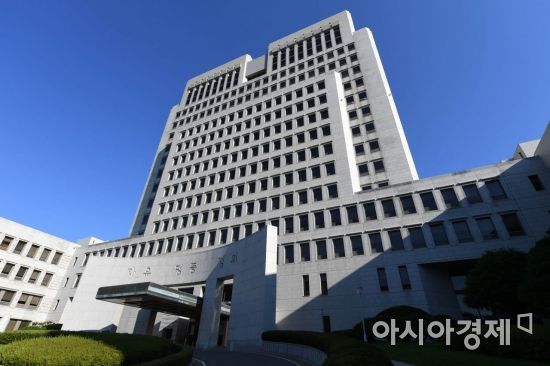
[Asia Economy Reporter Choi Seok-jin, Legal Affairs Specialist] The Supreme Court has ruled that it is illegal to base a judgment on facts not claimed by the parties in civil litigation where the principle of party presentation applies.
The principle of party presentation means that the responsibility for collecting and submitting evidence and facts lies with the parties, and only the evidence submitted by the parties to the court should be the basis for the trial.
The Supreme Court's 3rd Division (Presiding Justice Kim Jae-hyung) announced on the 21st that it overturned the original ruling that ruled in favor of member A in the appeal case confirming the non-existence of the chairman status against redevelopment maintenance association B, and remanded the case to the Busan High Court.
The court stated, "Under the principle of party presentation, the court must only judge on the claims made by the parties and cannot make judgments on matters not claimed by the parties."
It added, "Nevertheless, the original court made a judgment on matters not claimed by the plaintiff," and "there is an error in the original ruling violating the principle of party presentation, and the grounds for appeal pointing this out are valid."
C, the chairman of association B established to carry out a housing redevelopment maintenance project in Masanhappo-gu, Changwon-si, Gyeongsangnam-do, was appointed chairman in July 2016 and reappointed in July 2018 and July 2020, serving as chairman until the lawsuit was filed.
Originally living at a different address, C registered a move to an address within the maintenance area in December 2019 after the Urban and Residential Environment Maintenance Act (Urban Maintenance Act) was amended to add a residency requirement for the chairman within the maintenance area.
The amended Article 41, Paragraph 1 of the Urban Maintenance Act added a residency requirement (Article 41, Paragraph 1 preamble, qualification requirements for appointment) stating that the chairman, directors, auditors, and other association executives must be "persons residing in the maintenance area who have lived there for at least one year during the three years immediately preceding the appointment" or "persons who have owned buildings or land located in the maintenance area for more than five years."
Additionally, a clause was newly established for the chairman stating that "from the date of appointment until the approval of the management disposition plan, the chairman must reside in the relevant maintenance area" (Article 41, Paragraph 1 postscript, qualification maintenance requirement).
A filed a lawsuit claiming that C, re-elected as chairman in July 2020, did not reside within the maintenance area and was disqualified as chairman due to a fine imposed for violating the Urban Maintenance Act. Among the two requirements, A did not challenge the qualification for appointment but focused on the violation of the qualification maintenance requirement.
Meanwhile, Article 43, Paragraph 1, Item 5 of the Urban Maintenance Act at the time stipulated as a disqualification that "a person sentenced to a fine of 1 million won or more for violating the Urban Maintenance Act and for whom ten years have not passed" cannot become an association executive. Paragraph 2 of the same article provided that if such disqualification was found at the time of appointment or occurred during the term, it would be grounds for automatic dismissal. It also stipulated automatic dismissal for executives who do not meet the qualification requirements of Article 41.
C had two criminal records.
First, C was prosecuted for violating the Urban Maintenance Act, falsification of electronic records, violation of the Commercial Act, and other charges, and in July 2020 was sentenced to a fine of 500,000 won for violating the Urban Maintenance Act and a suspended prison sentence of 8 months with a 2-year probation for the other charges. However, the sentence was reduced to a fine of 3 million won in the appellate court.
Also, in 2021, C was summarily prosecuted again for violating the Urban Maintenance Act, requested a formal trial, and was fined 700,000 won in April of the same year, which was finalized.
The first trial court dismissed A's claim.
In the trial, A argued that C's family lived elsewhere, electricity and water usage were almost none until the notice of automatic dismissal for failure to meet residency requirements was sent, after which usage suddenly increased, and mail was returned marked "vacant and no one home," claiming that C did not reside within the maintenance area.
However, the court judged that based on the evidence submitted by A alone, it could not be recognized that C did not actually reside within the maintenance area. The Supreme Court's judgment, considering the purpose of the residency requirement in the Urban Maintenance Act, also noted that it is not necessary for the address within the maintenance area to be the sole and exclusive address.
Although C was sentenced to a fine exceeding 1 million won, which is a disqualification under the Urban Maintenance Act, the court concluded that since this was not only for the violation of the Urban Maintenance Act but also included other concurrent charges, it could not be considered that the disqualification under the Urban Maintenance Act had occurred.
The second trial court's judgment was different.
Article 41, Paragraph 1 of the Urban Maintenance Act requires that the chairman must have resided in the maintenance area for at least one year during the three years immediately preceding the appointment or have owned buildings for more than five years. Since chairman C registered his move only seven months before appointment, the court held that he did not meet the "one year or more residence" requirement.
However, the Supreme Court, after re-examining the case, found problems with the second trial's judgment.
It held that judging C as not meeting the chairman qualification by raising the appointment qualification requirement, which the plaintiff A did not claim, violated the principle of party presentation.
The court pointed out, "According to the records, the plaintiff claimed up to the original trial that 'C did not actually reside within the maintenance area after being appointed chairman, thus failing to meet the qualification maintenance requirement set forth in the postscript of Article 41, Paragraph 1 of the Urban Maintenance Act,' and it can be seen that the plaintiff never claimed that 'C did not meet all the appointment qualification requirements set forth in the preamble of Article 41, Paragraph 1, Items 1 and 2 before being appointed chairman.'"
It continued, "Nevertheless, the original court ruled that 'C did not meet all the appointment qualification requirements set forth in the preamble of Article 41, Paragraph 1, Items 1 and 2 of the Urban Maintenance Act and therefore does not hold the status of chairman,' thus making a judgment on matters not claimed by the plaintiff."
© The Asia Business Daily(www.asiae.co.kr). All rights reserved.
![Clutching a Stolen Dior Bag, Saying "I Hate Being Poor but Real"... The Grotesque Con of a "Human Knockoff" [Slate]](https://cwcontent.asiae.co.kr/asiaresize/183/2026021902243444107_1771435474.jpg)















