Gasoline Prices Rise 133 Won This Week... Largest Increase Since IMF Crisis
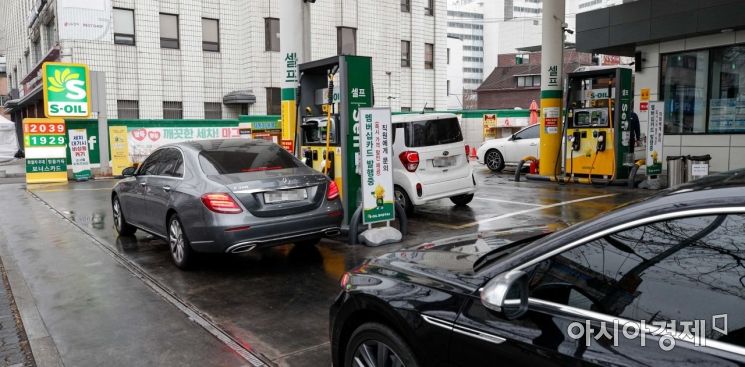
[Asia Economy Reporter Moon Chaeseok] This week, the weekly increase in gasoline prices sold at domestic gas stations recorded the largest rise since the International Monetary Fund (IMF) foreign exchange crisis. The price per liter rose by more than 130 KRW compared to the previous week. This is due to the international oil prices, which surged after Russia's invasion of Ukraine, being reflected with a 2-3 week time lag, making further increases inevitable.
According to Opinet, the oil price information service of the Korea National Oil Corporation, the nationwide gasoline sales price at gas stations during the third week of this month (13th-17th) was 1,994.4 KRW per liter, up 132.8 KRW from the previous week. Domestic gasoline prices, which had fallen to 1,621 KRW per liter (second week of January) earlier this year following the government's fuel tax reduction measures, have been rising for nine consecutive weeks recently, following international oil prices.
Domestic gasoline prices have been rising by about 20 KRW per liter weekly since last month, then increased by 97.7 KRW last week, and 132.8 KRW this week, showing an expanding rate of increase. A rise of over 100 KRW in a single week is the first in about 24 years since the fourth week of December 1997 (161.3 KRW), when domestic gasoline prices soared due to a sharp depreciation of the exchange rate caused by the foreign exchange crisis. The Korea Petroleum Association explained, "The recent sharp rise in international oil prices, influenced by Russia's invasion of Ukraine, has been reflected in domestic fuel prices with about a two-week time lag."
The daily nationwide average gasoline sales price at gas stations has already exceeded 2,000 KRW per liter since the 15th of this month. As of 2 a.m. on that day, the nationwide average gasoline price was 2,002.41 KRW per liter, down 0.15 KRW from the previous day. In Seoul, it was 2,080.64 KRW.
The highest-priced gas station nationwide, Seoul SK Energy Seonam Gas Station, charges 2,959 KRW per liter. It has been hovering close to the 3,000 KRW mark throughout the week.
However, the two-week average price of Dubai crude oil, which serves as the benchmark for domestic imported crude oil, was surveyed at 103.3 USD per barrel, down 17.1 USD from the previous week. The average international gasoline price also recorded 120.2 USD per barrel, down 18.3 USD from the previous week.
The variable is the prolongation of the war. Since directly operated gas stations account for only about 10% of the total, it is difficult for refiners to control gas station sales prices. Additionally, the sales structure, which adds fuel taxes (transportation energy environment tax, driving tax, education tax), value-added tax, crude oil import tariffs, petroleum import surcharges, and refiners' margins to crude oil prices, cannot be ignored.
Professor Kim Young-ik of Sogang University Graduate School of Economics said, "Although oil prices have started to decline, considering that the consumer price index lags behind oil prices by about two months and the possibility of prices rising again in the future, it is necessary to consider a temporary adjustment of the fuel tax reduction." He added, "If oil prices rise, not only will inflation increase, but real income will decrease and consumption will shrink, which could lead to a vicious cycle of stagflation (rapid inflation during economic stagnation), increasing the burden on ordinary citizens."
© The Asia Business Daily(www.asiae.co.kr). All rights reserved.
![Clutching a Stolen Dior Bag, Saying "I Hate Being Poor but Real"... The Grotesque Con of a "Human Knockoff" [Slate]](https://cwcontent.asiae.co.kr/asiaresize/183/2026021902243444107_1771435474.jpg)















