Both Economic Subcommittees 1 and 2 Comprise Non-Politicians... Attention on Ahn's Stake Supporting Unification Efforts
[Asia Economy Reporters Baek Kyunghwan and Boo Aeri] There were no appointments made as political favors. The “merit-based appointments” policy that President-elect Yoon Seok-yeol championed during his presidential campaign was directly applied to the personnel selections of the Presidential Transition Committee (PTC), which is considered the first personnel move of the new administration. Unlike previous political circles, it became clear that there are fewer factions that need to be rewarded with positions as political favors. This approach is expected to continue into the early days of the administration and government organizational appointments. Unlike past transition committees, there were no cases this time where appointments were decided based on personal closeness.
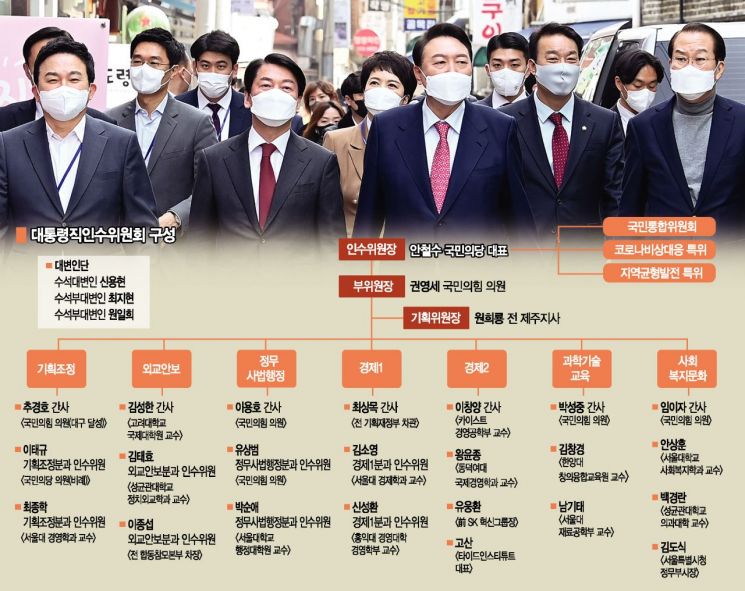
On the 18th, Asia Economy analyzed the list of secretaries and transition committee members within the seven subcommittees of the PTC and found that out of 23 members, only six are current lawmakers. This indicates a strong emphasis on appointing experts, with only four out of seven secretary positions held by lawmakers.
◆ All Economic Committee Members Are Non-Politicians = Particularly, the Economic Subcommittee 1 and Economic Subcommittee 2, which attracted much attention from political and economic circles, were staffed entirely by non-politicians. Choi Sang-mok, former Vice Minister of Strategy and Finance, was appointed secretary of Economic Subcommittee 1, responsible for macroeconomics and finance, while Lee Chang-yang, professor of Management Engineering at KAIST, was appointed secretary of Economic Subcommittee 2, which oversees industry and job policies. The committee members assisting these secretaries were also professors of business and economics from Seoul National University, Hongik University, and Dongduk Women’s University.
None of these individuals have special ties to President-elect Yoon. Former Vice Minister Choi gained experience during the Lee Myung-bak administration, serving as a working-level member of Economic Subcommittee 1 in the Lee Myung-bak transition committee, and also during the Park Geun-hye administration. Professor Lee, secretary of Economic Subcommittee 2, had connections with Ahn Cheol-soo, the chairman of the transition committee, during his time at KAIST. Choi reportedly told acquaintances that he was contacted and informed of his selection. Considering the criticism of President-elect Yoon’s lack of economic expertise during the presidential campaign, both Economic Subcommittees 1 and 2 were thoroughly staffed with experts.
The appointments of former SK Innovation Group leader Yoo Woong-hwan and Go San, CEO of Ateam Ventures, also stand out. Yoo was identified as a key figure during talent recruitment related to technology in President Moon Jae-in’s 2017 presidential campaign, and his future role within the transition committee is being closely watched. CEO Go built a connection with Chairman Ahn through a broadcast appearance.
The Science, Technology, and Education Subcommittee and the Social Welfare and Culture Subcommittee were also filled entirely with experts, except for the secretaries. Professor Kim Chang-kyung of Hanyang University, who will outline the new administration’s science and education policies in the Science, Technology, and Education Subcommittee, served as Vice Minister of Education, Science, and Technology during the Lee Myung-bak administration and reportedly contributed to President-elect Yoon’s “Digital Platform Government” strategy during this election.
The Social Welfare and Culture Subcommittee includes appointments considered experts in welfare, health, and culture, such as Professor Ahn Sang-hoon of Seoul National University’s Department of Social Welfare, Professor Baek Kyung-ran of Sungkyunkwan University’s Medical School, and Kim Do-sik, Deputy Mayor for Political Affairs of Seoul.
◆ Ahn Cheol-soo’s 30% Stake Likely to Continue = However, the share allocated to Ahn Cheol-soo, leader of the People’s Party who supported the unification during the presidential race, is evident. Lee Tae-gyu, a People’s Party lawmaker known as one of Ahn’s closest aides, was appointed to the Planning and Coordination Subcommittee, and Kim, the Deputy Mayor for Political Affairs who supported Ahn in the 2012 presidential election, the 2013 National Assembly election, and the 2019 presidential election, was appointed to the Social Welfare and Culture Subcommittee.
Among the expert group, CEO Go, former Group Leader Yoo, Professor Nam Ki-tae, Professor Baek Kyung-ran, and Professor Shin Seong-hwan were confirmed to have been recommended by Chairman Ahn to join the transition committee. Political circles expect Ahn’s stake to be reflected as much as possible through the early to mid-term of the new administration. One committee member scheduled to participate in the transition committee said, “Ahn’s 30% stake within the transition committee is highly likely to be applied as is in the early organizational structure of the new government.”
While there is no indebtedness to Yeouido, the fact that they reached out to Seocho-dong is noteworthy. A large number of prosecutors and investigators who had connections with President-elect Yoon during his time at the prosecution office joined the committee. This includes investigators who served as secretaries during Yoon’s tenure as Prosecutor General and staff members who worked in the Prosecutor General’s office. Prosecutors who helped Yoon during his confirmation hearings as a candidate for Prosecutor General also joined the transition committee.
Another change compared to past political circles is the significant decline in high school connections within the transition committee. It is difficult to find high school alumni among the confirmed committee members so far, while there are as many as 13 Seoul National University alumni.
© The Asia Business Daily(www.asiae.co.kr). All rights reserved.
![Clutching a Stolen Dior Bag, Saying "I Hate Being Poor but Real"... The Grotesque Con of a "Human Knockoff" [Slate]](https://cwcontent.asiae.co.kr/asiaresize/183/2026021902243444107_1771435474.jpg)
















