Human Rights Commission Urges National Assembly to Expedite 'Tattoo Legalization' Bill
In Korea, Tattooing Considered 'Medical Practice'... Punishable Without License
Meanwhile, US, Europe, Australia Already Legalized
"If Tattooing Is Done Illegally, Management and Supervision Are Difficult"
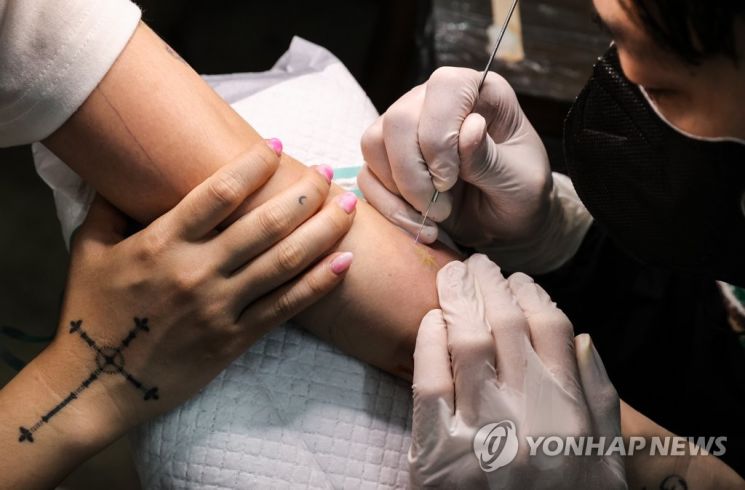
[Asia Economy Reporter Lim Juhyung] The National Human Rights Commission of Korea (NHRCK) has expressed the opinion that tattooing by non-medical personnel should be legalized, reigniting the controversy over 'tattoo legalization.'
Under the current Medical Service Act, tattooing by non-medical personnel is classified as 'unlicensed medical practice' and is subject to criminal punishment. However, recently, it has become common for celebrities and other famous figures in Korea to get tattoos on their bodies, and public awareness of tattoos has increased, leading to ongoing calls for legal revisions that reflect reality.
On the 16th, the NHRCK conveyed its opinion to the Speaker of the National Assembly, stating, "It is necessary to promptly process the tattoo-related bills pending in the National Assembly so as not to unjustly infringe on the freedom of occupational choice of tattoo practitioners and the freedom of self-expression of those receiving tattoos."
It added, "The bills refer to overseas systems that reasonably manage and supervise tattooing practices," emphasizing, "They share the common purpose of ensuring the safety and professionalism of tattooing and reducing health and hygiene risks, making them highly reasonable."
Currently, several bills are pending in the National Assembly, including the 'Tattoo Artist Act' by Park Jumin of the Democratic Party, the 'Semi-Permanent Makeup Tattoo Artist Act' by Eom Taeyoung of the People Power Party, and the 'Tattoo Business Act' by Ryu Hojeong of the Justice Party. These bills aim to clearly define the scope of work for tattoo practitioners, establish a licensing system related to tattooing, legalize tattooing, and ensure proper management and supervision.
The NHRCK urged, "Given the popularization of tattooing, it is desirable to enact laws that institutionalize the conditions, scope, and management and supervision systems for tattooing by non-medical personnel rather than completely prohibiting such practices."
The current Medical Service Act classifies tattooing as a 'medical act.' Accordingly, tattooing without a medical license is subject to criminal punishment under the Medical Service Act and the Act on the Prevention of Health Crimes.
However, it is extremely rare for licensed medical doctors to perform tattooing, and most tattoo practitioners in Korea are ordinary people without separate licenses. As a result, tattoo artists in Korea are effectively operating illegally.
Unlike the domestic situation, tattooing by tattoo artists has already been legalized in countries such as the United States, Europe, and Australia. In the U.S., tattooing was legalized in 1998, and tattoo artists can perform procedures on clients if they obtain a separate certification.
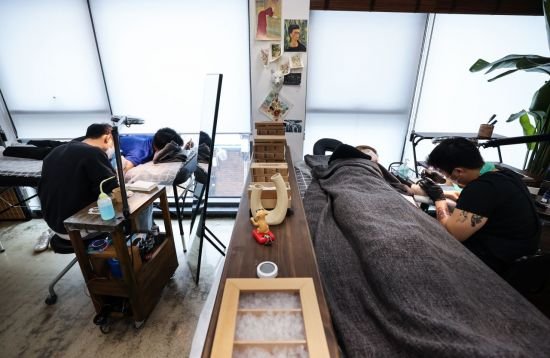 Tattoo artists are working in a studio in Seoul. The photo is unrelated to specific expressions in the article. Photo by Yonhap News
In Japan, the path to tattoo legalization was opened by a Supreme Court ruling in September 2020. The ruling overturned the previous precedent that considered tattooing without a medical license a violation of the Medical Practitioners Act and acquitted tattoo artists.
Recently, there have been cases of Koreans receiving tattoos abroad and returning to Korea, and a domestic 'tattoo culture' has already been activated. According to a survey by the National Assembly Research Service, the current number of tattoo practitioners in Korea is estimated at 350,000 (50,000 for tattoos and 300,000 for semi-permanent makeup), with about 13 million users annually.
According to the civic group 'Korea Tattoo Association,' which advocates for the legalization of the tattoo industry, the domestic tattoo industry recorded an annual scale of 1.2 trillion KRW as of 2019.
Given this situation, voices calling for tattoo legalization are gradually increasing among citizens. Since the domestic tattoo culture is already active, there are calls for the law to be revised to keep pace with social changes.
A 20-something office worker, Mr. A, said, "It's not difficult to see people with tattoos around me, so I was surprised to hear that tattooing is still illegal in Korea. There are people who make a living from tattooing, so I think banning it doesn't make sense."
Another office worker, Mr. B (31), said, "Adults should be able to do what they want with their bodies, so I don't understand why tattooing is still illegal. Because tattooing is illegal, tattoo shops operate in hidden places, and I heard their hygiene conditions are not good. I think we should move toward proper management through quick legalization."
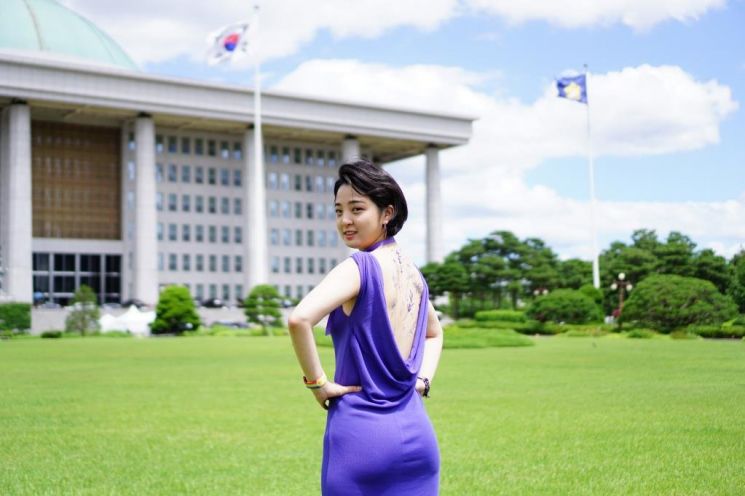 On June 16 last year, Ryu Ho-jeong, a member of the Justice Party, held a press conference at the National Assembly urging the enactment of tattoo legislation together with tattoo artists. At the time, Representative Ryu conducted the press conference with a tattoo sticker drawn by a famous tattoo artist attached to her back. / Photo by Yonhap News
On the other hand, some expressed concerns that excessive tattoos could cause discomfort to others. Mr. C, in his 30s, said, "Even if tattooing has become popular, that applies mostly to some young people. Society still has many negative views on tattoos. When people expose tattooed body parts, others glance sideways. I don't think restrictions can be lifted recklessly given these perceptions."
In fact, public opinion on tattoo legalization appears divided. According to a survey conducted by the public opinion research firm 'Korea Gallup' from June 22 to 24 last year, targeting 1,002 citizens aged 18 and over, 51% of respondents supported tattoo legalization, 40% opposed it, and 9% were undecided.
Regarding whether celebrities and media personalities should cover tattooed body parts, opinions were evenly split at 47% for and 47% against. Overall, awareness of tattoos has improved significantly, but opposition remains substantial.
Tattoo practitioners have called for proper management and supervision, stating that the current domestic tattoo industry environment does not protect either practitioners or customers.
The Korea Tattoo Association explained, "The current law lacks clear legal grounds regarding tattooing, so tattoo work is punished as a violation of the Medical Service Act. However, most tattoos are for cosmetic and artistic purposes rather than medical ones."
They added, "Because tattoos are performed clandestinely by non-medical personnel, management and supervision are difficult, negatively affecting public health. Through legalization, management and supervision should be strengthened to promote the sound operation of the tattoo industry and contribute to public health."
© The Asia Business Daily(www.asiae.co.kr). All rights reserved.
![Clutching a Stolen Dior Bag, Saying "I Hate Being Poor but Real"... The Grotesque Con of a "Human Knockoff" [Slate]](https://cwcontent.asiae.co.kr/asiaresize/183/2026021902243444107_1771435474.jpg)

















