Whether Evidence Submission is Key
Complete Change of Judges Due to Court Personnel Changes
Possibility of Verdict Delay to Second Half of the Year
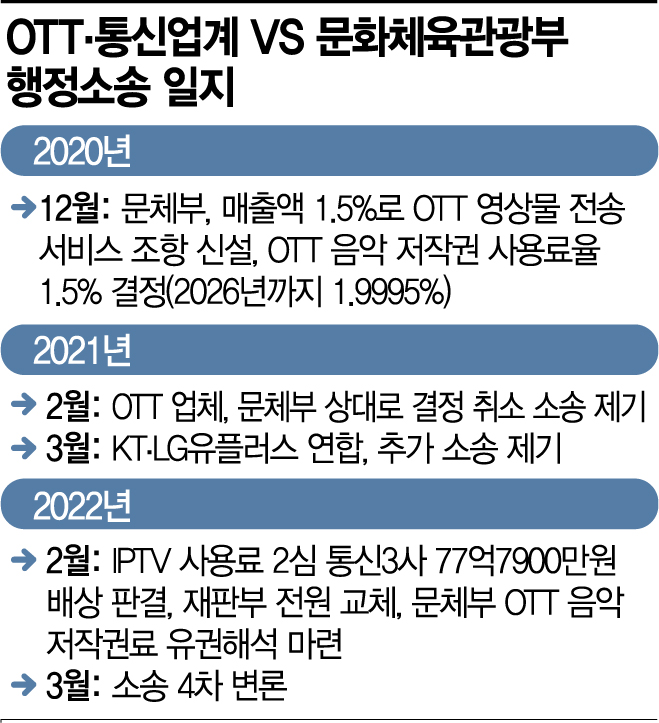
[Asia Economy Reporter Lim Hye-seon] The Ministry of Culture, Sports and Tourism (MCST) is clashing once again with online video service (OTT) providers over music copyright royalty rates, a legal battle that has lasted for over a year. The key issue is whether the MCST submitted the supporting data used in calculating the music copyright royalty rates.
On the 17th, the third hearing for the lawsuit filed by the KT and LG Uplus alliance against the MCST regarding the ‘Approval and Cancellation of the Amendment to the Music Copyright Usage Fee Collection Regulation’ will be held at the Administrative Court in Yangjae-dong, Seoul. On the 18th, the fourth hearing for the administrative lawsuit filed by the OTT Music Copyright Countermeasure Council (OTT Eumdae-hyeop), which includes Tving, Wavve, and Watcha, will take place.
MCST Remains Silent on Data Submission
The administrative lawsuits between OTT Eumdae-hyeop, the KT and LG Uplus alliance, and the MCST began after the MCST approved a revised proposal from the Music Copyright Association (Eumjeohyeop) that set the OTT copyright usage fee rate at 1.5% in 2012 and planned to increase it to 1.9995% by 2026. The OTT alliance argues that the approval process lacked proper opinion-gathering procedures and that the basis for calculating different music usage rates for identical services is unclear, claiming procedural and substantive illegality. They requested the MCST to provide the data and lists used during the review process, but the MCST has refused, stating up to the third hearing that "all available data has already been disclosed."
During the third hearing, the OTT alliance again requested the MCST to submit the research report commissioned from the Korea Copyright Commission to understand domestic and international trends in OTT music copyright fees. However, according to OTT Eumdae-hyeop, they had not received any response from the MCST regarding the submission of the related report as of the previous day. An industry insider said, "The fact that a research project was commissioned to understand overseas trends after the amendment approval itself indicates procedural illegality," adding, "This data is crucial to determine whether the MCST’s judgment is excessive considering the domestic industry circumstances."
Complete Change of Judges and IPTV Lawsuit Setbacks
The court personnel reshuffle in February brought another hurdle with a complete replacement of the judges. Given the highly contentious nature and the specialized field of copyright law, it is expected that the new judges will need considerable time to familiarize themselves with the related arguments. Although a ruling was anticipated by May, it is now likely to be postponed to the second half of the year.
Another factor is the recent ruling where domestic telecom companies, who filed a lawsuit against copyright organizations claiming that the music fees paid for Internet TV (IPTV) services were excessive, were instead ordered to pay 7.7 billion KRW. The telecom companies argued that the IPTV usage rate should be aligned with the 0.5% rate for cable TV operators (SO), but the court ruled that the copyright organizations’ usage rate of 1.2% was appropriate, citing structural differences where video-on-demand (VOD) services are more viewed on IPTV than on cable TV.
Separately from the legal disputes, OTT Eumdae-hyeop is negotiating with Eumjeohyeop. Discussions will be based on the MCST’s authoritative interpretation of the ‘Music Copyright Usage Fee Collection Regulation’ announced last month. The MCST’s interpretation includes provisions such as including in-app payment fees in revenue, recognizing only paid members as subscribers, acknowledging only actual users for OTT bundled product subscribers, and specifying standards for rights management of music used in film production. Conflicts arise particularly over in-app payment fees and rights management for film production music. An OTT industry insider said, "Without an agreement, negotiations will be difficult," adding, "It is highly likely to proceed to civil litigation."
© The Asia Business Daily(www.asiae.co.kr). All rights reserved.
![Clutching a Stolen Dior Bag, Saying "I Hate Being Poor but Real"... The Grotesque Con of a "Human Knockoff" [Slate]](https://cwcontent.asiae.co.kr/asiaresize/183/2026021902243444107_1771435474.jpg)
















