Phase of Uncertainty Resolution Including US Monetary Policy Normalization
Impact of Ukraine Conflict and China’s Economic Stimulus Measures
Domestic Stock Market: Need to Monitor Whether Foreign Inflows Begin
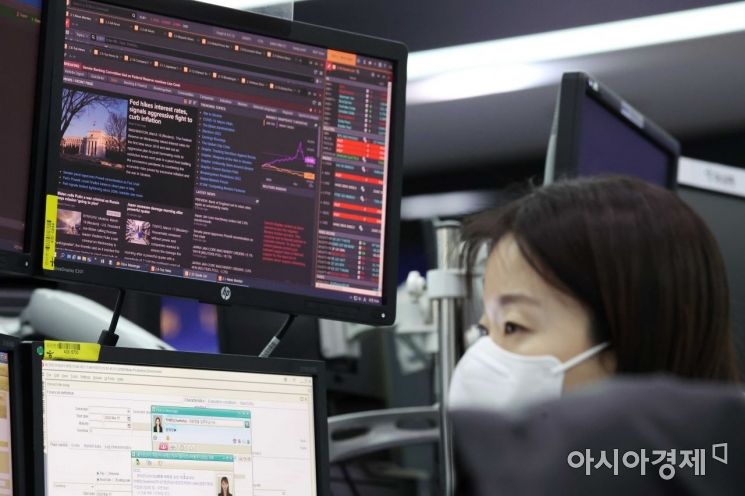 On the 17th, a dealer at the Hana Bank dealing room in Euljiro, Seoul, is watching news about the 0.25%p increase in the US Federal Reserve's base interest rate. / Photo by Moon Honam munonam@
[Asia Economy Reporter Hwang Junho] As geopolitical uncertainties such as the start of the normalization of U.S. monetary policy, the emergence of China's stock market stimulus measures, and signs of Ukraine-Russia negotiations begin to ease, expectations are growing that a spring breeze may blow through the domestic stock market.
On the 17th, the KOSPI recorded 2,710.18 at 9:35 a.m., up 1.92% from the previous session, recovering the 2,700 level for the first time in eight trading days. At the same time, foreign investors made net purchases worth 68.1 billion KRW. Following the easing of uncertainties, they stopped the net selling that had continued for the past eight trading days and began to inject funds. Until now, foreign investors had continuously sold stocks worth a total of 4.6783 trillion KRW, and their share of market capitalization fell to 31.90%, the lowest level in six years and one month since February 2016 (31.97% on the 12th).
Confidence in the normalization of U.S. monetary policy, which had been the biggest constraint on foreign inflows, also brought a warm breeze to the domestic stock market. On the 16th (local time), the U.S. Federal Reserve (Fed) raised the benchmark interest rate by 25 basis points (0.25?0.50%) through the Federal Open Market Committee (FOMC) and announced that it would begin quantitative tightening starting in May.
Despite the hawkish stance, the U.S. stock market closed higher. Fed Chair Jerome Powell expressed confidence in the economy even amid the Ukraine conflict during a statement after the FOMC, largely dispelling fears of a recession. Yoon Yeosam, a researcher at Meritz Securities, analyzed, "It was a case of 'taking the necessary punishment,' indicating that geopolitical risks or additional monetary policy burdens were not high," adding, "Short-term interest rates (U.S. 2-year Treasury at 1.938%, up 8.9 basis points) rose, while the dollar (98.6, down 0.5%) weakened."
China's government measures to stabilize the capital market are also positive for inflows into the domestic stock market. The day before, Chinese Vice Premier Liu He stated that measures that could shock the capital market would be announced cautiously. As a result, the Shanghai and Shenzhen Composite Indexes rose by over 3%, and the Hang Seng Index jumped 9.08%. Lee Kyungmin, a researcher at Daishin Securities, forecasted, "The calming phase of COVID-19, improvements in U.S. employment, and China's economic stimulus measures will have a positive butterfly effect that will support economic recovery with a time lag," adding, "Financial market sensitivity to the Ukraine situation is also likely to gradually weaken, and the stock market is expected to take a rising direction over time."
© The Asia Business Daily(www.asiae.co.kr). All rights reserved.
![Clutching a Stolen Dior Bag, Saying "I Hate Being Poor but Real"... The Grotesque Con of a "Human Knockoff" [Slate]](https://cwcontent.asiae.co.kr/asiaresize/183/2026021902243444107_1771435474.jpg)
















