Post-Election Conflicts Remain Unresolved... 'Ventings' Against Celebrities
In the Past, Ideological Screening Based on 'Pro-North Leftists' or Feminist Status
Also Occurring in Real Situations Like Job Interviews
Experts: The So-Called 'Divide and Rule' Caused by Partisan Logic... Must Be Avoided
 In online spaces, so-called 'witch hunts' are increasing, where celebrities are ideologically scrutinized over political views, feminism, and more. The photo is unrelated to specific expressions in the article. Photo by Asia Economy DB
[Asia Economy Reporter Park Hyun-joo] Since the presidential election, cases of supporters from both major parties conducting 'ideological verification' on celebrities have been increasing. They are pouring out criticism based solely on speculation and claims without clear evidence, such as wearing clothes in colors symbolizing a particular party. This behavior has not only targeted political colors but has also previously been a subject of controversy regarding feminism. Experts advise that society should become healthy enough for individuals to confidently express their political colors and views.
Right after the presidential election, webtoon artist and YouTuber Imalnyeon (real name Lee Byung-geon) was embroiled in controversy as a 'Democratic Party supporter.' This was due to baseless accusations that his eating of uni jjajang (sea urchin black bean noodles) on his YouTube broadcast the day after the election was intended to mock President-elect Yoon Seok-yeol’s derogatory nickname 'Yoonjjajang.'
As demands for clarification from some netizens grew, Imalnyeon posted a video on his YouTube channel 'Calm Man' on the 13th, saying, "It’s embarrassing to say, but at 40 years old, I still don’t understand politics well. I tend to ignore things when they get complicated," and added, "It’s something I have to deal with, but I’m a bit tired."
When a viewer asked him to insult former President Moon Jae-in to clarify the controversy, he refused, saying, "Why would I do that? I don’t understand the logic." Imalnyeon further stated, "There’s no way to stop people from writing as if they enjoy tormenting one person as a sport, but I just want them to know they’re being unreasonable."
Conversely, singer Jeon Somi became a target of criticism as she was labeled a 'People Power Party supporter.' After she posted on Instagram that she had completed voting in the presidential election, some netizens accused her of supporting President-elect Yoon simply because the background of her post was red, a color symbolizing the People Power Party. Additionally, Kim Hee-chul, a member of the boy group Super Junior, faced difficulties for visiting the polling station wearing red slippers. Seemingly aware of such controversies, some celebrities even visited polling stations dressed in neutral colors to preempt misunderstandings.
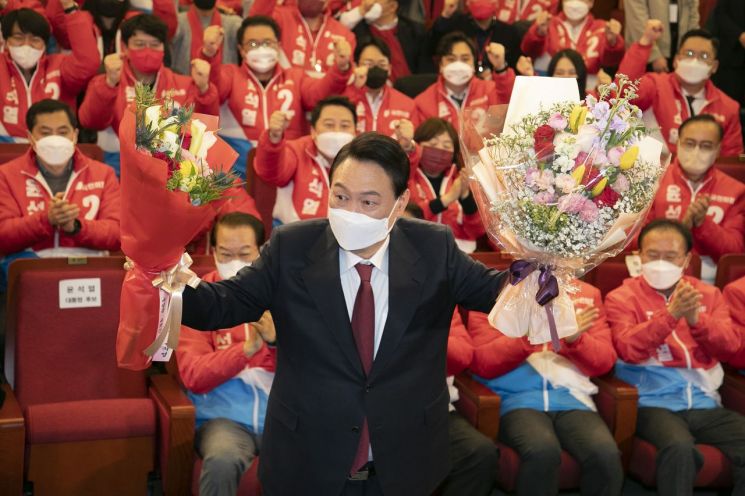 Yoon Seok-yeol, the president-elect of the 20th presidential election, is posing with a bouquet of flowers at the "People Power Party 20th Presidential Election Vote Counting Situation Room" set up at the National Assembly Library in Yeouido, Seoul, early on the 10th.
 [Image source=Yonhap News]
This kind of 'witch hunt' targeting celebrities is not new. It started with 'pro-North Korea leftist' verifications and has recently extended to feminist ideological verifications. Archery national team member An San became a target of feminist ideological verification and online lynching during the Tokyo Olympics in July last year.
Regarding this, 29 women’s organizations, including the Korean Women’s Political Network, issued a statement on the 30th of the same month titled "Who Created a Korean Society That Demands Feminists Return Their Gold Medals?" They pointed out that "(in some online communities) feminism is distorted as 'misandry,' and people try to stigmatize and oppress feminists based on specific appearances (such as short haircuts), engaging in sexist harassment."
They also criticized the political sphere for encouraging such behavior, stating, "In some online spaces, men use feminism as a tool for self-comfort and amusement to attack, and politicians have exploited this while society has accepted it."
In August last year, a website called 'CheckFemi,' which identified feminists among celebrities, also sparked controversy. It provided a list judging whether celebrities were feminists based on their social media posts and media interviews. The site included idols, singers, commentators, and even politicians.
The 'ideological verification test' has extended beyond online spaces to affect real life. There have been revelations from job seekers about inappropriate questions during interviews. In March last year, a person identifying as an aspiring game scenario writer, A, revealed that they underwent feminist ideological verification during an interview at a major domestic game company. This led to further revelations in the gaming industry that female voice actors and illustrators involved in game development who voiced opinions on women’s rights were often excluded from projects by some male users.
Experts attribute the cause of the 'ideological verification witch hunt' to intensified factional logic and slander directed at opposing camps. Cultural critic Jung Deok-hyun said, "The so-called 'divide and conquer' that occurred due to the overheated atmosphere and factional logic during the presidential election phase led to the spread of ideological verification. Political opinions should be openly expressed by anyone, and criticizing them as if they are wrong is very undesirable and should be avoided."
Jung added, "In fact, those celebrities didn’t even express their own opinions. The interpretations were imposed arbitrarily on specific actions, twisting them in directions the other party did not intend, which has caused significant fatigue."
© The Asia Business Daily(www.asiae.co.kr). All rights reserved.
![Clutching a Stolen Dior Bag, Saying "I Hate Being Poor but Real"... The Grotesque Con of a "Human Knockoff" [Slate]](https://cwcontent.asiae.co.kr/asiaresize/183/2026021902243444107_1771435474.jpg)















