300 Global Companies Leave Russia... 0 Korean Companies
Worried About Global Boycott Movement
Experts Say "Simple Withdrawal Is Not the Answer"... Need for Countermeasures
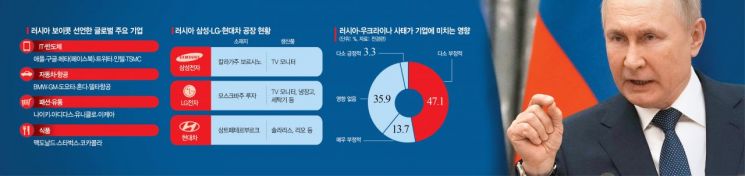
Global major companies such as Apple, Intel, and Tesla are successively joining the 'de-Russia' movement, deepening the concerns of domestic companies like Samsung Electronics and Hyundai Motor. Declaring withdrawal as a form of boycott against Russia risks losing the market they have painstakingly developed, while staying risks being caught up in global boycotts and other backlash. From the perspective of our companies, it is said that they are in a classic 'dilemma.'
Experts emphasize the need for companies to prepare countermeasures for the new international order. This is because the so-called global society's 'pressure to withdraw and supply chain disruptions' caused by Russia's invasion of Ukraine could recur at any time. In particular, considering the unique vulnerability of the Korean economy to external uncertainties, this case should be taken as a cautionary example.
◆ 300 vs 0... Korean companies unable to leave Russia = According to business circles and major foreign media on the 16th, about 300 multinational companies have withdrawn from the Russian market since Russia's invasion of Ukraine. Global companies such as Apple, which holds a 15% share of the Russian smartphone market, Google, GM, Intel, and Toyota have also joined the 'de-Russia' front one after another.
Especially as the war prolongs, global companies that had previously declared their intention to remain in the Russian market are now announcing their withdrawal one after another. Uniqlo, Starbucks, and Coca-Cola are representative examples. In the early stages of the war, they emphasized that their businesses were essential daily necessities and expressed no intention to withdraw. However, as backlash centered in the West intensified, along with criticisms that continuing operations would damage their reputation and affect other regional businesses, they ultimately chose to withdraw.
On the other hand, among Korean companies, not a single one has declared withdrawal from Russia yet. This is because they have spent decades striving to penetrate the Russian market since the collapse of the Soviet Union. Especially since they have successfully established themselves in the market, it is practically difficult to make a hasty decision to withdraw. Samsung Electronics and LG Electronics hold the number one position in major home appliance sectors such as washing machines and refrigerators in Russia. Samsung Electronics, in particular, has a 30% share of the smartphone market, twice that of Apple.
Therefore, it is reported that Samsung Electronics did not accept the direct request from Ukrainian Deputy Prime Minister Mykhailo Fedorov to suspend product sales. However, Samsung Electronics has currently suspended shipments of export goods bound for Russia due to disruptions in maritime logistics. Other major domestic companies such as Hyundai Motor and LG Electronics are in similar situations. It is reported that they are also not considering banning sales or withdrawing operations as part of global companies' pressure on Russia.
Unlike Apple and other global companies, domestic major companies have many factories locally, which is also analyzed as a cause. Since the factories, which required significant investment, have a large employment effect locally, deciding to withdraw carries a heavy burden of potentially being accused of 'offense' by Russian authorities, unlike other global companies. A business circle official said, "It is unreasonable to withdraw just because other global companies have done so," adding, "Since it could cause significant damage, this matter should be reviewed and decided with greater caution."
◆ "Simple withdrawal is not the solution... supplementary measures needed" = Experts also pointed out that domestic companies do not need to join the global companies' 'de-Russia' movement following Russia's invasion of Ukraine. However, they said fundamental supplementary measures are necessary to address the vulnerabilities of our industrial sector exposed by this incident. Since similar incidents could occur in our industrial sector at any time, thorough preparation is required.
The impact on our industrial sector from Russia's invasion of Ukraine is considerable. Representative issues include pressure on major companies to withdraw and supply chain problems for key raw materials such as naphtha and neon, which were dependent on Russia and Ukraine respectively. In particular, some companies are reportedly facing more severe situations due to Western sanctions on remittances to Russia, making payment settlements impossible.
Professor Jeong In-kyo of Inha University's Department of International Trade said, "The Ukraine crisis is in the same context as the 'supply chain risk' that emerged from the past US-China conflict," adding, "Recognizing that supply chains are linked to security and coming up with proper alternatives will be the fundamental countermeasure."
An official from an economic organization also said, "Even though the Ukraine crisis has occurred, immediate withdrawal from the Chinese or Russian markets does not seem desirable," adding, "It is time for the government to deliberate and discuss comprehensively and from a long-term perspective, thinking of the economy as security." An industry insider also said, "Withdrawal is not the best solution," adding, "However, in the case of the Chinese and Russian markets, business plans should be sought in ways that manage risks."
There were also calls to separate markets like Russia and China, which frequently clash with the West, from the global market. It is argued that the risk of problems starting in a part spreading to the whole should not be taken. Professor Kim Pil-su of Daelim University's Department of Automotive Engineering said, "It would be better to view Russia and China as separate markets rather than part of the global market," adding, "Since variables that could cause problems with the West at any time exist, more strategic countermeasures should be prepared."
© The Asia Business Daily(www.asiae.co.kr). All rights reserved.
![Clutching a Stolen Dior Bag, Saying "I Hate Being Poor but Real"... The Grotesque Con of a "Human Knockoff" [Slate]](https://cwcontent.asiae.co.kr/asiaresize/183/2026021902243444107_1771435474.jpg)
















