LG Chem and 74 Companies Participate
Most Rely on 'Green Premium'
No Direct PPA Contracts with KEPCO
40% More Expensive Than Regular Electricity Rates
"Need to Increase Benefits for Participating Companies"
[Asia Economy Reporter Oh Hyung-gil] It has been one year since the introduction of the 'Korean-style RE100 (K-RE100)' for companies to use 100% renewable energy, but participation by companies remains low due to high costs. With changes in carbon neutrality policies expected following the inauguration of the new government, experts point out that increasing benefits for participating companies is necessary for K-RE100 to be stably established.
According to POSCO Research Institute on the 18th, as of the end of last year, 74 companies including LG Chem, LG Display, SK Telecom, SK Materials, and Hanwha Solutions participated in K-RE100 implementation, resulting in 76 cases.
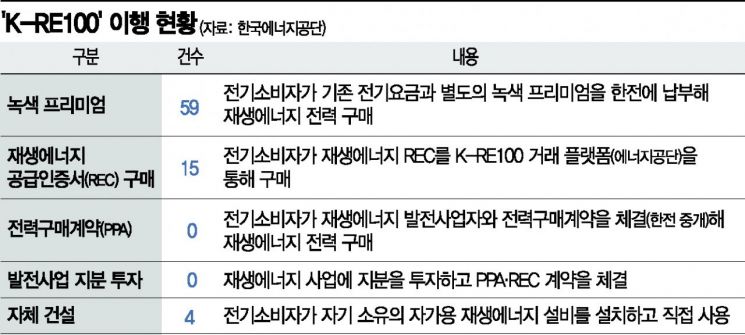
K-RE100 recognizes various methods for directly or indirectly procuring renewable energy, such as green premiums, REC (Renewable Energy Certificate) purchases, PPA (Power Purchase Agreements), equity investments, and self-construction.
The problem is that most participating companies rely on the green premium. By implementation method, green premium accounts for 59 cases, or 78%. REC purchases account for 15 cases (19%), self-construction for 2 cases, and there are no actual results for PPA.
The green premium is a method where companies pay a green premium separately from electricity charges to Korea Electric Power Corporation (KEPCO) to purchase renewable energy power, making it the cheapest and easiest way to buy renewable energy.
However, since it is not linked to greenhouse gas reduction performance, its effectiveness is limited, and more than 90% of the bid volume remains unsold. In two bidding rounds last year, 17,827 GWh and 12,319 GWh were bid respectively, but only 1,252 GWh (7.0%) and 203 GWh (1.6%) were awarded. The green premium price is mostly contracted at the bid floor price of 10 KRW per kWh. This means companies spend money on purchasing renewable energy but there is no actual greenhouse gas reduction effect.
REC trading has been concluded in about 30 cases since the market opened in August last year, but this accounts for only 0.3% of the green premium sales volume. As REC prices rise, they are traded at about five times the price of the green premium. On the 4th, a total of 8 cases amounting to 1,634 MWh were traded in the REC market, with an average unit price reaching 54,600 KRW per MWh. This is a 37.5% increase compared to the average price of 39,700 KRW last year.
There are no cases of PPA contracts. PPA is a method of trading power directly or indirectly with renewable power producers or KEPCO without going through the power market, gaining global attention. However, domestically, it is neglected because it is about 40% more expensive than general electricity rates.
In contrast, in the United States, REC accounts for 51% of RE100 implementation methods, PPA 27%, and green premium 20%. The additional cost of PPA compared to general electricity rates is only about 3-5%, making it less burdensome for companies.
Cho Yoon-taek, senior researcher at POSCO Research Institute, said, "It is necessary to provide reasonable incentives for the use of renewable energy," and added, "We need to discuss measures such as exempting participating companies from reporting and reducing obligations for indirect greenhouse gas emissions or reducing climate environment charges from electricity bills."
Meanwhile, LG Energy Solution has been selected as the first domestic company to serve as an advisory member of the 'RE100' board. LG Energy Solution will evaluate and review renewable energy expertise, experience, and future RE100 achievement plans alongside Apple, Unilever, Meta, Sony, Pepsi, and others, serving as a policy advisory role on the RE100 board.
© The Asia Business Daily(www.asiae.co.kr). All rights reserved.
![Clutching a Stolen Dior Bag, Saying "I Hate Being Poor but Real"... The Grotesque Con of a "Human Knockoff" [Slate]](https://cwcontent.asiae.co.kr/asiaresize/183/2026021902243444107_1771435474.jpg)
















