Collaboration with Nokia, Krimo, and Dongwoo Fine-Chem
Laboratory and Field Testing to Begin in First Half of This Year
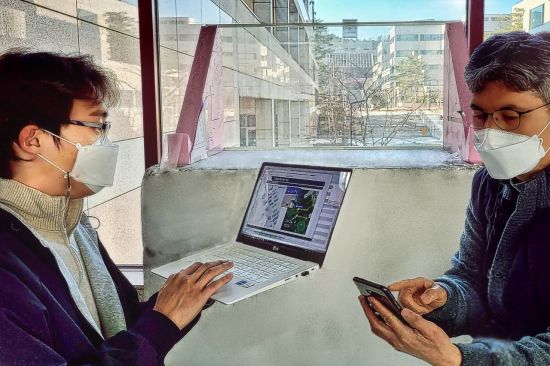
[Asia Economy Reporter Minyoung Cha] LG Uplus is accelerating the development of core technologies in preparation for the upcoming 6G era.
On the 15th, LG Uplus announced that it will conduct verification of the core antenna technology called ‘Reconfigurable Intelligent Surface (RIS)’.
In 6G, it is expected that the terahertz (THz) band, which has not been used in mobile communications until now, will be utilized. Terahertz waves have a wide available bandwidth, enabling data transmission speeds of terabits per second (Tbps), but because the wavelength is very short, signal loss occurs in environments with obstacles in the propagation path (NLoS·Non-Line-of-Sight) or when signals come indoors from outdoor base stations (O2I·Outdoor-to-Indoor).
The technology that is gaining importance to solve this issue is RIS. RIS is one of the 6G element technologies that uses the electromagnetic properties of the antenna surface to control the propagation of signals from the base station to the user. It can be compared to an ‘intelligent mirror’ that adjusts transmission according to the characteristics of the radio waves.
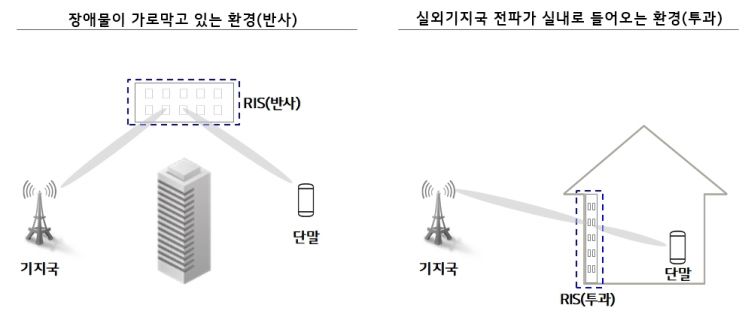
By using this, it is possible to provide the effect of transmitting external signals into buildings and improve coverage in shadow areas by providing reflection effects in NLoS environments. Several major domestic and international companies have introduced solutions to resolve shadow areas using RIS in their 6G white papers. Japan’s mobile carrier NTT Docomo also announced an indoor coverage improvement plan using RIS last year.
Since last year, LG Uplus has been collaborating on 6G RIS technology with Nokia, Criemo, and Dongwoo Fine-Chem, and has been verifying RIS in laboratory and 5G field environments since early this year. Initially, verification is being conducted in the 3.5 GHz and 28 GHz bands, and in the future, RIS will be applied to the terahertz band to confirm the effectiveness of RIS application in 6G.
Lee Sangheon, Head of NW Advanced Development at LG Uplus, said, “If it is verified that RIS can be used in actual mobile communication environments, it is expected to be utilized not only in the upcoming 6G era but also to improve 5G quality. We will continue to verify next-generation network technologies such as cloudification of network equipment in real communication environments and ultimately strive to improve customers’ perceived quality.”
© The Asia Business Daily(www.asiae.co.kr). All rights reserved.
![Clutching a Stolen Dior Bag, Saying "I Hate Being Poor but Real"... The Grotesque Con of a "Human Knockoff" [Slate]](https://cwcontent.asiae.co.kr/asiaresize/183/2026021902243444107_1771435474.jpg)
















