'Internet Free' Claim Abandoned by Netple
Claims Cost Reduction with Own Technology
What About SKB Electricity and Space Usage Fees?
Global Telecom Companies Also Demand "Pay Up" Wave
[Asia Economy Reporter Cha Min-young] As global Internet Service Providers (ISPs) demand cost-sharing for network investments from internet and streaming companies including Netflix, the second round of the "trial of the century," Netflix VS SK Broadband (SKB), is about to begin. Instead of the net neutrality principle argued in the first trial, Netflix plans to claim that by using its own technology to reduce ISP traffic, it is effectively paying for usage fees.
Netflix: "Our Technology Reduces ISP Costs"
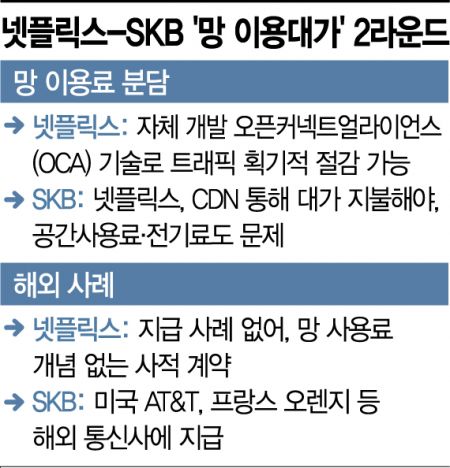
According to industry sources on the 15th, Netflix is expected to emphasize the traffic reduction effect through its own network technology, Open Connect Alliance (OCA), during the first hearing of the Netflix appeal and SK Broadband counterclaim scheduled for the 16th at the Seoul High Court.
After the Seoul Central District Court Civil Division 20 dismissed the case in the first trial in June last year, effectively ruling against the plaintiff and ending the trial, Netflix shifted its litigation strategy. Instead of the core arguments in the first trial such as "the obligation to deliver content lies with the ISP" and "net neutrality means internet use is free," Netflix has shifted focus to the mutual settlement-free logic through OCA.
Netflix repeatedly claims that OCA, its self-developed Content Delivery Network (CDN) technology, achieves revolutionary traffic reduction effects. At a press conference in November last year during his visit to Korea, Dean Garfield, Netflix’s Vice President of Policy, maintained the company's position, stating, "More than 1,000 ISPs worldwide use Netflix’s self-developed OCA free of charge, which was created with an investment of 1 trillion KRW to reduce the burden on ISPs."
SKB: "What About Electricity and Space Usage Fees?"
SKB plans to counter this argument by stating that the mutual settlement-free logic applies only to contracts between ISPs. They argue that the effectiveness of OCA is merely Netflix’s claim and insist on the fulfillment of standard CDN contracts. It is also expected that SK Broadband will raise issues regarding electricity usage fees and space rental fees associated with operating OCA within SKB’s facilities.
Demands for sharing massive network usage fees have been ongoing for over a decade but have gained momentum in the past one to two years. Last year, SK Broadband’s first trial victory against Netflix was the world’s first case where the judiciary distinguished roles between ISPs and Content Providers (CPs), attracting international attention. Dr. Roslyn Layton, a network expert from Aalborg University in Denmark, cited the SK Broadband case in a Forbes article, stating, "Even though a few global content companies account for 80% of network capacity, internet providers are not recovering fair costs."
Global Telecoms Also Say "Netflix and Google, Pay Up"
In February, major European telecom companies such as Deutsche Telekom, Orange, Telef?nica, and Vodafone issued an open letter in the Financial Times (FT) urging European Union (EU) lawmakers to "push Big Tech groups to contribute more to internet infrastructure expansion costs," voicing political demands. In the U.S., voices have risen among Federal Communications Commission (FCC) commissioners calling for Amazon, Apple, Facebook, and Google to help pay for broadband expansion costs.
The reason global ISPs are confronting major clients like Big Tech companies is that the advent of 4K high-definition video content from Netflix, YouTube, and others has astronomically increased the traffic burden on ISPs responsible for maintaining network quality. According to Canadian network solutions company Sandvine, the top six Big Tech companies including Google, Facebook, and Netflix accounted for 56.96% of global network traffic in 2021, exceeding half. In Korea, according to a 2020 report by the Ministry of Science and ICT, Google accounted for about 23.5%, Netflix 5%, and Facebook 4%, totaling approximately 32.5%. This is ten times the traffic volume of Naver and Kakao. The amount SK Broadband demanded from Netflix in 2020 reached 27 billion KRW.
KT, which had shown a passive stance, may also join depending on future trial outcomes. KT CEO Koo Hyun-mo, a board member of the Global System for Mobile Communications Association (GSMA), hinted at the possibility of government-led fund-type mechanisms in a press conference at the Mobile World Congress (MWC) held in Spain last March, stating, "There was discussion about the need for more active CPs to share network costs."
© The Asia Business Daily(www.asiae.co.kr). All rights reserved.
![Clutching a Stolen Dior Bag, Saying "I Hate Being Poor but Real"... The Grotesque Con of a "Human Knockoff" [Slate]](https://cwcontent.asiae.co.kr/asiaresize/183/2026021902243444107_1771435474.jpg)

















