[Seoul District News] Gwanak-gu Establishes 2022 Comprehensive Plan for Social Economy Revitalization: Coexistence with Residents through Social Economy Activation... Close Support for Social Economy Enterprises Including Consulting, Education, and Accounting, Expansion of Dream Market Online, Customized Education Provided... Seongdong-gu Supports Eco-friendly Rice and Kimchi for Free Kindergarten Meals... Dongdaemun-gu Creates Cooperative Housing with Management Workers... Seongbuk-gu Announces 2022 Village-Making Special Project Contest... Gangdong-gu Provides Medical Support for Pets of Vulnerable Groups
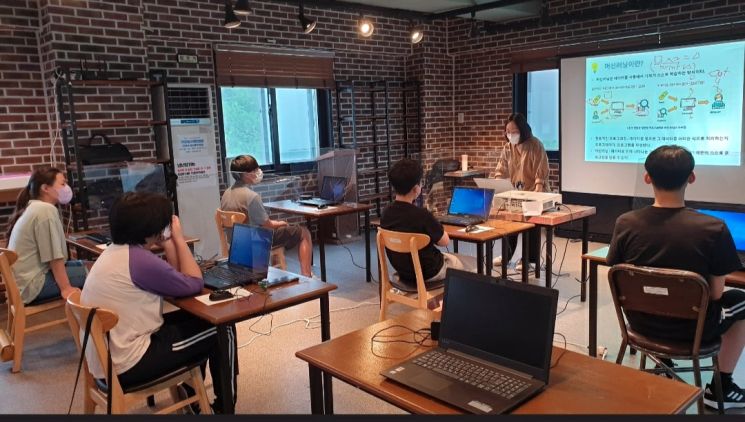
[Asia Economy Reporter Park Jong-il] Gwanak-gu (Mayor Park Jun-hee) has established the ‘2022 Comprehensive Plan for the Activation of Social Economy’ to fully support the discovery and assistance of social economy organizations, market development, and promotion, helping their stable growth and revitalizing the local economy and job creation.
Currently, there are about 230 social economy enterprises active in various fields within Gwanak-gu. The district has been making multifaceted efforts to help social economy enterprises become self-reliant and promote coexistence with residents through the enactment of ordinances for social economy activation, expansion of the Dream Market operation, and priority purchasing by public institutions.
Last year, despite the COVID-19 situation, focused support was provided for social economy enterprise startups, management, consulting, promotion, and education, resulting in the designation of 7 new social enterprises and an increase of 17 social economy organizations compared to the previous year, achieving quantitative growth.
Currently, to strengthen business capabilities and self-reliance of newly established or economically vulnerable social economy enterprises, the district supports spaces for 3 social economy facilities and a total of 9 enterprises within the region.
This year, under the vision of ‘Coexistence with Residents through Social Economy Activation,’ the district plans to actively promote four major strategies: ▲Infrastructure establishment and administrative support ▲Discovery and support of social economy enterprises ▲Market support and promotion enhancement ▲Human resource development and cooperation system establishment.
First, the ‘Gwanak-gu Social Economy Integrated Support Center’ will continue to operate, efficiently and stably supporting social economy organizations from establishment to operation, serving as a connection hub to enable systematic growth of social economy enterprises.
Additionally, the space support project, which provides workspaces to social economy enterprises at low cost, and the financial support project, which contributes to management support and job creation for vulnerable groups, will continue to be promoted.
The representative social economy marketplace in Gwanak-gu, the ‘Dream Market,’ faced difficulties in offline operation due to COVID-19, and since last year has been expanding online sales areas such as shopping live commerce to strengthen online sales.
This year, the district will continue to expand online sales areas and combine offline sales to help enterprises increase sales and develop markets, actively promoting various social economy support projects by field through the district website, SNS, and electronic billboards.
The creative space ‘Iruda Startup Workshop,’ which introduced the concept of sharing in social economy facilities, will also continue to operate, providing residents with a foundation for startups and experiential opportunities, and conducting social economy academy education to enhance understanding of social economy. Especially, for the first time this year, customized cooperative education will be provided for residents interested in establishing cooperatives.
A district official said, “In the post-COVID era, the role of social economy pursuing social values inevitably grows larger,” adding, “We will actively promote various projects for social economy activation and job creation to support Gwanak-gu social economy enterprises to grow as a key pillar of the local economy.”
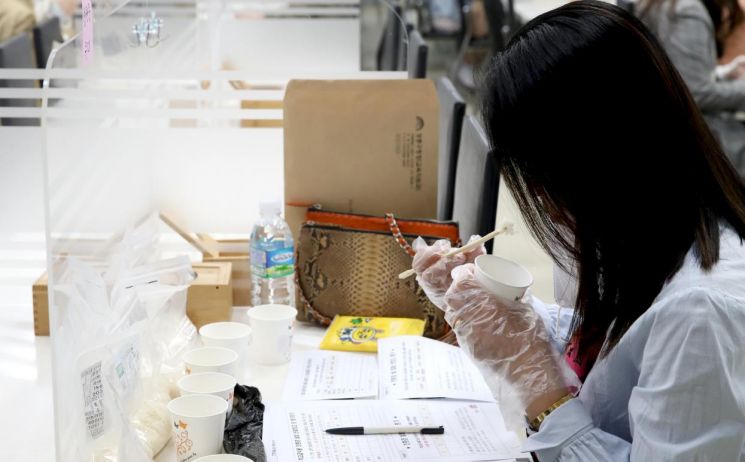
Seongdong-gu (Mayor Jung Won-oh) announced that it will expand the joint purchase support of eco-friendly rice and kimchi, which has been provided to elementary, middle, and high schools, to include kindergarten meals.
When purchasing eco-friendly rice, the district will provide a purchase price difference subsidy of 70 KRW per meal, the same as for elementary schools, to reduce the burden on kindergartens. For kimchi, a company using 100% domestic ingredients without synthetic additives will be selected, enabling kindergartens to jointly purchase from that company. Continuous quality management will also be conducted through detailed inspections and quarterly safety tests.
Following the ‘Seoul City Kindergarten Eco-friendly Free Meal Implementation Business Agreement Ceremony’ held by the Seoul Metropolitan Office of Education last December, free meals will be fully implemented for all public and private kindergartens in Seoul starting this month.
The free meal program, with costs shared by Seoul Metropolitan Office of Education (50%), Seoul City (30%), and autonomous districts (20%), provides one lunch per school day during the semester. The support unit price (3,689 to 5,555 KRW) is determined based on the number of children and whether the kindergarten is public or private. Ingredients are recommended to be purchased from the Seoul Eco-friendly Distribution Center and HACCP-certified companies to ensure safety and quality.
The kindergarten free meal program was finalized through operation of a working TF team and education administration council involving Seoul City, Seoul Metropolitan Office of Education, and autonomous districts, deciding on support unit prices, funding shares, and implementation timing. Notably, Seongdong-gu Mayor Jung Won-oh played a pivotal role as head of the ‘Welfare Grand Compromise TF Team’ of the Seoul Special City Mayors’ Association, facilitating autonomous negotiations between Seoul City and autonomous districts focusing on three major social welfare projects including school entrance preparation funds and childbirth congratulatory money.
By having local governments take responsibility for meal costs previously borne by parents and eliminating disparities in meals among kindergartens, the district actively promotes children’s health. It also plans to support meal costs for local early childhood physical education groups (Seongdong, Open, Rainbow) operating programs equivalent to kindergartens, realizing universal educational welfare.
Mayor Jung Won-oh of Seongdong-gu said, “Good eating habits formed in early childhood not only create basic life habits but also affect overall child development,” adding, “Through the expansion of eco-friendly kindergarten meals, we will provide safe food so that all children can grow healthily and do our best to promote children’s health.”

Dongdaemun-gu (Mayor Yoo Deok-yeol) is launching a public contest for the ‘Respect for Human Rights of Management Workers and Support for Model Apartment Complexes for Coexistence’ project to protect the human rights of laborers in multi-family housing and establish a culture of coexistence in housing.
As part of the multi-family housing community activation project, the model apartment complex support project is designed to provide comfortable rest areas for managers, improve working environments, and guarantee basic rights, offering more practical support.
The project budget totals 5 million KRW, with up to 2.5 million KRW per apartment complex fully funded by the city (with up to 10% self-contribution). Selected apartments will sign agreements with the district to implement the project.
Support includes ▲payment of common utility fees (electricity usage) for restrooms and security offices ▲purchase of necessary work supplies (cold-weather clothing, work shoes, etc.) ▲improvement of rest area working environments (air purifiers, heating/cooling devices, etc.) ▲meeting expenses to promote communication and harmony.
Those wishing to apply must submit a project plan and necessary documents jointly signed by the ‘Residents’ Representative Meeting,’ ‘Management Office Manager,’ and ‘Community Activation Group’ of mandatory management apartment complexes in the district by March 24, either by visiting or mailing to the Dongdaemun-gu Housing Division. Mailed applications must arrive by 6 p.m. on the 24th to be accepted. The selection will be made through a first review by the Multi-family Housing Deliberation Committee and a second review by the Seoul City Multi-family Housing Support Division.
For more details, refer to the announcement section on the Dongdaemun-gu website or contact the Multi-family Housing Support Team of the Housing Division at Dongdaemun-gu Office.
Mayor Yoo Deok-yeol of Dongdaemun-gu said, “This project was launched to guarantee the basic human rights of laborers managing multi-family housing, where disputes and conflicts are likely to occur, and to promote communication and harmony among management workers, management entities, and residents,” adding, “We ask for the participation of many apartment complexes to create a warm and livable residential environment.”
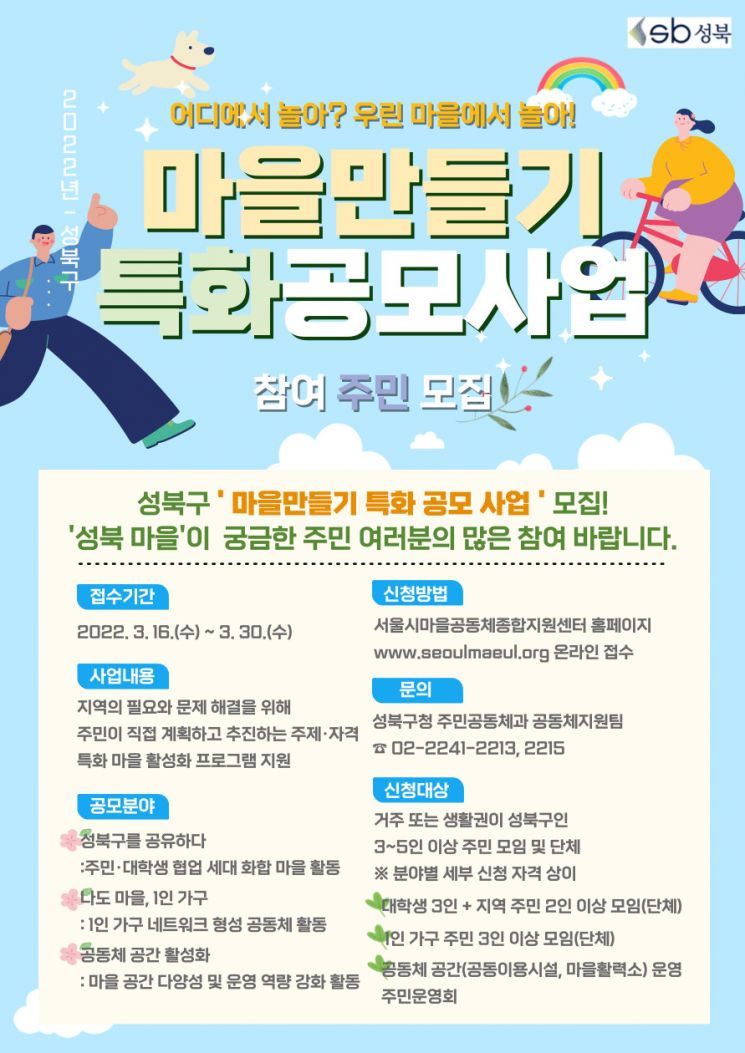
Seongbuk-gu (Mayor Lee Seung-ro) is conducting the ‘2022 Seongbuk-gu Village Making Specialized Contest Project’ to activate various village communities and strengthen residents’ capabilities for village living.
The 2022 Village Making Specialized Contest Project is tailored to application requirements depending on fields needing community expansion. It is conducted under the themes of ‘Generational Harmony,’ ‘Single-person Households,’ and ‘Village Spaces,’ consisting of three categories: ▲‘Sharing Seongbuk-gu,’ a village-level activity based on collaboration between local residents and university students centered on community space hubs ▲‘Me Too Village, Single-person Households,’ a community activity forming networks among single-person households ▲‘Seongbuk Community Space Activation,’ activities to discover diversity and strengthen operational capabilities of village spaces.
The project period is from May to October this year, with a total support budget of 40 million KRW, providing up to 4 million KRW per resident group (organization).
The basic applicants are resident groups (3 or more people) or organizations (nonprofit private corporations, nonprofit private organizations) residing or having living areas (workplace, school, etc.) in Seongbuk-gu. Since the project is specialized by theme, applicants must meet detailed qualifications for each category: ▲groups or organizations with at least 3 university students and 2 local residents for ‘Sharing Seongbuk-gu’ ▲groups or organizations with at least 3 single-person household residents for ‘Me Too Village, Single-person Households’ ▲operating committees managing village spaces for ‘Seongbuk Community Space Activation.’
Applications can be submitted online from the 16th to the 30th via the Seoul Village Community Comprehensive Support Center website by filling out the project plan and participant list announced on the district website. Detailed information is available on the Seongbuk-gu Office website under ‘Seongbuk-gu Introduction’ - ‘District News’ bulletin board.
A Seongbuk-gu official said, “Each resident gathers to form a community and a village, making Seongbuk-gu strong. We ask for the interest of residents who will take steps together for their neighborhoods, and we will strive to make Seongbuk-gu a better place to live by valuing the precious time and effort of residents participating in the specialized contest project.”
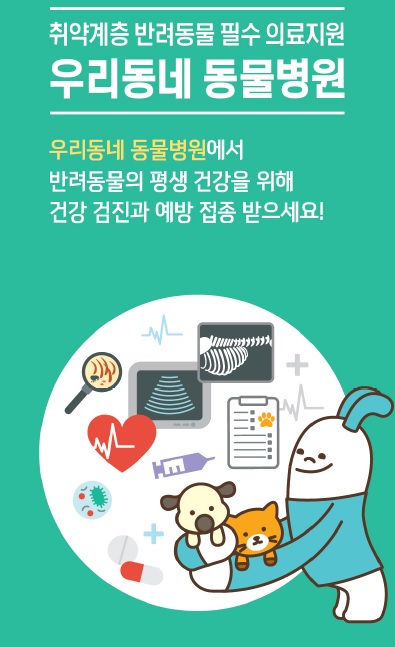
Gangdong-gu (Mayor Lee Jung-hoon) will launch the ‘Our Neighborhood Animal Hospital’ project from March to provide essential animal medical care such as vaccinations for pets of vulnerable groups.
‘Our Neighborhood Animal Hospital’ is a project to reduce the burden on pet owners and enhance pet welfare by supporting essential medical services including basic health checkups and mandatory vaccinations.
Last year, as a pilot project by Seoul City, it was found to have positive effects not only on improving pet health but also on the emotional stability of vulnerable groups.
From this year, Seoul City and Gangdong-gu will jointly support the costs, with some expenses covered through talent donations by designated contracted animal hospitals.
On February 25, after Seoul City’s evaluation, four animal hospitals in Gangdong-gu (Garam Animal Hospital, Zion Animal Hospital, Royal Animal Medical Center, Jurassic Animal Hospital) were designated as ‘Our Neighborhood Animal Hospitals’ and signed agreements with the district. Applications for the first half of the year (30 animals) have been accepted on a first-come, first-served basis since March 14.
Applicants must be Gangdong-gu residents who are basic livelihood security recipients or low-income households, and dogs must be registered. Unregistered dogs can receive support after registration.
Medical support is provided for up to two pets per household, divided into essential care (worth about 300,000 KRW / co-payment: 5,000 KRW per visit, up to 10,000 KRW) including basic health checkups, vaccinations, and heartworm prevention medication, and optional care (worth about 200,000 KRW / co-payment: amount exceeding 200,000 KRW) covering treatment or neutering surgery for symptoms or diseases found during basic checkups.
After application, applicants visit the designated animal hospital on the assigned date with ID, animal registration certificate, medical support application form, and proof of vulnerable status (certificate of livelihood recipient, low-income household confirmation) to receive treatment. For more details, contact the Social Economy Division of Gangdong-gu Office.
© The Asia Business Daily(www.asiae.co.kr). All rights reserved.
![Clutching a Stolen Dior Bag, Saying "I Hate Being Poor but Real"... The Grotesque Con of a "Human Knockoff" [Slate]](https://cwcontent.asiae.co.kr/asiaresize/183/2026021902243444107_1771435474.jpg)

















