Unvaccinated Students Allowed to Attend School Even if Family Tests Positive
Mom Cafes Say "Worried About Kids Going to School," "Family Positive Cases Should Quarantine for a Week"
Central Disaster Management Headquarters: "COVID-19 Vaccination for Ages 5-11 to Begin at the End of This Month"
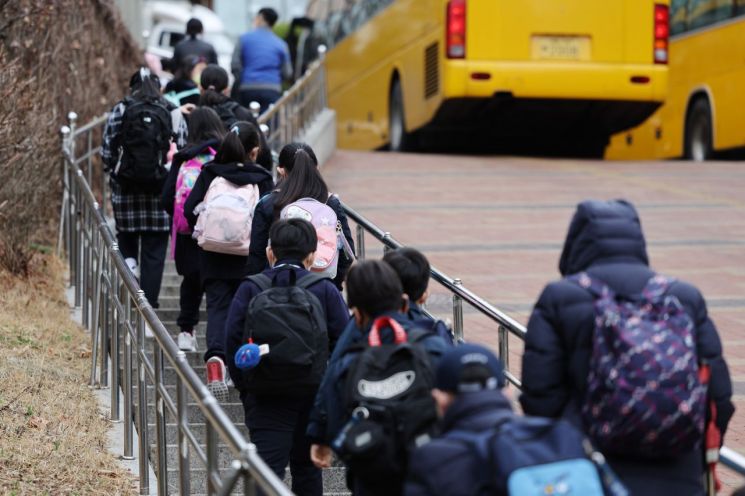 Even if family members or cohabitants test positive for COVID-19, students are now allowed to attend school. On the morning of the 14th, students are seen going to school at an elementary school in Seoul. The photo is unrelated to specific expressions in the article. [Image source=Yonhap News]
[Asia Economy Reporter Heo Midam] Starting today (the 14th), students whose cohabitants (family members) have tested positive for COVID-19 will be allowed to attend school regardless of their vaccination status. However, some parents have pointed out that implementing such measures amid the ongoing cases of pediatric and adolescent infections is inappropriate. Additionally, concerns are growing over the risk of cluster infections within schools if asymptomatic students attend classes.
From today, even if a student's cohabitant tests positive, the student will be designated as a passive monitor and allowed to attend school regardless of vaccination status. Passive monitoring refers to a measure where the individual continues daily life without quarantine but is advised to get tested if symptoms develop. Previously, students who completed vaccination could attend school as passive monitors when a cohabitant was confirmed positive, but unvaccinated students were prohibited from attending school for seven days.
Earlier, the government lifted quarantine requirements for cohabitants of confirmed cases regardless of vaccination history and designated all as passive monitors starting from the 1st of this month. However, in the case of schools, the application of this standard was deferred considering the quarantine situation immediately after the start of the semester.
However, it is recommended that students under passive monitoring undergo a polymerase chain reaction (PCR) test within three days from the cohabitant's test date and a rapid antigen test on the 6th to 7th day.
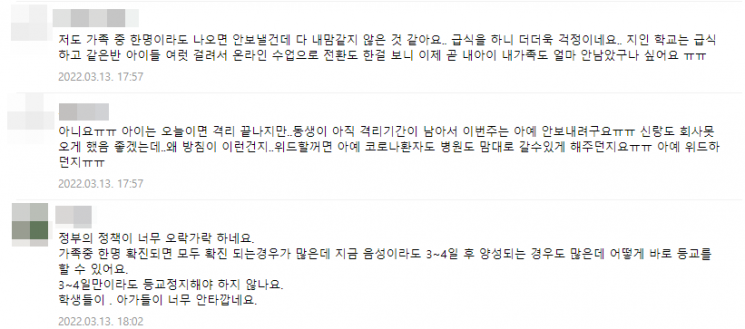 Voices expressing concerns about cluster infections within schools are continuing, especially among mom cafes. Photo by Gyeonggi Paju Mom Cafe screen capture.
Concerns have been raised mainly on mom cafes and similar platforms regarding these guidelines. Since diagnostic testing for passive monitoring students is recommended but not mandatory, there are worries about further spread of infections.
A member of a mom cafe in Cheonan, Chungnam, said, "A family member tested positive. Shocked, I had my child take a PCR test, which came back negative. According to school policy, the child can attend school in this case, but sending them feels like it would only trouble their friends," adding, "If I don't send them, they might struggle to adapt as they just started elementary school. The homeroom teacher says it's okay to send them if negative, but I'm really worried."
Other parents also expressed their concerns through mom cafes, saying, "I feel anxious that the number of confirmed cases will increase because of this policy," "If even one cohabitant tests positive, it's better not to send children to school. If a family member is confirmed, there's a high chance the child will be too," "If a family member is confirmed, at least a week of self-quarantine together is necessary," and "Self-test kits are not reliable. Many confirmed cases around me had negative results on self-test kits."
In response to this situation, the Korea Federation of Teachers' Associations (KFTA) recently sent an official letter to the Ministry of Education urging a temporary suspension of the passive monitoring policy for unvaccinated students.
In the letter, KFTA pointed out, "Facilitating attendance of students with a high likelihood of infection can worsen the infection situation and make even minimal academic operations difficult."
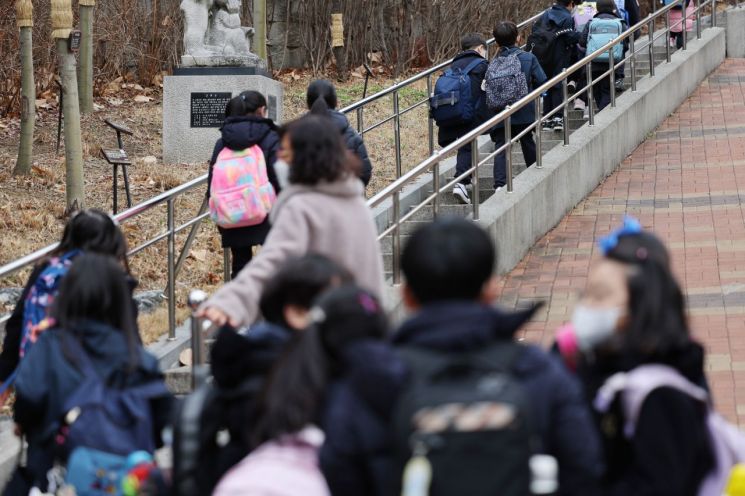 On the morning of the 14th, students are arriving at an elementary school in Seoul. The photo is unrelated to specific expressions in the article. [Image source=Yonhap News]
Meanwhile, the number of confirmed cases among students and staff continues to rise, increasing concerns further.
According to the Central Disaster and Safety Countermeasures Headquarters, last week the average daily number of locally transmitted confirmed cases was 284,730, which is 1.4 times the 197,247 cases of the previous week. Notably, the proportion of confirmed pediatric and adolescent cases aged 18 and under, many of whom are not eligible for vaccination, rose by 0.6 percentage points to 25.5% from 24.9% the previous week.
Meanwhile, as the spread continues, the government announced plans to begin COVID-19 vaccinations for children aged 5 to 11 starting at the end of this month.
Jeon Hae-cheol, the 2nd Deputy Head of the Central Disaster and Safety Countermeasures Headquarters (Minister of the Ministry of the Interior and Safety), said in a Central Disaster and Safety Countermeasures Headquarters meeting, "The government will begin vaccinating children aged 5 to 11, who were previously excluded from vaccination, through about 1,200 designated entrusted medical institutions nationwide starting at the end of March." Pre-registration will begin on the 24th of this month, and vaccinations will start on the 31st.
He added, "This decision was made considering that the safety and effectiveness of the vaccine have been sufficiently verified in overseas countries that started vaccinations earlier than us, and that the proportion of confirmed cases among children aged 11 and under exceeds 15% of total cases."
© The Asia Business Daily(www.asiae.co.kr). All rights reserved.
![Clutching a Stolen Dior Bag, Saying "I Hate Being Poor but Real"... The Grotesque Con of a "Human Knockoff" [Slate]](https://cwcontent.asiae.co.kr/asiaresize/183/2026021902243444107_1771435474.jpg)

















