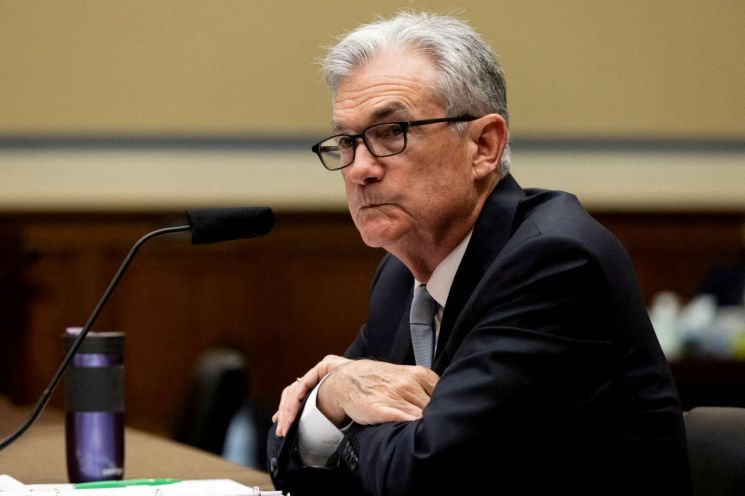
[Asia Economy New York=Special Correspondent Joeslgina] "The Federal Reserve (Fed) has no choice."
The U.S. central bank, the Fed, is almost certain to implement a 0.25 percentage point interest rate hike at the Federal Open Market Committee (FOMC) meeting scheduled for the 15th-16th (local time), as originally announced. The market consensus is that there is no choice given that U.S. inflation, at its highest level in 40 years, is expected to worsen further due to the Ukraine invasion crisis.
According to the Chicago Mercantile Exchange (CME) FedWatch on the 13th, the federal funds (FF) rate futures market reflects a 94.9% probability of a rate hike this month. Considering that Fed Chair Jerome Powell has unusually mentioned the figure of 0.25 percentage points in advance, it is expected that there will be no surprises. This would be the first rate hike since the COVID-19 pandemic.
The key issue is the Fed’s next move. The reason the market is paying more attention to Chair Powell’s remarks is to gain hints about additional rate hikes. The FOMC will also release its quarterly updated economic projections. Interest focuses include changes in growth forecasts, shifts in the rate hike path on the dot plot, and any changes in long-term rates on the dot plot.
Some analysts suggest that the Fed’s tightening pace could accelerate due to increased inflationary pressure from Russia’s invasion of Ukraine. Recently, futures markets have signaled that the benchmark interest rate could rise to 1.65% within the year. This implies at least six rate hikes of 0.25 percentage points each. Bloomberg assessed, "If the Fed maintains a gradual monetary tightening now, it may need to increase the intensity of tightening later."
However, if the Ukraine crisis prolongs more than expected, the Fed cannot ignore the possibility of a recession. Especially, with Western sanctions isolating Russia, there are growing views that Russia may soon declare a debt default, which has become a major variable. Kristalina Georgieva, Managing Director of the International Monetary Fund (IMF), said in an interview with CBS on the same day, "I no longer think that a Russian default is an improbable event."
Tim Durb of SGH Macro Advisors predicted, "The Fed will take hawkish measures to respond to inflation," but also "will signal an intention to increase flexibility in monetary policy thereafter." It is expected that the FOMC this month will also provide more detailed plans for reducing the Fed’s balance sheet, which expanded to about $9 trillion during the pandemic.
Meanwhile, there are forecasts that the U.S. Consumer Price Index (CPI) could record double-digit increases this year due to the impact of Russia’s invasion of Ukraine. Mohamed El-Erian, Chief Economic Advisor at Allianz, appeared on CBS and said, "Russian President Vladimir Putin’s war is causing disruptions to commodity prices, supply chains, and logistics, which could push U.S. inflation close to or above 10%."
© The Asia Business Daily(www.asiae.co.kr). All rights reserved.
![Clutching a Stolen Dior Bag, Saying "I Hate Being Poor but Real"... The Grotesque Con of a "Human Knockoff" [Slate]](https://cwcontent.asiae.co.kr/asiaresize/183/2026021902243444107_1771435474.jpg)















