Received Demographic Data of Early Voting from the Election Commission, Conducted Extensive Adjustments to Understand Public Opinion
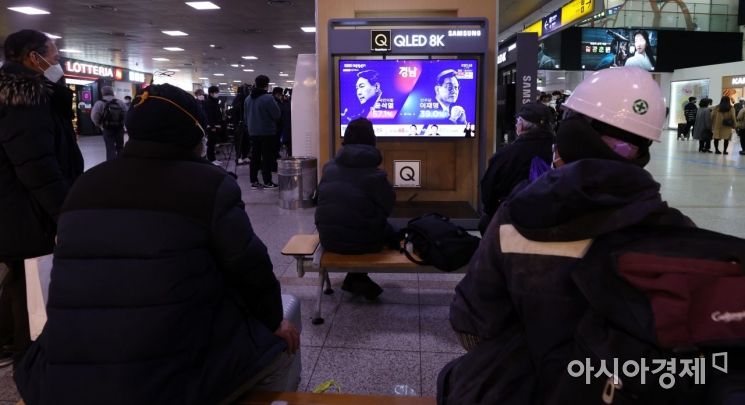 On the 9th, the day of the 20th presidential election, citizens are watching the exit poll results in the waiting room of Seoul Station. Photo by Hyunmin Kim kimhyun81@
[Asia Economy Reporter Naju-seok] The exit polls conducted by the three major broadcasters in this presidential election attracted attention for their accurate predictions. They forecasted the vote margin between the first and second place candidates to be 0.6 percentage points, while the actual margin was 0.7 percentage points.
Despite the record-high early voting rate, the exit polls conducted among those who had voted were precisely accurate, largely due to extensive adjustment processes.
Exit polls are conducted by sampling every fifth voter at designated polling stations on election day. The three broadcasters, together with polling agencies such as Korea Research, Korea Research International, and Ipsos, conducted the polls from 6 a.m. to 6 p.m. at 330 polling stations over 12 hours, surveying 73,297 people.
However, this presidential election faced a major variable with the unprecedented early voting. A record 36.9% of eligible voters participated in early voting over two days, April 4-5, rather than on election day, leading to criticism that exit polls had fundamental limitations.
While candidate Lee showed strength in early voting, many forecasts predicted that candidate Yoon Seok-yeol of the People Power Party would see a significant increase in vote share in the main election, considering regional differences.
The reason the vote share predictions were accurate despite these differences was the adjustment process. A polling official explained, "We conducted extensive surveys on early voters and then applied weighting based on information such as age and gender of early voters provided by the National Election Commission to accurately gauge early voting preferences."
Although the accuracy of exit polls was confirmed in this election, they have frequently missed the mark in general and local elections. This is because as polling data becomes more segmented, the margin of error increases. The official added, "In local elections, the larger sample sizes and greater number of candidates make exit polling even more challenging."
© The Asia Business Daily(www.asiae.co.kr). All rights reserved.
![Clutching a Stolen Dior Bag, Saying "I Hate Being Poor but Real"... The Grotesque Con of a "Human Knockoff" [Slate]](https://cwcontent.asiae.co.kr/asiaresize/183/2026021902243444107_1771435474.jpg)















