Surge in Oil and Commodity Prices... Sharp Inflation Rise and Current Account Deficit Worsening
Exports Also in Red Due to Slowing Growth in Largest Exporter China... "Government Role Crucial to Curb Malignant Inflation"
[Asia Economy Sejong=Reporters Kwon Haeyoung and Moon Jewon] The government's decision to lower its economic growth forecast reflects the increasingly bleak domestic and international environment surrounding our economy. Amid rising inflation concerns due to soaring prices of crude oil and other raw materials caused by the Russia-Ukraine conflict and the rising won-dollar exchange rate, the economic growth of China, our largest export market, is also slowing down. Consequently, some analysts suggest that our economy has entered the early stage of a 'stagflation' phase (economic stagnation accompanied by rising prices).
◆ Rising oil prices and exchange rates expand 'S fear'= According to the international oil market on the 8th, West Texas Intermediate (WTI) and Brent crude oil closed at $119.40 and $122.98 respectively on the 7th (local time). Due to Russia's invasion of Ukraine and the possibility of Western energy sanctions, oil prices have surged to their highest level in 13 years. Prices of other raw materials such as natural gas, grains, and minerals are also rising rapidly.
In particular, the rise in oil prices could lead to 'increased import prices → higher producer prices → transmission to consumer prices and weakened export competitiveness,' which may cause a sharp rise in inflation and a deterioration in the current account balance in our economy. Last month, the domestic consumer price inflation rate remained in the 3% range for five consecutive months at 3.6%, but concerns are growing that it could surge to the 4% range in March when the impact of the Ukraine crisis is fully reflected. Last month, the Bank of Korea also sharply raised its inflation forecast for this year from 2.0% to 3.1%, marking the first time in about 10 years that the forecast exceeded 3%.
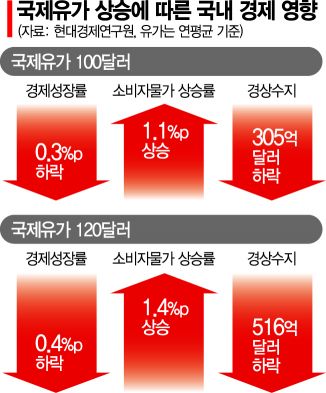
The Hyundai Research Institute estimated that if international oil prices reach $100, the economic growth rate would decrease by 0.3 percentage points, consumer prices would rise by 1.1 percentage points, and the current account balance would decline by $30.5 billion. If oil prices soar to $120, these figures are expected to be 0.4 percentage points, 1.4 percentage points, and a $51.6 billion decline, respectively.
◆ Export red light due to China's slowing growth= Although the spread of Omicron and soaring prices raise the possibility of consumption stagnation, the export outlook is even bleaker. Last month, the Bank of Korea maintained its economic growth forecast for this year at 3.0% (with domestic demand contributing 2.1% and exports 0.9%), revising the export contribution upward by 0.1 percentage points from 0.8%. Professor Lee Insil of Sogang University Graduate School of Economics pointed out, "The Bank of Korea's growth forecast for this year assumes a robust recovery in exports, but if exports face setbacks, the growth rate could decline further." This is because the Ukraine crisis has reduced global trade, and the sharp rise in the won-dollar exchange rate and import prices due to a preference for safe assets increases cost burdens, negatively affecting exports. The won-dollar exchange rate broke through 1,230 won intraday for the first time in 1 year and 9 months on this day. Although the trade balance turned positive last month after three months of deficits, it could return to a deficit this month due to rising oil prices and the won-dollar exchange rate. If the U.S. raises interest rates, there is also a high possibility of capital outflows from the domestic financial market due to the depreciation of the won.
To make matters worse, China's economic growth target, as Korea's largest export market, has been lowered to around 5.5% this year, down more than 0.5 percentage points from last year's target of over 6%. This is the first time since 1991 that China has set a target below 6%, which is a significant negative factor for our exports.
Professor Kim Youngik of Sogang University Graduate School of Economics said, "I expect this year's economic growth forecast to be about 2.5%, and next year, due to slowing growth and reduced demand, there is a possibility of 'deflation'." Professor Lee Insil added, "The possibility of stagflation is not zero. Since the monetary authorities will find it difficult to respond quickly due to the expiration of the governor's term, the government's role is ultimately the most important at this point regarding economic issues."
© The Asia Business Daily(www.asiae.co.kr). All rights reserved.
![Clutching a Stolen Dior Bag, Saying "I Hate Being Poor but Real"... The Grotesque Con of a "Human Knockoff" [Slate]](https://cwcontent.asiae.co.kr/asiaresize/183/2026021902243444107_1771435474.jpg)















