Wildfire Uncontrolled for Three Days
Forest Damage 58 Times the Size of Yeouido
This Spring's 'Worst Ever' Drought Fuels the Flames
Abnormal Climate Observed Worldwide
Experts Say "Fundamental Measures Needed to Stop Climate Change"
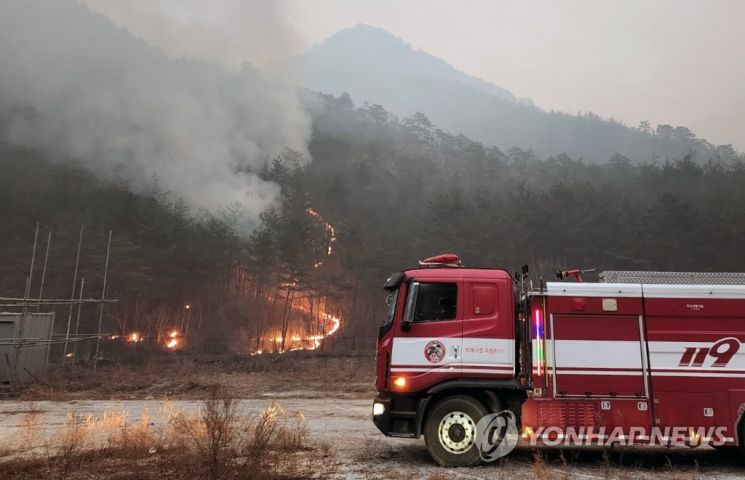 On the morning of the 7th, fire trucks are holding the defensive line in Sagok-ri, Wondeok-eup, Samcheok-si, Gangwon, in preparation for the spread of a wildfire. / Photo by Yonhap News
[Asia Economy Reporter Lim Juhyung] The wildfire that spread mainly in the Donghae coastal area of Samcheok City, Gangwon Province on the 4th has been burning for the fifth consecutive day. Thousands of firefighting personnel have been deployed to fully concentrate on extinguishing the fire, but the blaze has already consumed an enormous forest area equivalent to about one-quarter of Seoul's size and 58 times the size of Yeouido.
Typically, winter and spring, the dry seasons on the Korean Peninsula, are prone to wildfires. This is because dry vegetation and frequent strong winds make it easy for embers to spread. However, this winter on the Korean Peninsula has experienced the worst drought on record since the Korea Meteorological Administration began observations, significantly increasing the risk of disasters such as wildfires. Concerns are rising that the threat of a 'climate catastrophe' accompanied by abnormal weather is rapidly approaching Korea's doorstep.
◆The worst wildfire in 22 years... burned near nuclear power plants
According to the Central Disaster and Safety Countermeasure Headquarters (CDSCH) on the 8th, approximately 21,772 hectares (ha) of forest were damaged by the Donghae coastal wildfire as of 6 a.m. that day. This corresponds to one-third of Seoul's area and nearly 75 times the size of Yeouido.
As the wildfire spread, thousands of residents in nearby areas evacuated urgently overnight, and about 570 facilities, including houses, were destroyed by fire. There was also one cultural heritage damage case, including the 'Eodalsan Beacon Mound' in Donghae, Gangwon.
The embers spreading also threatened facilities important to the national economy. The wildfire approached near the Hanul Nuclear Power Plant in Uljin and the liquefied natural gas (LNG) production base in Samcheok.
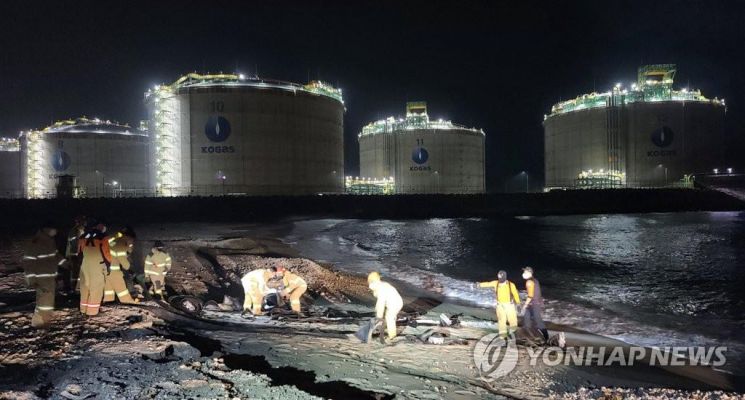 A wildfire has been confirmed to have spread near the liquefied natural gas production base in Samcheok, Gangwon. / Photo by Yonhap News
On the 6th, President Moon Jae-in personally addressed the wildfire situation, saying, "If an accident occurs at LNG facilities or nuclear power plants, the damage would be unpredictably large," and he specially urged, "Please thoroughly defend until the wildfire is completely extinguished, considering even the slightest possibility."
This wildfire is the largest scale in 22 years since the Donghae coastal wildfire in 2000, which burned 23,794 ha. Currently, the firefighting authorities have issued a nationwide Fire Mobilization Order Level 2 and are concentrating all their capabilities on extinguishing the wildfire. The Fire Mobilization Order involves receiving firefighting support from other regions when a large fire occurs and local firefighting resources are insufficient; Level 2 corresponds to 10% of all full-time firefighting personnel.
◆The worst drought and strong winds that fueled the fire
It is known that wildfires frequently occur during the transitional period from winter to spring. This is because, despite insufficient rainfall, strong winds blow frequently, making it easy for even small embers to ignite new fires.
According to data from the Korea Forest Service, an average of 474 wildfires occurred annually over the 10 years from 2011 to 2020, with 280 cases, or 59% of the total, concentrated in the spring transitional period.
However, the damage from this Donghae coastal wildfire is much more severe than in previous years. In 2020, 2,920 ha were lost to wildfires, and in the previous year (2019), 3,255 ha burned. This year, the damage has already exceeded 16,000 ha.
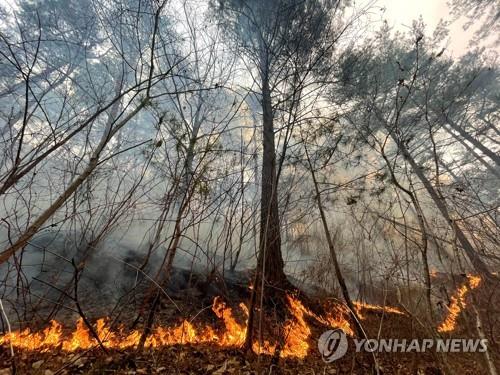 A Jangnoesam field in Sinrim-ri, Uljin-eup, Uljin-gun, Gyeongbuk, is burning. Due to unusually low rainfall compared to previous years, the vegetation has dried up, making it more vulnerable to wildfires. / Photo by Yonhap News
Why has wildfire damage suddenly become more severe than before? The direct causes of wildfires vary, including arson by visitors, cigarette butts, and fires spreading from house fires, but the reason embers spread rapidly is also related to 'climate change.'
According to data from the Korea Meteorological Administration, nationwide precipitation in January was 2.6 mm. This is only about 10% of the normal level (26.2 mm) and the lowest since records began in 1973. The combined precipitation for January and last month was 12.1 mm, the lowest in 35 years.
Due to the severe drought, the forests in Korea are currently in a 'parched' state. With dried leaves shriveled from lack of moisture and parched trees, even a tiny ember can quickly ignite a blazing fire.
Adding to this, during the past weekend (5th-6th), some parts of the country experienced typhoon-level strong winds exceeding 20-25 m/s. Conditions were optimal for the wildfire to spread rapidly.
◆Abnormal climate observations are not limited to Korea
As the worst wildfire in decades occurred, citizens reacted with shock. A 20-something office worker, Mr. A, who heard about the Donghae coastal wildfire through the news, said, "I thought such large wildfires only happened abroad; I never expected it to happen in Korea," and added, "Photos from nearby areas are being posted on online communities and social media, and it's so devastating."
Netizens living in the wildfire-affected Gangwon area actively shared photos of the outside scenery and reported the situation. They expressed concerns such as, "Even though I am somewhat far from the wildfire area, I can smell smoke in the air," and "The sky is gray even though the sun is shining. This is the first time I've experienced weather like this."
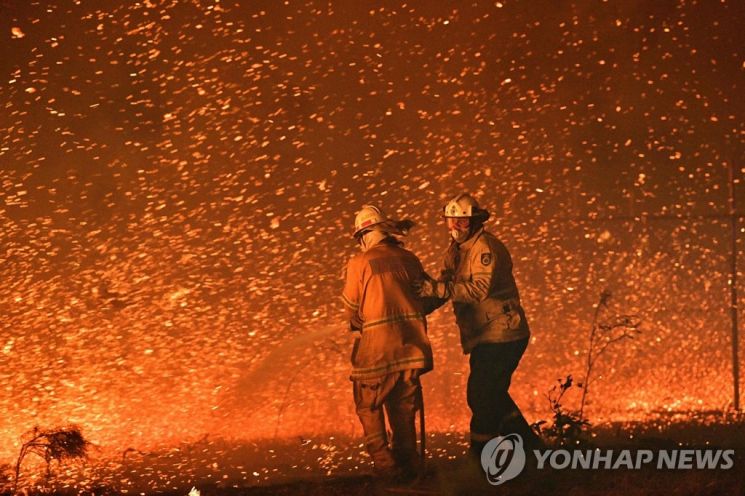 A wildfire that occurred near Nowra, New South Wales, Australia, at the end of 2019 spreads rapidly due to strong winds. Firefighters are working to stop the flames from reaching residential areas. / Photo by Yonhap News
Abnormal climate phenomena are not only observed domestically. According to the U.S. financial media Bloomberg last month, in Brazil, a Southern Hemisphere country, prolonged drought and heatwaves are expected to reduce production of rice, corn, and other crops by more than 25.2 million tons.
There have also been cases where sudden droughts led to massive fire damage like this Donghae coastal wildfire. The wildfires that started in Australia in September 2019 continued for six months until the following year, burning an area larger than the entire South Korean Peninsula.
In California, USA, the 'Dixie' wildfire that occurred in the northeast last September burned forest areas more than three times the size of Seoul.
◆International experts: "Climate change causes large wildfires"
International environmental experts have warned that wildfire damage worldwide could increase sharply in the future.
The United Nations Environment Programme (UNEP) published a report last month titled "Spreading Like Wildfire ? The Rising Threat of Extraordinary Wildfires," jointly with the Norwegian environmental organization GRID-Arendal.
In this report, UNEP predicted that large wildfires worldwide would increase by 14% by 2030, 30% by 2050, and 50% by the end of the century.
UNEP warned that "poor countries will be more vulnerable to wildfires." The periodic destruction of forests, buildings, and facilities caused by wildfires is a cost that low-income countries cannot bear. They also predicted that residents inhaling smoke mixed with ash face risks of respiratory and cardiovascular diseases.
A bigger problem is that wildfires accelerate climate change. Wildfires raise atmospheric temperatures and lower humidity, worsening droughts, and destroy tropical rainforests and forests, weakening the Earth's self-purification function. This can lead to a vicious cycle where the likelihood of large wildfires increases.
Professor Sally Archibald of the University of the Witwatersrand in South Africa, who participated in this study, told the British media The Guardian, "Massive wildfires are caused by climate change, so they cannot be completely controlled by fire prevention alone," but added, "Strengthening national fire response capabilities definitely helps minimize damage," urging enhanced firefighting resources.
Hwang Incheol, executive director of the domestic environmental group 'Climate Crisis Emergency Action,' explained, "During the period from winter to spring, rainfall and snowfall were absent, significantly reducing precipitation compared to usual years," and "We believe the expanding wildfire damage is also related to such abnormal weather."
He continued, "Although efforts to reverse abnormal weather will not show results in the short term, fundamentally, environmental policies to prevent climate change must be implemented to solve this problem," and suggested, "Until now, response policies were prepared based on existing wildfire patterns, but large wildfires will become more frequent and larger in scale, so appropriate disaster prevention measures are also needed."
Meanwhile, President Moon declared the wildfire-affected areas as special disaster zones and decided to provide national-level support. Earlier, on the 6th, President Moon had declared the severely wildfire-damaged areas of Uljin, Gyeongbuk, and Samcheok, Gangwon, as special disaster zones. This declaration expanded the designation to include Gangneung and Donghae in Gangwon.
Blue House spokesperson Park Kyung-mi said in a written briefing on the 8th, "This morning, President Moon approved the declaration of special disaster zones for Gangneung City and Donghae City," and added, "Plans are underway to provide national-level support for damage recovery and restoration."
Areas declared as special disaster zones will receive partial national funding for the restoration costs of private facilities such as houses and public facilities, depending on the scale of wildfire damage. Restoration costs for private facilities are covered at 70%, and public facilities at 50%. The government also plans to provide indirect support to affected residents, including livelihood stabilization funds for emergency relief, deferral of local tax payments, and reductions in public utility charges.
© The Asia Business Daily(www.asiae.co.kr). All rights reserved.
![Clutching a Stolen Dior Bag, Saying "I Hate Being Poor but Real"... The Grotesque Con of a "Human Knockoff" [Slate]](https://cwcontent.asiae.co.kr/asiaresize/183/2026021902243444107_1771435474.jpg)


















