Subscription Deadline for 11 Banks
Soaring Popularity Leads to Additional Burdens for Government and Banks
Ruling and Opposition Presidential Candidates Also Intensify Youth Savings Pledge Campaigns
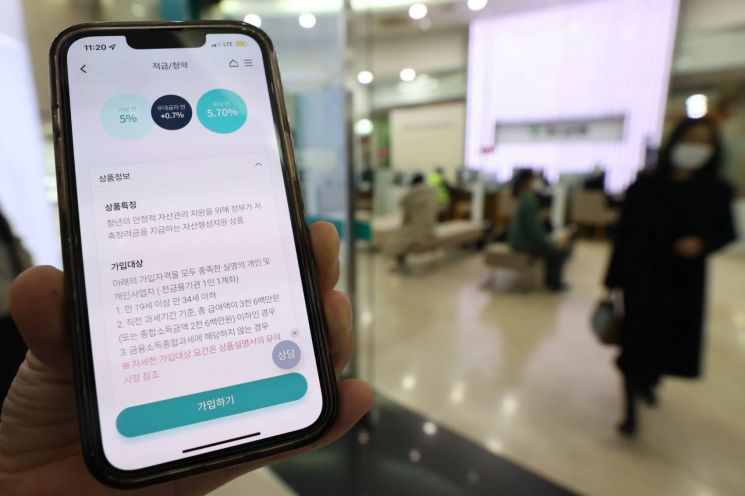
[Asia Economy Reporter Sim Nayoung] The Youth Hope Savings product, which gained great popularity among people in their 20s and 30s, saw 2.9 million sign-ups within ten days. This is about eight times the demand initially expected by the government. On the first day of the product launch, the surge in applications led the government to abandon the first-come, first-served basis and accept all applicants who met the criteria.
Since the government bears a maximum subsidy burden of 360,000 KRW per subscriber, additional fiscal input is required. Banks also face extra costs as they must offer higher interest rates than the general market rates, but in return, they have benefited from attracting young customers, which had been difficult until now.
On the 6th, through non-face-to-face (app) and face-to-face (branch) channels of 11 banks (KB Kookmin, Shinhan, Hana, Woori, NH Nonghyup, Industrial Bank, Busan, Daegu, Gwangju, Jeonbuk, and Jeju Banks), applications for the Youth Hope Savings were accepted over ten days spanning from February 21 to 25 and February 28 to March 4, resulting in approximately 2.9 million subscriptions.
The Financial Services Commission set a total budget of 45.6 billion KRW for the Youth Hope Savings product. The interest is paid by the banks, and this budget is used for the savings incentive added on top of the interest.
A Financial Services Commission official explained, "Banks provide subscribers with an annual interest rate of 5%, and if the two-year maturity is met, a savings incentive of 2% of the first-year deposit and 4% of the second-year deposit is paid from the government budget. Additionally, with exemptions from interest income tax and special rural tax, the effective interest rate can reach about 9% annually." For example, saving 500,000 KRW monthly for two years would yield 625,000 KRW in interest and 360,000 KRW in savings incentives, totaling 985,000 KRW in interest earnings.
With the stock market downturn coinciding, young people flocked to the savings product, causing the banks' applications for Youth Hope Savings to become unresponsive at times. Due to this high interest, the government announced on the second day of applications (February 22) that all applicants meeting the criteria would be accepted until March 4.
The interest rates for Youth Hope Savings are determined by a base rate of 5.0% plus up to 1.0 percentage point in preferential rates depending on the bank, resulting in a minimum of 5.0% and a maximum of 6.0%. This significantly exceeds the general deposit and savings interest rates, which hover around 3%. Although banks faced unexpected burdens from this event, securing new customers aged 19 to 34 is considered a benefit.
The Youth Hope Savings situation even drew responses from presidential candidates. "We will expand Youth Hope Savings to enable young people to save 50 million KRW over five years through preferential interest rates of about 10% and national incentives" (Lee Jae-myung, Democratic Party candidate). "We will create a Youth Leap Account to support young people in building assets of 100 million KRW" (Yoon Seok-youl, People Power Party candidate) were among the pledges made.
The Youth Leap Account sets four income brackets and provides monthly government support of 400,000 KRW (for annual income under 24 million KRW), 200,000 KRW (24 million to 36 million KRW), and 100,000 KRW (36 million to 48 million KRW) to subscribers according to income. For those earning above 48 million KRW, tax exemption benefits are included.
© The Asia Business Daily(www.asiae.co.kr). All rights reserved.
![Clutching a Stolen Dior Bag, Saying "I Hate Being Poor but Real"... The Grotesque Con of a "Human Knockoff" [Slate]](https://cwcontent.asiae.co.kr/asiaresize/183/2026021902243444107_1771435474.jpg)















