Seoul City Announces 2040 Seoul Urban Master Plan
Abolishes Apartment Floor Restrictions After 8 Years... Encourages Diverse Skyline
Complete Overhaul of Zoning System... Reorganizes 30-Minute Walking Zone Spaces
Gradual Undergrounding of Surface Railways... Revitalization Around Han River and Four Major Rivers
[Asia Economy Reporters Lim Cheol-young, Kim Hye-min] The ‘2040 Urban Master Plan’ (2040 Seoul Plan) is the highest-level concept that will serve as a guideline for Seoul’s urban planning going forward. It includes the future vision Seoul aims for 20 years from now and the plans to realize it.
Seoul City has removed floor height regulations in this ‘2040 Seoul Plan’ to enable more flexible urban planning, moving away from rigid and uniform urban planning regulations. The plan also aims to transform citizens’ daily living spaces so that within a 30-minute walk, people can enjoy jobs, leisure, green spaces, commercial facilities, and public transportation hubs. To achieve this, the existing zoning system will be completely overhauled to allow for a mixed arrangement of residential, office, and green spaces.
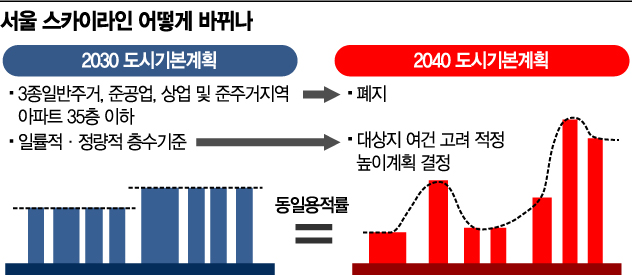
◆Abolishing the ‘35-floor rule’ after 8 years... Complete overhaul of the ‘zoning system’= The most notable part of the newly prepared ‘2040 Seoul Plan’ is the removal of the ‘35-floor rule.’ The ‘35-floor rule’ was a floor height regulation guideline included in the 2014 ‘2030 Seoul Plan’ by the late Park Won-soon, former Mayor of Seoul. Because this was included in the highest-level urban plan, newly built apartments in Seoul could not exceed 35 floors.
However, Seoul City viewed that the ‘35-floor rule’ had been uniformly applied and standardized Seoul’s skyline, so it has now removed the height standard. Following this removal, specific floor counts will be decided during Seoul City’s review process, considering the conditions of each site. Since total floor area and floor area ratio will remain the same, it is unlikely that high-rise apartments will densely fill every part of Seoul. The privatization of views and disharmony with existing landscapes were reasons why the ‘35-floor rule’ was originally established.
Lee Eun-hyung, Senior Researcher at the Korea Construction Policy Institute, said, “With the removal of floor height limits and the floor area ratio remaining unchanged, various designs that preserve views of the Han River are likely to emerge, potentially lowering building coverage ratios. This can help avoid the ‘screen-like apartment’ effect that was expected as a downside of high-density development.” A Seoul City official said, “Buildings of varying heights will be harmoniously arranged according to conditions. This will create a diverse skyline when looking across the Han River, rather than the sharply cut skyline we see now.”
The ‘zoning system,’ used since the industrial era, will also be completely overhauled in the 2040 Seoul Plan. The zoning system regulates land use by dividing it into residential, office, green spaces, etc., and controls building height and floor area ratio. However, it has been criticized for not reflecting lifestyle changes where work, leisure, and residence are mixed. Accordingly, Seoul City plans to introduce the concept of ‘Beyond Zoning,’ which increases autonomy to allow mixed arrangements of residential, office, and green spaces. Discussions with the government and academia are underway to revise the National Land Planning Act, with plans to gradually apply this citywide from 2025.
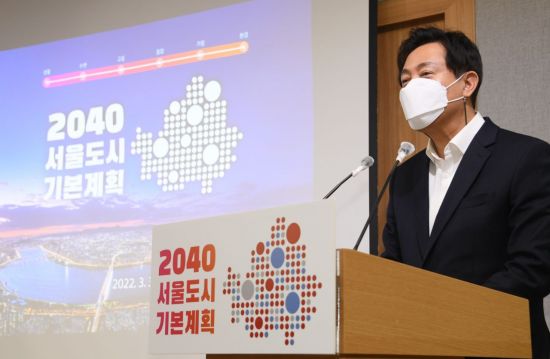 Seoul Mayor Oh Se-hoon is announcing the 2040 Urban Master Plan at Seoul City Hall on the 3rd. (Provided by Seoul City)
◆Creating mixed-use spaces within a 30-minute walk... Reorganizing urban spaces centered on 61 streams= The existing daily living spaces, mainly residential, will be completely reorganized into self-sufficient living zones where people can enjoy jobs, leisure, waterfront green spaces, commercial facilities, and transportation within a 30-minute walk. The city plans to identify lacking facilities and necessary functions in each area and flexibly assign zoning accordingly.
The reorganization to make 61 streams flowing throughout Seoul the central spaces of citizens’ lives will also be actively pursued. Small streams and tributaries will be developed as waterfront-friendly living spaces, while Anyangcheon, Jungnangcheon, Hongjecheon, and Tancheon will be designated as the four major tributaries to improve accessibility and connection to surrounding residential areas. The Han River will be positioned as a center for business, commerce, and tourism.
The existing framework of three downtowns, seven metropolitan centers, and twelve regional centers established in the ‘2030 Seoul Plan’ will be maintained, but the functions of the three downtowns (Seoul downtown, Gangnam, Yeouido) will be further strengthened. In particular, Seoul downtown, located within the Hanyang Fortress area, will be revitalized by creating four north-south axes: ▲ Gwanghwamun?City Hall ‘National Central Axis’ ▲ Insadong?Myeongdong ‘Historical Cultural Tourism Axis’ ▲ Sewoon District ‘North-South Green Axis’ ▲ DDP ‘Complex Cultural Axis.’ Additionally, a ‘Global Commercial Axis’ connecting these areas east-west will be added, forming a ‘4+1 axis’ plan.
Yeouido will be developed as a global innovation hub centered on the Han River, linked with the international business functions of the Yongsan Maintenance Depot redevelopment. Gangnam’s functions will be strengthened in connection with the three-dimensionalization of the Gyeongbu Expressway and the creation of an international exchange complex district. For efficiency, some sections will pursue three-dimensional complex development by installing decks above railway lines.
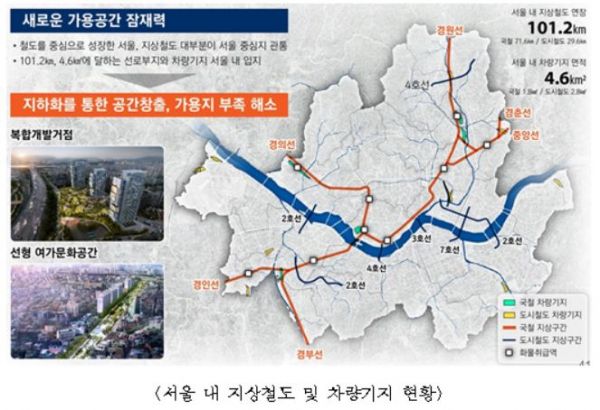
◆Submerging above-ground railways to resolve land shortages... Expanding future transportation infrastructure such as autonomous driving= Seoul City is also promoting a plan to gradually submerge above-ground railways to resolve land shortages. Currently, Seoul has 101.2 km and 4.6 km² of above-ground railway tracks and vehicle depots. For efficiency, some sections will pursue three-dimensional complex development by installing decks above railway lines.
Future transportation infrastructure such as autonomous driving and Seoul-type Urban Air Mobility (UAM) will be expanded to establish mobility hubs throughout Seoul. For autonomous driving infrastructure, the focus will be on establishing a full autonomous vehicle operation system, and for Seoul-type UAM, urban air transportation infrastructure will be prepared in line with the commercialization of aircraft in 2025.
Mayor Oh Se-hoon stated, “We will build public consensus through public hearings, consultations with the Ministry of Land, Infrastructure and Transport, gathering opinions from the City Council, and review by the Urban Planning Committee, and finalize the plan by the end of the year.”
© The Asia Business Daily(www.asiae.co.kr). All rights reserved.



















