Discussion on Gradual Abolition of High Tariffs on Major Export Items
Promotion of Korea-Mexico Supply Chain Cooperation MOU Signing
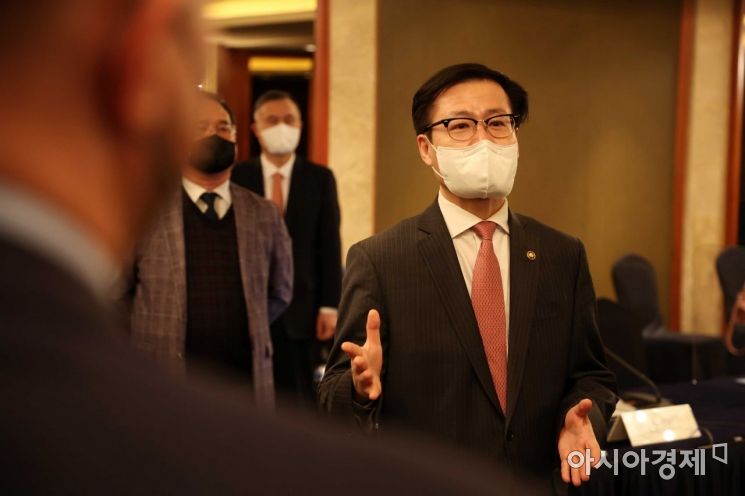 On the 24th, as concerns over potential disruptions in raw material supply due to the Ukraine crisis emerged, Yeohangu, Director General for Trade Negotiations at the Ministry of Trade, Industry and Energy, engaged in discussions with participants at the "Meeting to Strengthen Cooperation in Raw Material Supply Chains" held at Lotte Hotel in Jung-gu, Seoul. Ambassadors to Korea from nine resource-rich countries with high mutual dependence on South Korea, including Indonesia, Canada, Brazil, the United Arab Emirates (UAE), Mexico, Vietnam, Malaysia, Chile, and the Philippines, attended the meeting. Photo by Moon Honam munonam@
[Asia Economy Sejong=Reporter Dongwoo Lee] Our government is pursuing zero tariffs on major export items such as automobiles and steel through the resumption of free trade agreement (FTA) negotiations with Mexico. The plan is to bring to the negotiation table a gradual tariff elimination approach for key items, similar to the Japan-Mexico Economic Partnership Agreement (EPA) that took effect in 2005.
According to the Ministry of Trade, Industry and Energy on the 3rd, Ye Han-gu, the Chief Negotiator for Trade, held the 'Korea-Mexico Trade Ministerial Meeting' with Tatiana Clouthier, Mexico's Minister of Economy, in Mexico City on the 1st (local time), and agreed to resume the FTA negotiations between the two countries, which had been suspended since 2008, after 14 years.
The background for the resumption of FTA negotiations between the two countries is the growing global supply chain crisis due to the spread of COVID-19 and the Ukraine situation, which has led to a consensus on the need for strategic trade cooperation for expansion into Asia and Latin America.
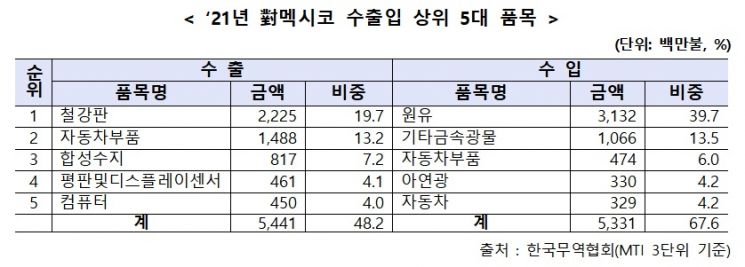
Mexico is the only country among Korea's top 10 export destinations with which Korea has not concluded an FTA. As of last year, Mexico is Korea's number one trading partner in Latin America, and Korea is Mexico's second largest trading partner in Asia. Korea's major export items to Mexico include steel plates (19.7%), auto parts (13.2%), synthetic resins (7.2%), and flat panel display sensors (4.1%). Major imports from Mexico include crude oil (39.7%), metal ores (13.5%), and auto parts (6.0%).
Our government is hopeful that this negotiation will improve Mexico's high tariff rates imposed on major export items such as automobiles (tariff rates 15-20%), steel (15%), refrigerators (10-15%), and TVs (10-15%). The Korea-Mexico EPA with neighboring Japan serves as a reference model. In Japan's case, after the EPA between the two countries took effect in 2005, gradual tariff reductions were implemented for automobile and steel exports, and tariffs were completely eliminated starting in 2015, ten years later.
A government official said, "Through the Japan-Mexico EPA, Mexico immediately applied zero tariffs on Japanese processed goods and clothing, and achieved gradual tariff elimination on automobiles and steel," adding, "If export conditions improve through this Korea-Mexico FTA negotiation, it will be possible to make up for the relative competitive disadvantage compared to Japan."
This negotiation is also expected to have a positive impact on Korea's upcoming application for accession to the Comprehensive and Progressive Agreement for Trans-Pacific Partnership (CPTPP) next month. Since Mexico is a CPTPP member and holds a major FTA network covering North America, South America, and the Asia-Pacific region, the government intends to form a mutually complementary trade structure and establish a close cooperative relationship through this negotiation. The Mexican government also supports Korea's CPTPP accession and has requested continuous sharing of Korea's preparation status.
A Korea-Mexico supply chain cooperation memorandum of understanding (MOU) is also being pursued. With the global supply chain crisis intensifying due to Russia's invasion of Ukraine, the plan is to cooperate jointly in case of emergencies. Discussions will be held through future working-level consultations on cooperation between Korea's highly competitive industries such as semiconductors, batteries, and electric vehicles, and Mexico, a global producer of key resources used in secondary batteries and semiconductor production.
In addition, Chief Negotiator Ye held a video conference with Julio Jose Prado, Ecuador's Minister of Production, Foreign Trade, Investment, and Fisheries, to promote the resumption of the Strategic Economic Cooperation Agreement (SECA), which has been suspended since the 5th round of negotiations in 2016. Ye said, "The Korea-Mexico FTA is a long-standing task for the trade authorities of both countries and is expected to serve as a game changer that will newly advance the economic relationship between the two countries at a time when supply chains have become more important than ever."
© The Asia Business Daily(www.asiae.co.kr). All rights reserved.
![Clutching a Stolen Dior Bag, Saying "I Hate Being Poor but Real"... The Grotesque Con of a "Human Knockoff" [Slate]](https://cwcontent.asiae.co.kr/asiaresize/183/2026021902243444107_1771435474.jpg)

















