Professor Cho Seung-woo of Yonsei University Awarded March Scientist of the Month Award
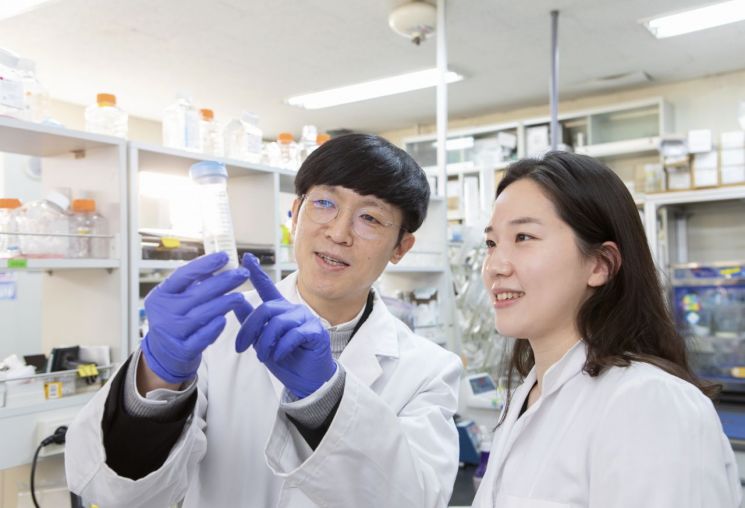
[Asia Economy Reporter Kim Bong-su] Research on artificial brains in South Korea has advanced to the level of cultivating brains comparable to newborns, surpassing the previous fetal stage.
The Ministry of Science and ICT and the National Research Foundation of Korea announced on the 28th that Professor Cho Seung-woo of Yonsei University's Department of Biotechnology has been selected as the recipient of the March Science and Technology Person of the Month Award.
Professor Cho has made significant contributions by implementing artificial brains based on stem cells and tissue engineering, and developing an organ-on-a-chip that mimics the blood-brain barrier, which protects the brain from external substances, thereby broadening the horizon of research on intractable brain diseases. The 'artificial brain' is an in vitro model created by culturing or reconstructing stem cells for brain research, but due to limitations in the culturing system, previous studies have remained at the developmental stage of fetal brains.
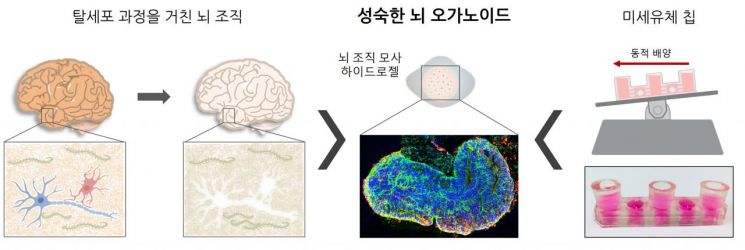
Professor Cho developed a three-dimensional culturing matrix similar to the brain tissue environment and a core chip capable of smoothly supplying oxygen and nutrients to the center of the artificial brain, achieving the production of experimental artificial brains at the newborn brain level that are structurally more mature and have enhanced neural functions compared to existing methods. He also succeeded in producing an organ-on-a-chip that mimics the blood-brain barrier, which selectively allows external substances and pathogens to pass through to protect the brain. Organ-on-a-chip devices that simulate the microenvironment of organs can induce biological responses similar to those in vivo, making them effective for new drug development.
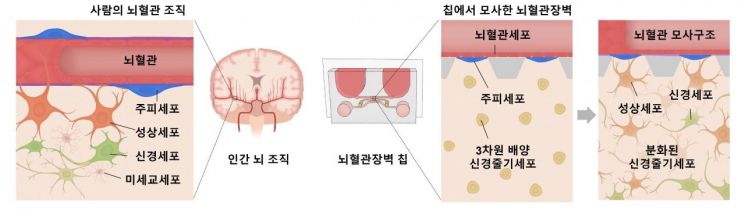
Until now, the blood-brain barrier has been difficult to replicate in organ-on-a-chip devices due to its complex structure and cellular components and the challenge of implementing its permeable membrane functions. Professor Cho's team implemented a blood-brain barrier organ-on-a-chip between brain vascular cells and neural stem cells, and conducted infection experiments with pathogenic fungi that cause brain inflammation, successfully elucidating the mechanism of fungal brain invasion and related gene regulation.
These achievements in artificial brain development by Professor Cho were published as cover papers in 'Nature Communications' in August last year, and the blood-brain barrier chip production results were published as a cover paper in 'Nature Biomedical Engineering.'
Professor Cho stated, "It is meaningful that we produced an artificial brain with enhanced neural functions by integrating stem cell and tissue engineering technologies compared to existing methods," adding, "I hope this will be used as an in vitro model to elucidate the mechanisms of intractable neurodegenerative diseases such as dementia and Parkinson's disease and to discover treatments in the future."
© The Asia Business Daily(www.asiae.co.kr). All rights reserved.
![Clutching a Stolen Dior Bag, Saying "I Hate Being Poor but Real"... The Grotesque Con of a "Human Knockoff" [Slate]](https://cwcontent.asiae.co.kr/asiaresize/183/2026021902243444107_1771435474.jpg)

















