Number of Employees at KOSPI Listed Companies Decreased by 5,000 in 2 Years
While KOSDAQ Listed Companies Increased by 4,000 in the Same Period
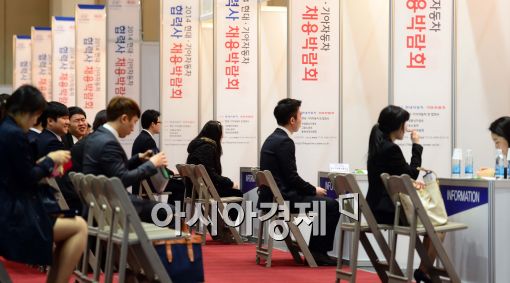
[Asia Economy Reporter Kim Jin-ho] An analysis has revealed that job polarization by industry deepened over the past two years during the COVID-19 pandemic. In particular, the employment impact on KOSPI-listed companies was found to be greater than that on KOSDAQ-listed companies.
The Federation of Korean Industries (FKI) announced on the 1st that it reached this conclusion after comparing the number of employees of KOSPI and KOSDAQ listed companies as of the third quarter of 2019 and 2021.
According to the FKI, the number of employees at KOSPI-listed companies was 1,057,000 as of the third quarter of 2021, which is 5,000 fewer than the 1,062,000 recorded in the third quarter of 2019 before the outbreak of COVID-19. On the other hand, the number of employees at KOSDAQ-listed companies increased by 4,000, from 245,000 in the third quarter of 2019 to 249,000 in the third quarter of 2021.
The FKI analyzed, "While KOSPI-listed companies, which are heavily concentrated in traditional manufacturing and wholesale and retail industries, were somewhat affected by the economic shock caused by COVID-19, KOSDAQ-listed companies, which include many in new industries and new technologies such as software development and supply, electronic components, and pharmaceutical manufacturing, appear to have benefited relatively from the acceleration of the 4th Industrial Revolution due to COVID-19."
Looking at the increase in the number of employees by industry among listed companies during the period, telecommunications and broadcasting equipment manufacturing saw the largest increase with 8,174 employees (a 7.1% increase). Software development and supply increased by 2,457 employees (13.1%), ranking second. Primary battery and accumulator manufacturing followed with an increase of 2,367 employees (15.0%).
The surge in demand for non-face-to-face industries and the acceleration of digital transformation due to the spread of COVID-19 are analyzed to have significantly increased jobs in broadcasting, telecommunications equipment, battery, and semiconductor manufacturing industries.
Conversely, the industry with the largest decrease in the number of employees during the same period was general retail, which declined by 5,759 employees (-8.6%). This was followed by motion picture and video production and distribution (3,731 employees, -45.4%) and air passenger transportation (2,305 employees, -6.1%).
Accordingly, the FKI suggested that active support for industries affected by COVID-19 is necessary to protect jobs. An FKI official emphasized, "The next government should prioritize policies that create a business-friendly environment so that companies can take the lead in revitalizing the economy."
© The Asia Business Daily(www.asiae.co.kr). All rights reserved.
![Clutching a Stolen Dior Bag, Saying "I Hate Being Poor but Real"... The Grotesque Con of a "Human Knockoff" [Slate]](https://cwcontent.asiae.co.kr/asiaresize/183/2026021902243444107_1771435474.jpg)














