AI-caused Chicken Supply Instability Continues
3.5 Million Hatching Eggs Culled
Chicken Industry on Alert Due to Supply Instability... Price Surge Feared
Poultry Association "Stability Expected After March"
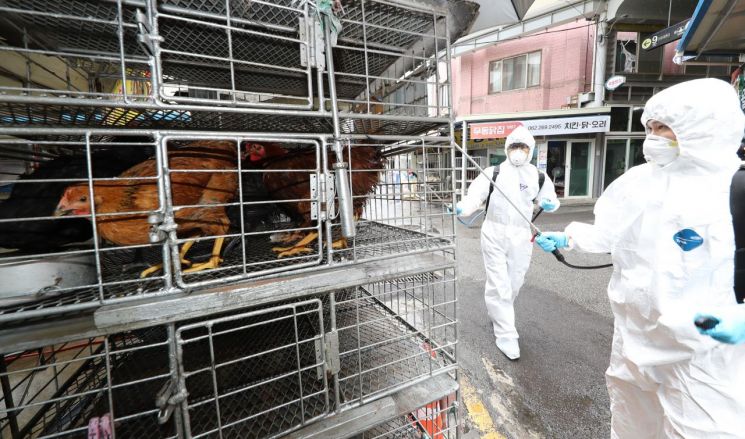
[Asia Economy Reporter Song Seung-yoon] Since the end of last year, the high pathogenic avian influenza (AI) sweeping across the country has caused instability in chicken supply, putting poultry farms on high alert. The chicken industry is also facing urgent challenges. The market fears that if this supply shortage prolongs, it could lead to price increases.
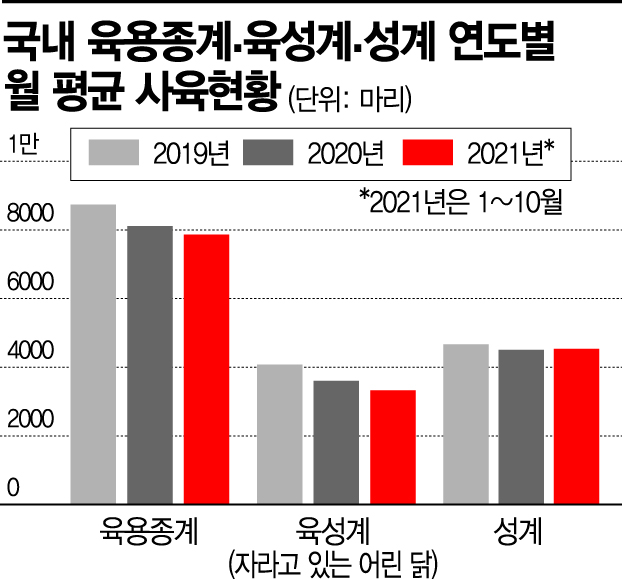
According to the Korea Poultry Association on the 28th, 44 cases of high pathogenic AI have occurred in poultry farms nationwide since November last year. In particular, in mid-this month, 3.5 million hatching eggs were culled. The chicks hatched from these eggs were supposed to be delivered to various broiler farms, but the supply for about three weeks has effectively disappeared. As a result, there is now a shortage of chickens that were supposed to enter production from March, and farms are paying premiums to 'secure chicks,' indicating unstable supply and demand.
The chicken industry is busy preparing countermeasures. ZicoBa announced on its website notice board that "due to the unstable supply of chicken drumsticks, the recipe for boneless seasoned chicken has been changed to include chicken breast." Since contracted farms have been unable to meet their usual supply volumes, chicken breast, which has relatively more available supply, is being used as a substitute ingredient until the supply instability is resolved. A ZicoBa representative said, "This situation seems likely to be prolonged, so we are preparing various measures including this one," adding, "We are running around in all directions, but since the products use actual meat, there is a limit to supply, and everyone is suffering significant impacts."
Other companies are in similar situations. Some chicken franchises are busy with their CEOs personally visiting regions to secure available supply. A bhc representative explained, "The entire industry is facing a shortage of chickens, so we are using every possible method and visiting all sites," adding, "With chicken prices recently on the rise and expected to increase further, all companies are under greater pressure."
Kyochon Chicken, which has a relatively large proportion of partial meat products compared to other companies, states that it has secured sufficient supply and is not facing major problems. Large chicken franchises have relatively stabilized supply channels, so their situation is somewhat better, but small franchises are expected to suffer more damage, and the industry is closely monitoring the situation.
If the supply instability prolongs, supply prices will inevitably rise, putting cost pressure on companies. When chicken prices, which constitute the largest cost burden, increase, companies inevitably face significant concerns. However, many companies have already raised prices, so further price increases are realistically difficult. A BBQ representative emphasized, "A similar situation occurred last year; AI ended in March, but supply normalized only by September," adding, "If the headquarters raises the delivery price in such a situation, franchisees’ margins would be almost zero, so the headquarters bears this risk."
A Korea Poultry Association official said, "Usually, each company has one or two large-scale hatcheries, but the culling of 3.5 million hatching eggs at once had a big impact," adding, "Originally, this volume was to be consumed through school meals, but due to remote classes, it could not be used, and since prices have already risen significantly, the price increase is not expected to be large for now." According to statistics from the Korea Poultry Association, as of the 23rd, broiler chickens (raised for meat production) weighing 1.6kg or more are traded at around 2,100 KRW per kg in Seoul, a 16% increase from about 1,800 KRW during the same period last month.
© The Asia Business Daily(www.asiae.co.kr). All rights reserved.
![Clutching a Stolen Dior Bag, Saying "I Hate Being Poor but Real"... The Grotesque Con of a "Human Knockoff" [Slate]](https://cwcontent.asiae.co.kr/asiaresize/183/2026021902243444107_1771435474.jpg)
















