Second Dose Vaccination Rate 86.4%, Third Dose Vaccination Rate 61.1%
143 Deaths per 1 Million Population
Adverse Reaction Reporting Rate 0.39%
[Asia Economy Reporter Ki Ha-young] It has been one year since the first COVID-19 vaccination began in South Korea on February 26 last year. During this time, about 9 out of 10 people nationwide have received at least one dose of the vaccine, and it is evaluated that the number of deaths relative to the population is being stably managed through the high vaccination rate.
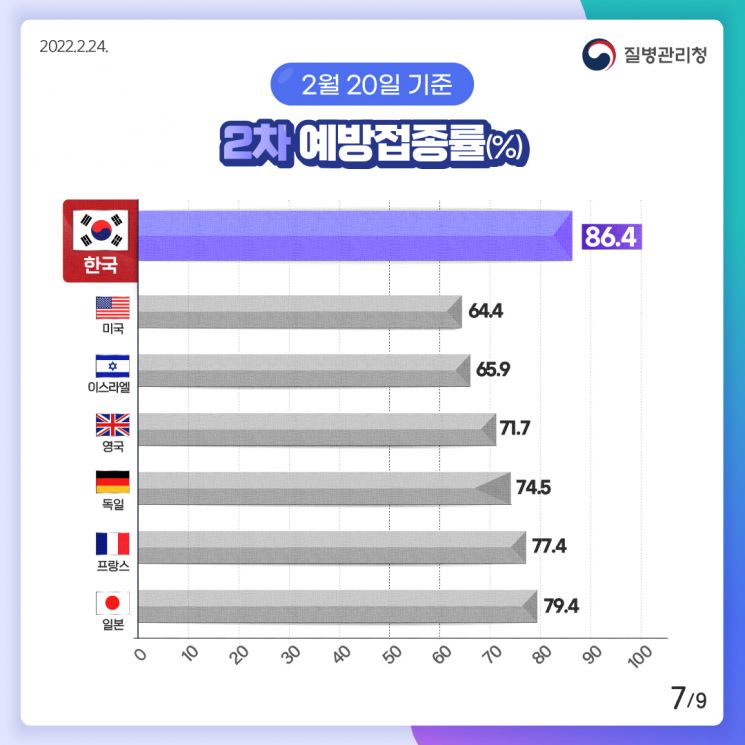
According to the Korea Disease Control and Prevention Agency (KDCA) on the 27th, as of midnight, the completion rate of vaccination (the proportion of those who have completed the primary vaccination) is 86.4% of the population (a cumulative total of 44,358,392 people). The third dose has been completed by 61.1% of the total population (a cumulative total of 31,352,874 people). The first dose vaccination rate is 87.4%.
Among the 38 member countries of the Organisation for Economic Co-operation and Development (OECD), South Korea ranks third in the second dose vaccination rate relative to the population, following Portugal (91.5%) and Chile (89.4%), and seventh in the third dose vaccination rate. It also shows higher second and third dose vaccination rates than major countries that started vaccinations earlier than South Korea, such as the United States (second dose 64.4%, third dose 27.9%), France (77.4%, 52.2%), the United Kingdom (71.7%, 55.8%), Germany (74.5%, 55.8%), Japan (79.4%, 14.4%), and Israel (65.9%, 55.8%).
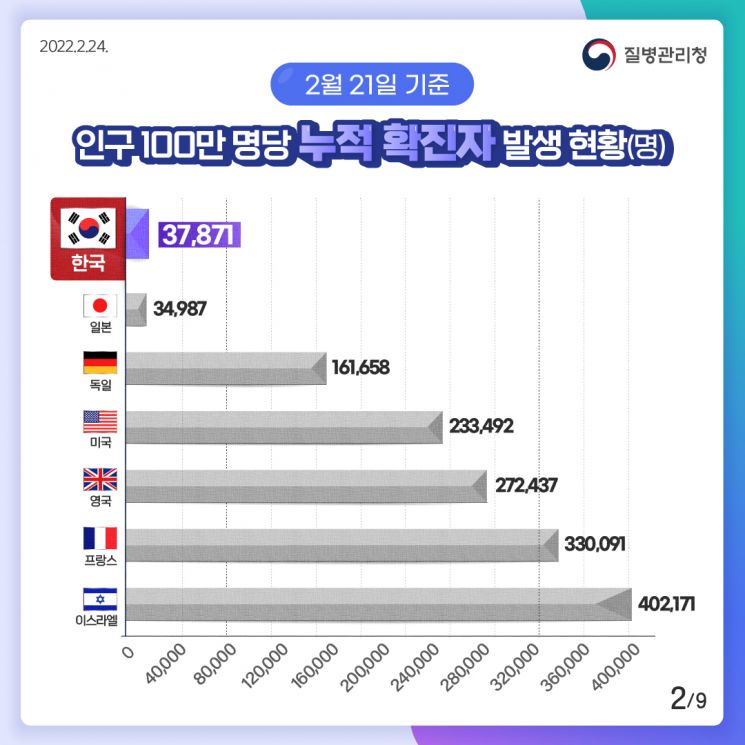
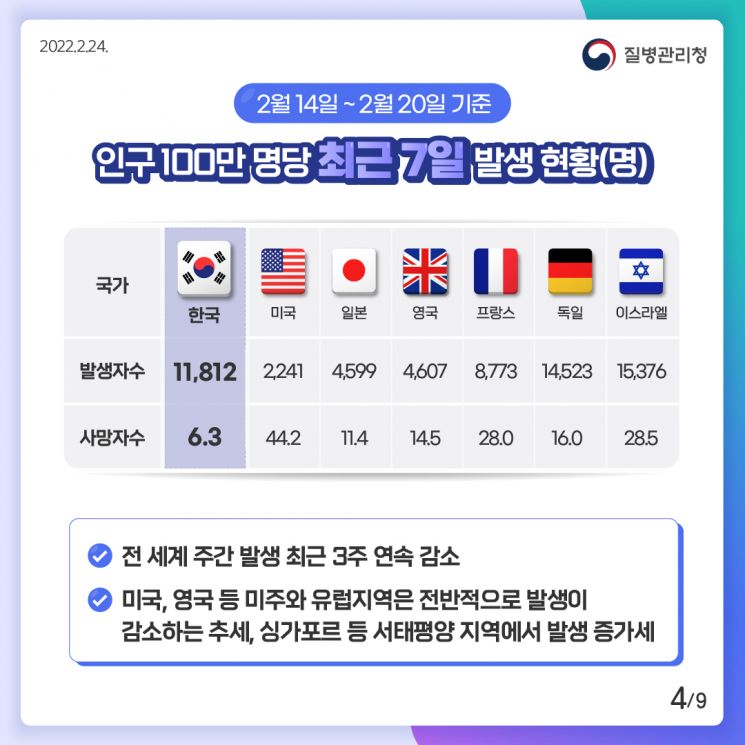
The number of deaths relative to the population is also significantly low. South Korea’s death toll per 1 million people is 143, which is the lowest among the United States (2,782), the United Kingdom (2,353), France (2,043), Germany (1,445), Israel (1,133), and Japan (172).
The vaccine supply situation is currently stable. Starting with the AstraZeneca (AZ) vaccine, the first COVID-19 vaccine approved domestically, a total of 126.78 million doses of five types of vaccines (AZ, Janssen, Pfizer, Moderna, Novavax) have been introduced into the country so far. Vaccines have been purchased or donated not only from individual pharmaceutical companies but also from the governments of the United States, Israel, Romania, and the United Kingdom. Surplus domestic vaccine doses have also been donated to Vietnam, Thailand, Iran, and the Philippines.
Nationwide, 17,342 COVID-19 vaccination delegated medical institutions are operating. Vaccination centers for large-scale inoculations started in early February last year with four regional centers (National Medical Center, Soonchunhyang University Cheonan Hospital, Chosun University Hospital, Yangsan Pusan National University Hospital). At one point, up to 282 centers were operating across cities, counties, and districts nationwide, but currently, the number has been gradually reduced to nine centers.
A total of 134,079,500 low dead space (LDS) syringes, known as "squeezing syringes," have been supplied to each vaccination institution along with vaccines, resulting in the effect of vaccinating approximately 7 million additional people.
The total number of adverse reaction reports after vaccination is 459,784, with a reporting rate of about 0.39% relative to the number of vaccinations. The Vaccine Injury Investigation Team, through a total of 50 meetings, recognized causality between vaccination and 837 cases out of 5,264 reports of severe cases, deaths, and anaphylaxis. Additionally, the Vaccine Injury Compensation Expert Committee reviewed 13,792 cases of compensation claims due to adverse reactions after COVID-19 vaccination over 19 meetings and decided to compensate 5,158 cases.
Jung Eun-kyung, Commissioner of the KDCA, said, "Achieving the vaccination goal in such a short time was thanks to the citizens who participated in vaccination for their own and their neighbors’ health, the medical staff who silently dedicated themselves to safe vaccination, local government officials, military and police personnel, volunteers, and all field workers." She added, "I also thank all those involved, including support workers who worked tirelessly day and night for vaccine production and delivery."
© The Asia Business Daily(www.asiae.co.kr). All rights reserved.
![Clutching a Stolen Dior Bag, Saying "I Hate Being Poor but Real"... The Grotesque Con of a "Human Knockoff" [Slate]](https://cwcontent.asiae.co.kr/asiaresize/183/2026021902243444107_1771435474.jpg)

















