UNIST Proposes Dye Chemical Molecule Design Strategy Mimicking Photosynthetic Electron Transfer Without Electronic Loss
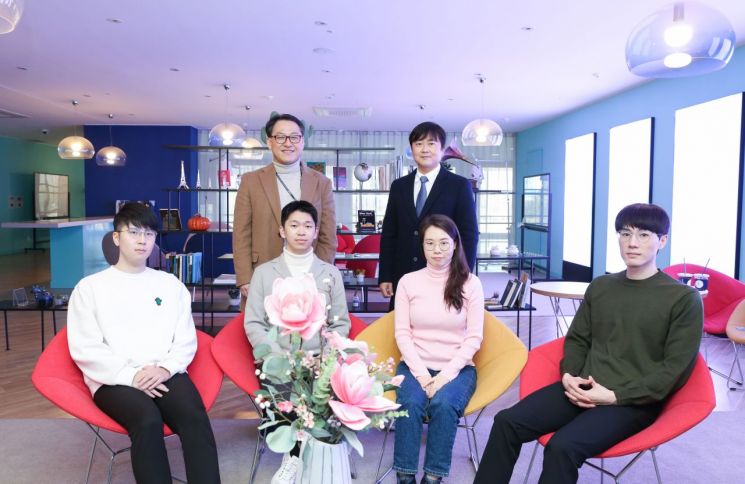 (From the top left clockwise) UNIST Professors Taehyuk Kwon, Ohhoon Kwon, Researcher Hyungyu Han, Dr. Yejin Kim, Researcher Deokho Noh, Dr. Junhyuk Park.
[Asia Economy Yeongnam Reporting Headquarters Reporter Kim Yong-woo] A technology that mimics the way plants perform photosynthesis to improve the efficiency of solar cells has been developed.
It is a new dye molecule design strategy that allows electrons generated by dyes absorbing sunlight to be transferred to the electrode without loss.
Dye-sensitized solar cells using this dye showed efficiency improvements of up to 60% compared to existing cells.
Ulsan National Institute of Science and Technology (UNIST) announced on the 27th that a team led by Professors Kwon Tae-hyuk and Kwon Oh-hoon from the Department of Chemistry developed a dye that can mimic the electron transfer method of plant photosynthesis by adding a new chemical structure called a ‘molecular unit’ to the donor-acceptor molecular structure of existing dye molecules.
This dye has the characteristic of having both strong and weak interactions (electronic coupling) between molecular units.
Strong interactions quickly transfer electrons within the molecule but have the disadvantage of rapid recombination of electrons (-) and holes (+).
The research team explained that by additionally forming weak interactions, electrons can be transferred quickly while reducing recombination losses.
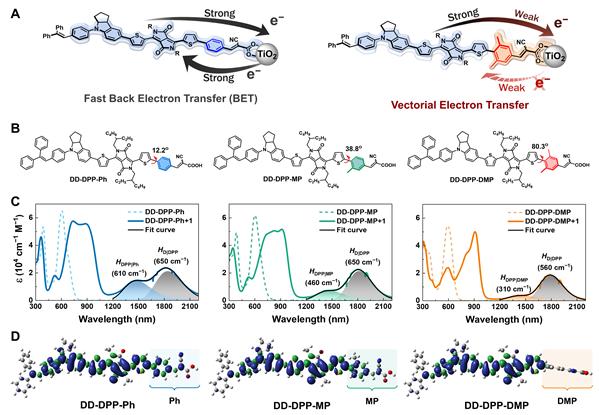
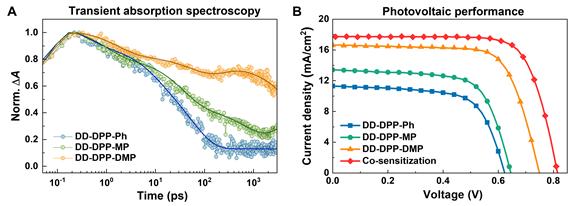
The solar cell using this dye molecule recorded an efficiency of up to 10.8%. This is more than 60% improvement compared to solar cells that do not regulate interactions within the dye molecule.
First author and chemistry researcher Noh Deok-ho said, “We developed a molecule for solar cells that mimics the electron transfer method in plant photosynthesis by forming different interactions within the molecule, leveraging the advantages of each interaction and complementing their disadvantages.”
Plant photosynthesis has the characteristic of vectorial electron transfer, transferring electrons in only one direction to prevent electrons (-) from returning and recombining with holes (+).
Because of this, electrons generated by chlorophyll absorbing light are efficiently transferred to the next photosynthesis stage without loss due to recombination.
In fact, the efficiency of electron transfer to the next stage in plant photosynthesis is known to be close to 100%.
Additionally, the research team quantified these results using transient absorption spectroscopy. By analyzing charge movement (electron and hole movement) in the solar cell over timescales from 10^-13 seconds to 10^-1 seconds, they confirmed that this dye rapidly transfers electrons while suppressing electron-hole recombination to about one-eighth of the conventional level. This is similar to the characteristic of vectorial electron transfer in plant photosynthesis.
Professor Kwon Oh-hoon, who led the absorption spectroscopy study, introduced, “This research is the result of convergent studies combining knowledge from various fields such as organic chemistry, spectroscopy, electrochemistry, and computational chemistry.”
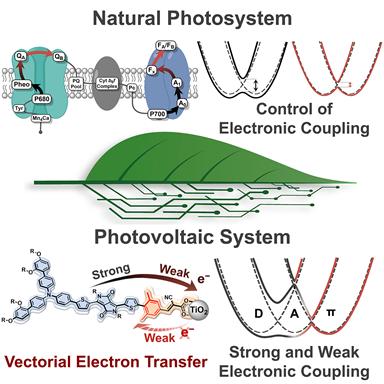 Conceptual diagram of molecular design strategy for solar cells mimicking the electron transfer function of photosynthesis.
Professor Kwon Tae-hyuk said, “The significance lies in developing a molecular design that can effectively use electrons generated by light, inspired by plant photosynthesis.”
He explained, “The molecular design strategy developed in this study has great ripple effects as it can be applied not only to solar cells but also to artificial photosynthesis, photocatalysis, and various other fields.”
This research was published online on February 16 in Chem, a sister journal of the world-renowned journal Cell.
The study was conducted jointly with Professor Shogo Mori’s team from Shinshu University in Japan. Graduate student Noh Deok-ho, Ph.D. candidate Park Jun-hyuk, Ph.D. candidate Han Hyun-gyu, and Dr. Kim Ye-jin from UNIST participated as co-first authors.
The research was supported by the National Research Foundation of Korea (NRF) under the ‘Climate Change Response Project’ and Ulsan National Institute of Science and Technology, among others.
© The Asia Business Daily(www.asiae.co.kr). All rights reserved.
![Clutching a Stolen Dior Bag, Saying "I Hate Being Poor but Real"... The Grotesque Con of a "Human Knockoff" [Slate]](https://cwcontent.asiae.co.kr/asiaresize/183/2026021902243444107_1771435474.jpg)

















