Finished consumer goods are excluded from sanctions... but US approval required for semiconductor module exports
Possibility of stricter US approval requirements and expanded regulations if full-scale conflict escalates and situation prolongs
Concerns over worsening trade deficit due to soaring energy prices
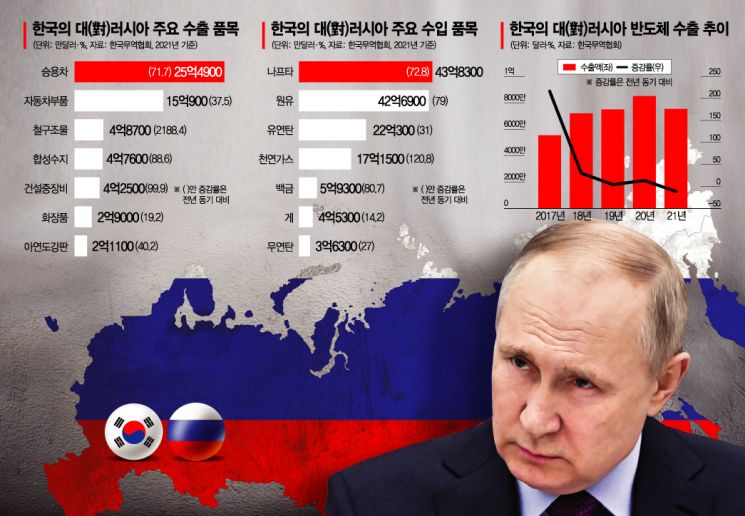
[Asia Economy Sejong=Reporters Kwon Haeyoung, Lee Junhyung, and Lee Hyeyoung] As the United States announced export control sanctions against Russia, which invaded Ukraine, a red light has been lit on South Korea's export front. The export control targets mainly cover defense, aerospace, and maritime sectors, including semiconductors, computers, communications, and equipment. There are growing concerns that domestic companies could suffer blows across the board, including semiconductors, home appliances, mobile phones, and automobiles that have been exported to Russia. This is why Hong Namki, Deputy Prime Minister and Minister of Economy and Finance, held an unscheduled emergency meeting with related ministers (a "green room meeting") at the Government Complex Seoul around 8 a.m. on the 25th to discuss countermeasures related to Russia's invasion of Ukraine.
If the military conflict between Russia and Ukraine escalates into a full-scale war and the situation prolongs, it is expected to fuel the rise in international oil prices and further worsen the trade deficit.
◆Samsung Electronics must obtain U.S. approval for semiconductor exports=According to the industry, items directly or indirectly affected by the U.S. export control measures against Russia include semiconductors, home appliances, mobile phones, and automobiles. Among these, the item that domestic companies are most sensitive about is semiconductors, which are included in the U.S. sanctions list. Semiconductors, the core components of all electronic devices, are embedded in most products that South Korea exports to Russia. The U.S. applied the "Foreign Direct Product Rule (FDPR)," which was the basis for sanctioning China's Huawei, to this Russia sanction, banning exports to Russia of products made in third countries if they use U.S. technology or software (SW). Most semiconductors produced by Korean companies rely on U.S. technology.
The government’s stance is that finished consumer goods that are not military items are excluded from the sanction list and can be exported. However, exporting semiconductor-embedded parts for assembling finished products could be problematic. A Ministry of Trade, Industry and Energy official explained, "Finished consumer goods such as home appliances, smartphones, and automobiles containing semiconductors can be exported as general consumer goods, not military goods. The issue arises when exporting semiconductors or semiconductor-embedded modules (parts) to Russia, which requires U.S. approval on a case-by-case basis." He added, "In Samsung's case, when exporting modules to local production bases, it is considered possible as a relationship between the parent company and subsidiaries, and discussions with the U.S. are ongoing."
However, if military tensions escalate, the U.S. export approval requirements for Russia could become more stringent. Industry insiders assess that if semiconductor procurement locally is difficult for more than 2-3 months, the ability to endure with inventory will be exhausted. Lee Jongho, director of the Semiconductor Joint Research Center at Seoul National University, said, "In the short term, the impact may not be significant, but a chain reaction is inevitable," and expressed concern that "if the situation prolongs, there will definitely be an impact on semiconductor-related exports."
◆Direct hit to exports and worsening trade deficit if the situation prolongs=The problem is that if the Russia-Ukraine conflict expands fully and the situation prolongs, the U.S. could significantly expand export control items to include general consumer products containing semiconductors, such as automobiles and smartphones. The U.S. is already seriously considering including automobiles containing its semiconductors in the export control list. There is also concern about a potential contraction in local consumption.
The automobile and parts industry, which accounts for over 40% of exports to Russia, is on high alert. If trade is restricted, not only will finished car exports be affected, but the operation of domestic car and parts factories running locally will inevitably face difficulties. Hyundai Motor has a car assembly plant in Russia with an annual capacity of 200,000 units, and Hyundai Mobis operates module and parts factories there. An industry official said, "The Russian finished car market has often been unstable due to external factors such as oil prices," adding, "If export restrictions prolong, local production and sales will be severely impacted."
The semiconductor industry is closely monitoring the situation as concerns grow over supply disruptions of special gases from Ukraine and Russia needed for production, along with the increasing possibility of export restrictions. The scale of semiconductor exports directly from Korea to Russia was about 90 billion won (75 million dollars) last year, which is not large, but preparations are underway for potential widespread chain impacts. The home appliance industry, which exports about 200 billion won annually to Russia, is also on alert for production disruptions at local factories and the effects of export controls. Samsung Electronics is also on high alert as exports of its Galaxy S22 series to Russia have been suspended, affecting its position as the number one smartphone brand in the local market.
Jang Sangsik, head of the Trend Analysis Office at the Korea Institute for International Trade and Commerce, said, "If sanctions at the same level as those against Huawei are imposed, exports of all items containing any U.S. technology could be blocked regardless of Korea's participation in the sanctions," adding, "The impact may vary depending on how much Korean companies, including Samsung Electronics, utilize U.S. core technologies related to semiconductors and mobile phones."
With rising military tensions, there are concerns about disruptions in the supply of energy raw materials. According to the Korea International Trade Association, the items South Korea imports most from Russia are naphtha (25.3%) and crude oil (24.6%). If naphtha and crude oil supplies from Russia become difficult, alternatives will need to be found. If oil prices continue to surge, South Korea, which heavily depends on energy imports, could face a prolonged trade deficit. The trade balance has already recorded deficits for three consecutive months: -452 million dollars in December last year, -4.89 billion dollars in January this year, and -1.679 billion dollars from the 1st to the 20th of this month.
Meanwhile, as an emergency response, the government plans to inject up to 2 trillion won in emergency funds targeting domestic import-export companies. Ko Seungbeom, chairman of the Financial Services Commission, said, "We will closely examine the extent of damage and financial conditions of import-export companies," adding, "If necessary, we will activate emergency financial support programs to actively supply the necessary funds to related companies."
© The Asia Business Daily(www.asiae.co.kr). All rights reserved.
![Clutching a Stolen Dior Bag, Saying "I Hate Being Poor but Real"... The Grotesque Con of a "Human Knockoff" [Slate]](https://cwcontent.asiae.co.kr/asiaresize/183/2026021902243444107_1771435474.jpg)
















