KAIST Develops Low-Power, Semi-Permanent Recognition System Mimicking Human Tactile Cells
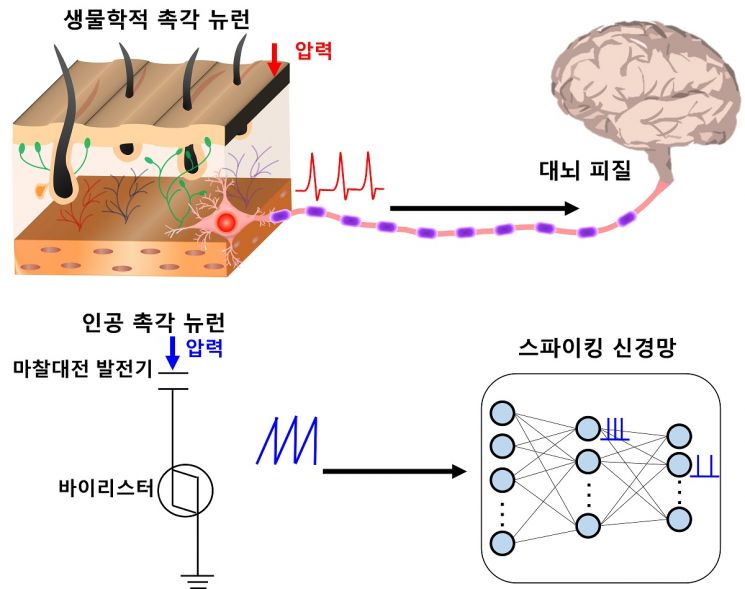 Conceptual diagram of a neuromorphic module mimicking human tactile neurons. Image courtesy of KAIST.
[Asia Economy Reporter Kim Bong-su] A domestic research team has developed an artificial intelligence tactile recognition system that mimics human tactile cells. With low power consumption due to self-generation, it is expected to be utilized in the Internet of Things (IoT) field, robotics, prosthetics, artificial tentacles, and medical devices.
The Korea Advanced Institute of Science and Technology (KAIST) announced on the 24th that a research team led by Professor Yang-Kyu Choi of the Department of Electrical Engineering and Computer Science succeeded in developing a "neuromorphic module mimicking human tactile neurons." The developed module can recognize pressure and output spike signals like human tactile neurons, enabling the implementation of a neuromorphic tactile recognition system.
AI-based tactile recognition systems can recognize objects, patterns, or textures with high accuracy using artificial neural networks on signals received from sensor arrays, making them useful across various fields. However, most of these systems rely on software requiring von Neumann computers, inevitably consuming high power, making them difficult to apply to mobile or IoT devices.
Biological tactile recognition systems transmit sensory information in spike form, allowing the discrimination of objects, patterns, or textures with low power consumption. Therefore, neuromorphic tactile recognition systems mimicking biological tactile recognition systems are gaining attention to build low-power tactile recognition systems. Components that convert external pressure signals into spike-form electrical signals like human tactile neurons are necessary. However, conventional pressure sensors cannot perform this function.
The research team developed a neuromorphic module capable of recognizing pressure and outputting spike signals by using a triboelectric nanogenerator (TENG) and a biristor device. It is self-powered and can detect low pressures at the level of 3 kilopascals (kPa), which is the pressure felt by the skin when touching an object with a finger.
Based on the fabricated neuromorphic module, the research team built a low-power respiration monitoring system. When the respiration monitoring sensor is installed around the nose, it detects inhalation and exhalation, and when installed around the abdomen, it can separately detect abdominal breathing. Therefore, if apnea occurs during sleep, it can detect it and send an alarm to prevent progression to a serious condition.
Jun-gyu Han, a doctoral candidate leading the research, explained, "The neuromorphic sensor module developed this time is a semi-permanent self-powered type that produces the energy required to drive the sensor by itself, and it is expected to be usefully applied in the IoT field, robotics, prosthetics, artificial tentacles, and medical devices." He added, "This will be a stepping stone to advancing the era of 'In-Sensor Computing.'"
This research was published in the January online edition of the international journal Advanced Science and was selected as a Back Cover paper.
© The Asia Business Daily(www.asiae.co.kr). All rights reserved.
![Clutching a Stolen Dior Bag, Saying "I Hate Being Poor but Real"... The Grotesque Con of a "Human Knockoff" [Slate]](https://cwcontent.asiae.co.kr/asiaresize/183/2026021902243444107_1771435474.jpg)















