Genie Music Creates AI-Generated Children's Songs, Lullabies, and ASMR
Gaining Popularity and Increasing Users
Apple, Sony, and Other Foreign Companies Enter AI Music Market
Copyright Issues Remain Challenging... Only Human-Created Works Recognized Domestically
[Asia Economy Reporter Kang Nahum] As the era of the metaverse and one-person media arrives, "AI (Artificial Intelligence)-created music" is gaining attention. Although the market demand is high due to the ability to produce music quickly at low cost, the current copyright law does not recognize AI copyrights, making it a global challenge.
◆ AI Penetrating the Music Industry = According to the industry on the 24th, the number of users of AI-composed soundtracks provided through Genie Music’s ‘StoryG’ is rapidly increasing. AI creates individually customized white noise content considering the user’s time, place, and situation, offering themes such as ‘sleep,’ ‘study-focused mode,’ ‘meditation,’ and ‘relaxation.’ Through word of mouth, the number of users has increased by 191% compared to its launch in November last year.
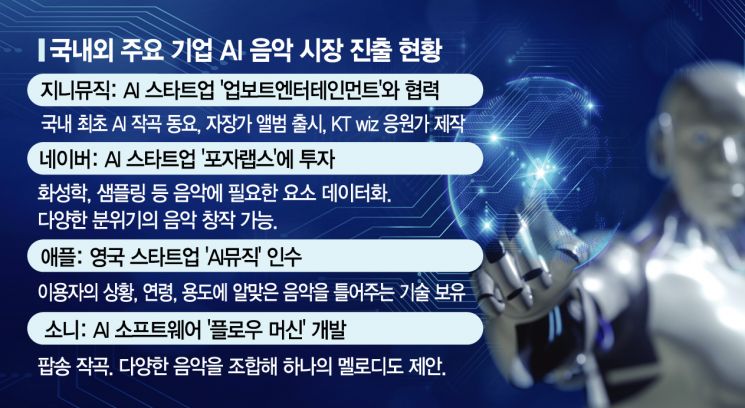
AI composers are also active in children’s songs, lullabies, cheer songs, and background music for entertainment programs. Genie Music released albums of children’s songs and lullabies in 2020 in collaboration with the AI startup ‘Upvote Entertainment.’ Recently, AI also composed background music for the popular entertainment program ‘Gangcheolbudae’ (Steel Troops).
Naver is also actively investing in the AI music market, including investing in the AI startup ‘Poza Labs.’ Poza Labs digitizes all elements necessary for music such as harmony and sampling to create high-quality music with various atmospheres. It automates the entire process in detail, including sound source post-processing, mixing, and mastering systems, producing natural yet grand AI sounds. They are discussing collaborations with content platforms and entertainment companies including Naver and are preparing a stock music web service for individual creators.
◆ Apple and Sony Also Provide Customized Music Through AI = Earlier this month, Apple acquired the UK startup ‘AI Music.’ AI Music possesses music creation technology suitable for situations, ages, and purposes. For game music, AI composes autonomously according to the game’s atmosphere, genre, and age group. For people listening to music while exercising, different music can be provided depending on the exercise intensity.
Sony developed the composition tool ‘Flow Machines.’ Its purpose is to expand the creativity of music creators rather than full-fledged music composition. It has learned over 13,000 songs enabling pop song composition and combines music according to the creator’s intent.
Additionally, ‘Aiva Technologies’ provides music composed by its self-developed AI ‘AIVA’ as background music for various media such as movies, games, and advertisements.
◆ Copyright Recognition Remains a Challenge = Although AI, with its outstanding productivity, is emerging as a new alternative in the music industry, copyright issues remain unresolved.
The U.S. Copyright Office recently rejected AI scientist Stephen Thaler’s request to recognize the algorithm called ‘Creativity Machine’ as a copyright holder, ruling that AI does not qualify as a copyright holder. The U.S. Copyright Office stated that the “link between the human mind and creative expression” is a core element of a work, which AI lacks, thus denying the claim.
In Europe, after passing the ‘Robot Citizenship Recommendation’ in 2017, legal status has been imposed on ‘electronic humans,’ viewing AI as independent decision-making entities. Follow-up work is underway to legislate copyright protection for AI-created works.
In South Korea, current copyright law recognizes copyrights only for ‘human creations.’ However, as AI music and others rapidly spread, the Ministry of Culture, Sports and Tourism is pushing for amendments to the copyright law. Discussions are ongoing regarding the legal protection and ownership of intellectual property created using AI, as well as intellectual property rights issues for creations made or used in virtual environments such as the metaverse.
© The Asia Business Daily(www.asiae.co.kr). All rights reserved.
![Clutching a Stolen Dior Bag, Saying "I Hate Being Poor but Real"... The Grotesque Con of a "Human Knockoff" [Slate]](https://cwcontent.asiae.co.kr/asiaresize/183/2026021902243444107_1771435474.jpg)
















