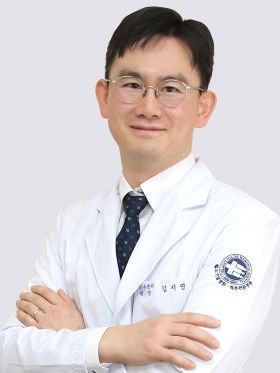
 Kim Ji-yeon, Director of Anyang Wills Memorial Hospital.
[Asia Economy Reporter Lee Gwan-joo] A study has been published showing that severely protruded lumbar disc herniation can be effectively removed through transforaminal endoscopic spine surgery.
The research team led by Director Kim Ji-yeon (neurosurgery specialist) at Anyang Wills Memorial Hospital, a spine-specialized hospital designated by the Ministry of Health and Welfare, announced on the 23rd that they proved positive results of this surgical method by tracking and observing 32 surgical patients over two years using an advanced transforaminal endoscopic spine surgery technique.
A severely protruded lumbar disc herniation in the spinal canal, which is the passageway for nerves, compresses the nerves causing lower limb paralysis and nerve deficits. Therefore, surgery approached from the back of the waist can cause additional nerve damage due to traction.
In the past, spinal screw fixation surgery was sometimes performed to treat severely protruded lumbar disc herniation, but this paper demonstrated that transforaminal endoscopic spine surgery can reduce joint damage compared to conventional surgery.
Transforaminal endoscopic spine surgery allows safe and effective removal of severely protruded lumbar disc herniation caused by disc herniation without additional nerve traction, even when approached from the back of the waist. It is also a surgical technique that enables treatment without damage to joints, ligaments, or muscles.
Director Kim Ji-yeon explained, “Endoscopic spine surgery is very diverse, and the most appropriate endoscopic treatment should be determined according to the lesion. Especially important is to proceed while minimizing the risk of nerve damage. The method of removing giant lumbar discs through minimally invasive transforaminal endoscopic surgery is a good surgical technique that overcomes the limitations of conventional screw fixation surgery, which carries the risk of facet joint damage.”
This paper was published in the recent issue of the SCIE-level international academic journal Journal of Neurological Surgery Part A: Central European Neurosurgery, and was conducted in collaboration with medical staff from Gangnam Nanuri Hospital.
© The Asia Business Daily(www.asiae.co.kr). All rights reserved.
![Clutching a Stolen Dior Bag, Saying "I Hate Being Poor but Real"... The Grotesque Con of a "Human Knockoff" [Slate]](https://cwcontent.asiae.co.kr/asiaresize/183/2026021902243444107_1771435474.jpg)














