Sharp Decline in Working-Age Population Due to Low Birthrate
Current Retirement Age: Men 60, Women 55; Gradual Extension Until 2025
[Asia Economy Reporter Kim Hyun-jung] Facing the issues of low birthrate and aging population, China is pushing for a retirement age extension for the first time in over 70 years. This move is interpreted as an effort to find solutions amid slowing economic growth before the country fully enters the ranks of developed nations.
On the 23rd, Hong Kong's South China Morning Post (SCMP) cited a recent announcement by the Chinese State Council stating that the current retirement ages?60 for men, and 55 and 50 for women in white-collar and blue-collar jobs respectively?will be gradually extended by 2025. Regarding this, the Chinese State Council explained, "We will further strengthen the people's social security system and improve the basic pension and basic medical insurance systems to expand coverage."
China's current retirement system was established in the 1950s, and there has been little active discussion about extending it over the past 70 years. However, as China faces a low birthrate and aging society, this issue has rapidly emerged as a social problem. This is because it could further slow China's recently decelerating economic growth.
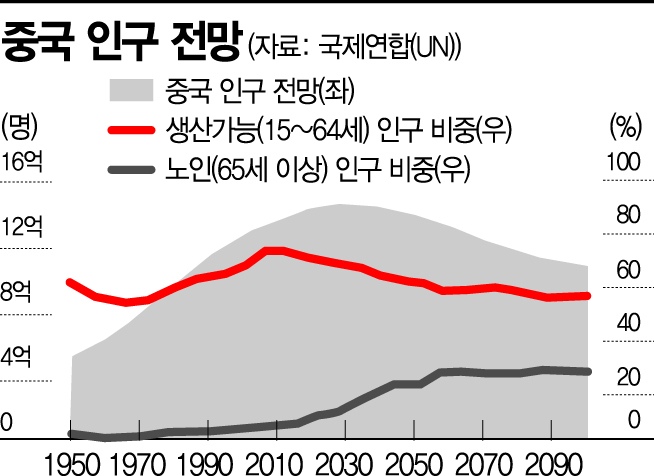
China's working-age population (ages 16?59) has decreased by 40 million over the past decade since 2010, and it is projected to decline by 7 million annually from this year through 2025. Last year, China's birth rate was 7.52 births per 1,000 people?the lowest since the founding of the People's Republic of China in 1949. During the same period, there were 10.62 million births and 10.14 million deaths, resulting in a population increase of only 480,000 compared to the previous year.
Conversely, the elderly population is rapidly increasing each year, and China has already entered an aging society. As of last year, the population aged 60 and above was 267.36 million, accounting for 18.9% of the total population, and those aged 65 and above numbered 205.6 million, making up 14.2%. Generally, a population with more than 14% aged 65 and above is classified as an aging society, and over 20% as a super-aged society. According to the National Bureau of Statistics, China's life expectancy has more than doubled over 70 years, from 35 years in 1949 to 77.3 years in 2019.
Since last year, China has been discussing retirement age issues primarily at the local government level, and various forms of retirement systems are already in place. Jiangsu Province has allowed all workers to voluntarily apply for a retirement deferral of at least one year starting from next month. Shandong Province has permitted senior technical experts to apply for delayed retirement of 1 to 3 years, provided their final retirement age does not exceed 65, since 2020.
© The Asia Business Daily(www.asiae.co.kr). All rights reserved.
![Clutching a Stolen Dior Bag, Saying "I Hate Being Poor but Real"... The Grotesque Con of a "Human Knockoff" [Slate]](https://cwcontent.asiae.co.kr/asiaresize/183/2026021902243444107_1771435474.jpg)















