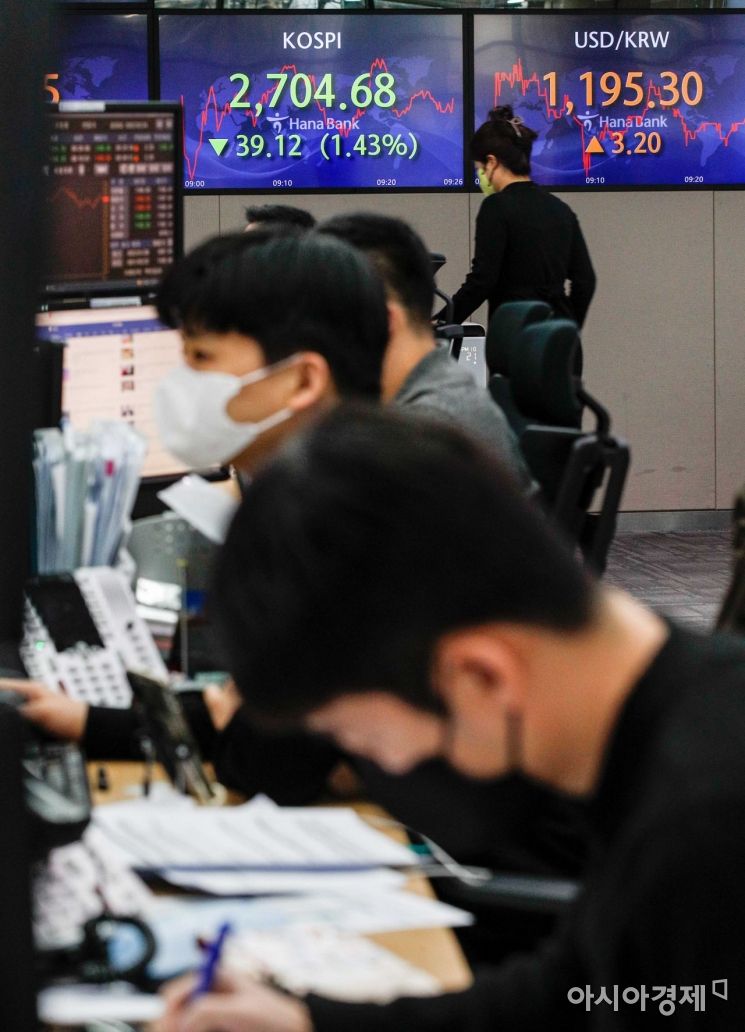
 As geopolitical tensions surrounding Ukraine escalate, the KOSPI index fell more than 1% in early trading on the 22nd. Dealers are working in the dealing room at the Hana Bank headquarters in Jung-gu, Seoul. Photo by Kang Jin-hyung aymsdream@
[Asia Economy Reporter Hwang Junho] As the Ukraine crisis escalates into a critical situation, an exodus is unfolding toward "Gopbus," a leveraged inverse betting instrument that profits from index declines.
According to the Korea Exchange on the 22nd, since the plan for Russia to invade Ukraine on the 16th was revealed on the 11th, the KODEX 200 Futures Inverse 2X Exchange-Traded Fund (ETF) has seen a trading volume of 4.1031 trillion KRW as of the 21st. Approximately 3 trillion KRW had been invested in this product from the 1st to the 11th, so the trading volume increased by 1 trillion KRW. It ranks first in total ETF trading volume. The trading volume also reached 1.66731 billion units, making it the highest among all ETFs.
Considering that the combined trading volume of KOSPI and KOSDAQ is about 13 trillion KRW, the lowest in two years, this truly represents a massive exodus to Gopbus. In particular, individual and foreign investors emerged as key players, with net purchases of 46 billion KRW and 26 billion KRW, respectively.
This product is an ETF that can be traded like stocks and is designed to yield twice the return when the KOSPI 200 index falls. The return during the same period was 1.46%, which is not very high. This is because the KOSPI fluctuated up and down amid the tension of the conflict. During the same period, the KOSPI fell by about 0.46%, and the KOSPI 200 by about 0.08%.
However, as news came that Russian President Vladimir Putin had deployed troops into Ukraine, as of 9:42 AM on the 22nd, the KOSPI slid 1.46%, the KOSPI 200 dropped 1.59%, and the Gopbus ETF's return surged 3.29%.
Kim Daejun, a researcher at Korea Investment & Securities, said, "Optimism about the current situation can be summarized as negotiations between both sides, while pessimism centers on the West's advance into Ukraine," adding, "If the West advances into Ukrainian territory, a full-scale war between major powers could erupt, causing a severe shock to the financial markets."
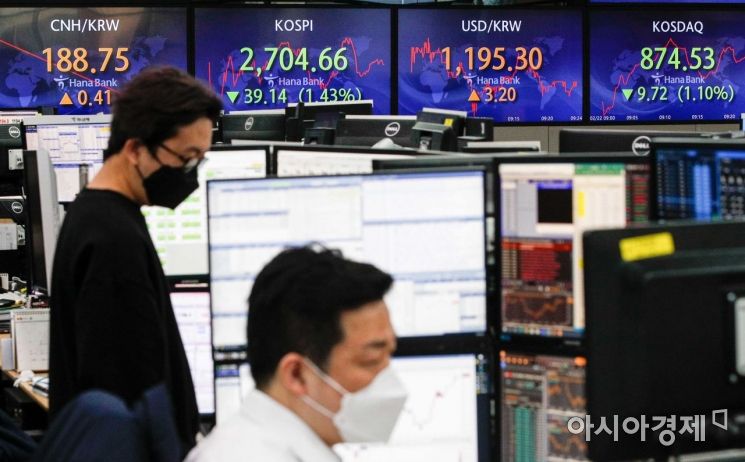 As geopolitical tensions surrounding Ukraine escalate, the KOSPI index fell more than 1% in early trading on the 22nd. Dealers are working in the dealing room at the Hana Bank headquarters in Jung-gu, Seoul. Photo by Kang Jin-hyung aymsdream@
Some investors expect overseas stock markets to be hit harder than domestic ones. These investors are channeling funds into ETFs that invest in the US market's downturn instead of Gopbus, achieving higher returns. The KODEX US Nasdaq 100 Futures Inverse and TIGER US S&P 500 Futures Inverse recorded returns of 6.04% and 4.85%, respectively, during the same period. As of this time, they have added 2.34% and 1.45% more returns, respectively. The KBSTAR China H Futures Inverse, tracking the Hong Kong market downturn, is also showing a 3.32% return amid geopolitical repercussions. An industry insider cited the Ukraine crisis and the Chinese government's strict COVID-19 measures as causes of the weakness.
As geopolitical tensions rise, many have early shifted their focus to safe assets. They have switched strategies to securing gold or silver instead of risky assets like stocks. Products such as KINDEX Gold Futures Leverage (5.78%) and TIGER Gold and Silver Futures (3.17%) have recently ranked among the top performers.
Jung Sungin, head of ETF Strategy at Korea Investment Trust Management, advised, "Historically, similar events have temporarily driven asset prices up. However, investors should be cautious as the volatility of gold prices may increase depending on the outcome of negotiations between Western countries and Russia."
© The Asia Business Daily(www.asiae.co.kr). All rights reserved.
![Clutching a Stolen Dior Bag, Saying "I Hate Being Poor but Real"... The Grotesque Con of a "Human Knockoff" [Slate]](https://cwcontent.asiae.co.kr/asiaresize/183/2026021902243444107_1771435474.jpg)
















