Sharp Rise in Jeonse Prices After Enforcement of Lease Protection Act
Jeonse-to-Wolse Conversion Rate at 4.7%
Loan Restrictions and Rising Interest Rates Push It Above 5%
Tenants Prefer Monthly Rent Over Jeonse
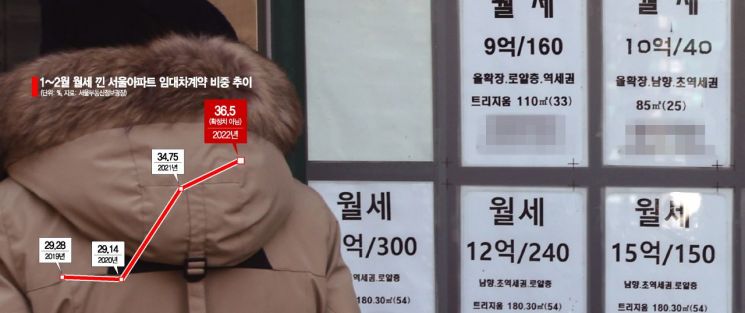
[Asia Economy Reporters Minyoung Kim, Seoyul Hwang] In Jamsil Els, Songpa-dong, Seoul, there were a total of 24 lease transactions from the beginning of this month until the 21st. Among these, only 5 were Jeonse (long-term deposit lease) transactions, while the remaining 19 involved monthly rent (Wolse). In January, the previous month, out of 70 transactions, 34 were Jeonse and 36 were Wolse. The gap has widened since monthly rent transactions surpassed Jeonse. This contrasts with January last year, when out of 78 total transactions, 53 were Jeonse?more than twice the number of Wolse transactions.
◆ Result of Aligned Interests Between Landlords and Tenants = The recent acceleration of the Jeonse-to-Wolse shift is due to the alignment of landlords’ desire to cover taxes by receiving monthly rent and tenants’ judgment that paying monthly rent is preferable to bearing the higher interest on Jeonse loans.
Institutionally, the sharp rise in Jeonse prices was significantly influenced by the enforcement of the Lease Protection Act in July 2020, which mainly introduced the right to request contract renewal and the cap on rent increases for Jeonse and Wolse. According to the Korea Real Estate Board, the average Jeonse price for nationwide apartment complexes rose 77% in January this year compared to the month the act was enforced (July 2020).
While Jeonse prices increased, loans became restricted and interest rates rose, causing significant changes in the real estate market. First, let’s compare the Jeonse-to-Wolse conversion rate, which is the interest rate applied when converting Jeonse deposits into monthly rent, with Jeonse loan interest rates. The interest rates on Jeonse loans from commercial banks range between 4% and 5%. The nationwide apartment complex Jeonse-to-Wolse conversion rate was 4.7% as of December last year. For example, if a tenant borrows 200 million KRW to live in a Jeonse house worth 500 million KRW, the bank interest is 1.25 million KRW per month (5% annual interest, 2-year repayment period), whereas converting the 200 million KRW into monthly rent would require paying 1.175 million KRW per month.
Lee Eun-hyung, a senior researcher at the Korea Institute of Construction Policy, said, "If the instability in the sales and Jeonse markets continues and Jeonse loan interest rates remain higher than the Jeonse-to-Wolse conversion rate, the trend of Jeonse shifting to Wolse will continue for the time being."
◆ Concerns Over ‘Monthly Rent Refugees’ if Jeonse Prices Surge in August = One aspect of the monthly rent trend is landlords’ ‘tax pass-through’ behavior, which is expected to peak when the burden of property holding taxes increases due to the rise in publicly announced property prices in March. As landlords face higher comprehensive real estate taxes, many will prefer monthly rent over Jeonse, and others will follow suit.
An official from a real estate agency in Jamsil said, "Jeonse transaction volume has decreased to about two-thirds, but monthly rent transactions have maintained the same volume despite price increases," adding, "Since tenants also prefer monthly rent, many landlords facing higher tax burdens are raising monthly rents."
The three lease laws, which will reach their two-year anniversary at the end of July, are also seen as factors encouraging the shift to monthly rent. Landlords are expected to list new properties reflecting the rent increases they were unable to apply during the previous period. This creates a domino effect where Jeonse prices rise, landlords prefer monthly rent, and tenants who cannot afford the increased Jeonse prices through loans are pushed into monthly rent. Furthermore, if monthly rent prices rise, there is a risk of ‘monthly rent refugees’?low-income residents being pushed further to the outskirts in search of affordable housing.
Yoon Ji-hae, chief researcher at Real Estate R114, said, "Although Jeonse prices in Seoul have risen significantly since the enforcement of the Lease Protection Act, many landlords were unable to raise prices properly due to the ‘5% rule.’ The new supply coming out in August is likely to reflect this by increasing Jeonse and monthly rent prices."
◆ Possibility of Jeonse Regaining Dominance if Conditions Change = Of course, the recent shift to monthly rent is not unprecedented. The share of monthly rent, which was about 34% in 2012, rose to 41.6% in 2014, and in January 2014, the number of monthly rent contracts (4,018) surpassed Jeonse contracts (3,274) for the first time. This was due to a downward stabilization in the sales market and a prolonged low-interest rate environment.
At that time, landlords had little incentive to engage in gap investment using Jeonse deposits and could not expect significant interest income from deposits, making monthly rent more advantageous. Although this situation differs somewhat from the current one, where both landlords and tenants are pushing for monthly rent, the market returned to Jeonse dominance after conditions changed.
Therefore, experts believe that while the current monthly rent trend may last longer than in 2014, it should not be seen as the ‘end of the Jeonse system.’ In other words, if monthly rent prices exceed the burden of Jeonse loan interest, the Jeonse-dominant market could quickly return. Moreover, the Jeonse system, unique to Korea, has advantages for tenants, which is another factor suggesting the potential revival of Jeonse.
© The Asia Business Daily(www.asiae.co.kr). All rights reserved.
![Clutching a Stolen Dior Bag, Saying "I Hate Being Poor but Real"... The Grotesque Con of a "Human Knockoff" [Slate]](https://cwcontent.asiae.co.kr/asiaresize/183/2026021902243444107_1771435474.jpg)















