Opportunity Balance Selection Target and Recruitment Ratio Specified
Local Universities Can Recruit 5% as Regional Talent
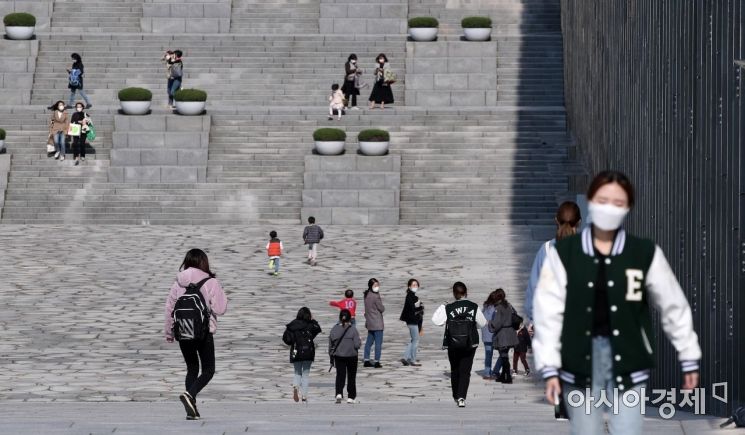 As the transition to 'With Corona' approaches, major universities are gradually switching to face-to-face classes, bringing some vitality back to campuses and surrounding commercial areas. On the 19th, Ewha Womans University campus in Seodaemun-gu, Seoul, is regaining its liveliness with students. Photo by Hyunmin Kim kimhyun81@
[Asia Economy Reporter Han Jinju] Starting from the 2024 academic year college admissions, self-introduction letters will be abolished, and the quota for opportunity-balanced selection will be mandated at 10%. A separate admission track outside the quota will be established at regional universities to increase college admission opportunities for adults aged 30 and over.
On the 22nd, the Ministry of Education announced that it reviewed and approved a partial amendment to the Enforcement Decree of the Higher Education Act at the Cabinet meeting. The amendment to the Higher Education Act, effective from March, mandates opportunity-balanced selection in universities and specifies the obligation for the Minister of Education to consult when establishing or changing higher education financial support, detailing necessary related matters.
To eliminate unfair elements in the comprehensive student record screening, self-introduction letters will be abolished from the 2024 academic year admissions materials.
With the revision of the Higher Education Act, the target groups and selection ratios for opportunity-balanced selection were also specified. The enforcement decree stipulates that the selection ratio for social integration screening candidates shall be 10% of the total recruitment quota.
The opportunity-balanced selection targets include ▲ national veterans, ▲ persons with disabilities or special educational needs due to physical impairments, ▲ students from farming, fishing, and island or remote areas, ▲ recipients of basic livelihood security, low-income families, and single-parent family support, ▲ graduates of specialized high schools and those employed in industry for more than three years after graduation, ▲ protected children, and ▲ North Korean defectors and children born in third countries during the defection process.
Recommendations are also made for necessary measures to select freshmen considering regional balance. Regional balanced admission freshmen are regulated to be at least 10% of the recruitment quota.
However, when regional universities recruit regional balanced talents, they may include 5% of the opportunity-balanced mandatory recruitment quota as regional talents within the recruitment quota. Regional talents refer to those who graduated from high schools or regional universities located in the respective regional university’s area.
To guarantee higher education participation opportunities for adult learners, a separate admission track outside the quota will be established for learners aged 30 and over entering universities, industrial universities, and technical colleges located outside the metropolitan area.
To promote the cultivation of advanced talents at the master's and doctoral levels in cutting-edge new technology fields, the requirements for increasing graduate school quotas will be relaxed. A system to increase quotas by utilizing graduate school deficit numbers will be introduced.
Additionally, to prevent duplication and overlap in university financial support projects carried out individually by various ministries, inter-ministerial collaboration will be strengthened.
When establishing the basic plan for higher education financial support, the Minister of Education must consult with relevant central administrative agencies. When an agency head establishes or changes a higher education financial support project under their jurisdiction, prior consultation with the Minister of Education is also required.
To review the establishment of the basic plan for higher education financial support and the consultation on project establishment or changes, a Higher Education Finance Committee composed of heads of related ministries and experts will be operated, and investigations and performance analyses of projects across all ministries will be strengthened.
© The Asia Business Daily(www.asiae.co.kr). All rights reserved.

















