From March 2 to 11, 'New Semester Adaptation Week'
Full remote classes possible at principals' discretion.. Simple meals for school lunches
Ministry of Education encourages flexible school academic operations
Shortened classes after kit distribution on March 2, the first day of school
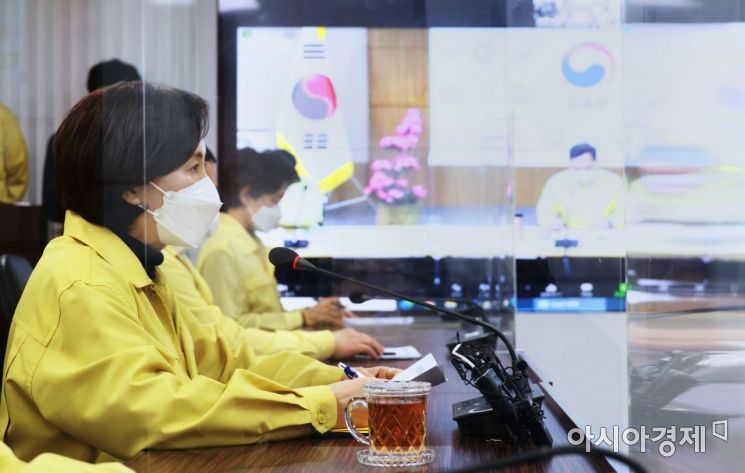 Deputy Prime Minister and Minister of Education Yoo Eun-hye is speaking at the Ministry of Education's Omicron Response Task Force meeting held on the 21st.
[Asia Economy Reporter Han Jinju] Schools will be allowed to operate academic schedules flexibly, including shortened classes and remote learning, for two weeks after the start of the new semester in March. Due to concerns that confirmed cases will surge until mid-March, measures have been taken to allow full remote learning at the discretion of school principals.
On the 21st, Deputy Prime Minister and Minister of Education Yoo Eun-hye activated the 'Omicron Response Emergency Inspection and Support Team' and personally chaired a Ministry of Education task force meeting involving related departments.
The Ministry of Education will operate a new semester adaptation period from March 2 to 11 to help schools adjust to the changed Omicron quarantine system and academic schedules.
Deputy Prime Minister Yoo said, "We will guide schools to prepare for flexible academic operations during the two-week adaptation period starting March 2," adding, "From the 28th, schools will use a self-diagnosis app to preemptively identify infection situations and take necessary measures. On the first day of school, March 2, we plan to distribute rapid antigen test kits and provide education on their use so that students can leave school promptly after testing."
Yoo also stated, "All schools nationwide are expected to operate with the highest level of vigilance until late March, and no one can predict what situations may arise at schools. Schools should not panic under any circumstances but respond promptly in consultation with the education office's emergency response team," urging cooperation.
The Ministry of Education announced that during this period, in regions where confirmed cases are concentrated and infections are a concern, flexible academic operations such as shortened class hours, adjusting overcrowded school density, and remote learning will be possible. Additionally, for two weeks, school meals can be replaced with simplified meals that shorten serving and eating times.
In the academic operation standards announced on the 7th, the decision on the fourth type, 'full remote learning,' was originally to be made through consultation among the Ministry of Education, education offices, and schools, but now it will be flexibly applied to allow decisions solely at the school principal's discretion.
An official from the Ministry of Education explained, "When the Ministry announced the academic operation standards on the 7th, we requested careful decisions on switching to remote learning. However, since confirmed cases are expected to peak in early to mid-March, we are emphasizing that switching to remote learning can be done based on the school principal's judgment rather than the Ministry or education offices."
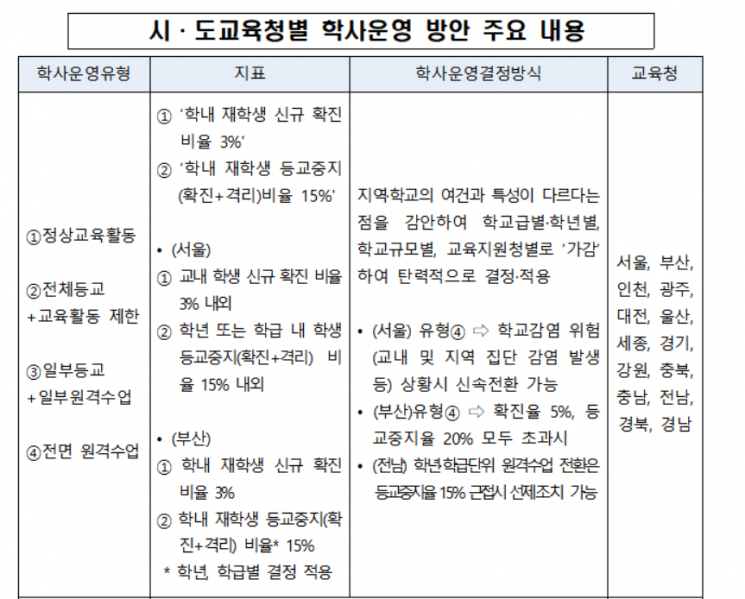
Criteria for switching to full remote learning at level 4 vary by region. In Busan, guidelines have been established allowing full remote learning by grade or school if the new confirmed case rate exceeds 5% and the school attendance suspension rate exceeds 20%. Other local governments, including Seoul, have set criteria for level 4 transitions based on the risk of school infections or occurrences of cluster infections within schools or communities. The Ministry of Education is not considering full remote learning at the city/province or national level.
Before returning to school, the self-diagnosis app will be improved starting on the 28th to reflect confirmed or quarantined statuses, enabling schools to preemptively monitor students' infection situations.
The Ministry plans to actively guide early dismissal after distributing rapid antigen test kits and providing usage education from March 2. During the first week of school, focused education and promotion on how to use rapid antigen test kits and updated quarantine guidelines will be conducted intensively.
The Ministry of Education announced the Omicron response plan for the first semester on the 7th, and local education offices and schools are preparing their own plans for the new semester. The Ministry will switch to an Omicron response emergency inspection and support team system with education offices and education support offices to review focused inspection tasks until the end of March.
Additionally, weekly meetings will be held with deputy superintendents of local education offices participating, chaired by the Deputy Prime Minister or the Ministry of Education Vice Minister. To gather field opinions, teacher and parent meetings will be held under the chairmanship of the Deputy Prime Minister or Vice Minister, and school visits are also planned.
Teachers have opposed the flexible academic operation plan, saying it shifts the burden of judgment onto schools. The Korea Federation of Teachers' Associations (KFTA) criticized, "Protecting the health of students and staff requires epidemiological standards and professional judgment, but leaving it to school autonomy is irresponsible administration," and urged, "Clear standards and guidelines for switching to remote learning based on levels of confirmed cases and quarantines must be established and immediately communicated to schools."
Meanwhile, according to the Omicron response academic operation plan announced by the Ministry of Education on the 7th, academic operation standards will vary by the number of confirmed and quarantined individuals at each school from the new semester. To maintain normal attendance as before COVID-19, the new confirmed case rate among enrolled students must not exceed 3%, and the attendance suspension rate (confirmed and quarantined) must not exceed 15%. If either condition is not met, restrictions on full attendance and (non-)curricular activities will apply, and if both conditions are exceeded, partial attendance will be implemented. If confirmed cases surge, the Ministry of Education, quarantine authorities, and education offices will consult to switch to full remote learning. Kindergartens, grades 1 and 2 of elementary school, special schools, after-school care, and small or rural schools will attend daily.
© The Asia Business Daily(www.asiae.co.kr). All rights reserved.


















