[Asia Economy Yang Nak-gyu, Military Specialist Reporter] Our military first made rifles after the Korean War. They modified the ‘M1 Carbine,’ which the US military had discontinued using, to create the single-shot M1 and the 36-round M2. Later, under the directive of the late President Park Chung-hee, the weapons development project called the ‘Lightning Project’ began, and simultaneously, the Ammunition Factory (Jobyungchang) capable of producing ammunition was established. Currently, the defense company Poongsan has set up the Angang plant to produce medium-caliber ammunition and the Busan Dongnae plant to manufacture rifle cartridges. To glimpse the future of ammunition, I visited Poongsan’s Busan plant on the 7th.
Upon entering the Busan plant, tightly spaced barbed wire fences dividing the area caught my eye. The military and police dormitories built during the old Jobyungchang era still remained intact. These traces clearly showed that the Busan plant started as an Army Ammunition Factory (a facility for producing and supplying ammunition).
A bullet consists of a primer, cartridge case, propellant, and projectile. When the trigger is pulled, the primer of the bullet is struck. At this moment, the primer ignites, and the propellant explodes, firing the projectile, which is the very front part of the bullet. The greater the amount of propellant, the longer the range, and the larger the projectile, the greater the destructive power. This is the principle of a bullet. To perfectly complete this process, even a tiny bullet no bigger than a fingertip undergoes a complex manufacturing process.
At Poongsan’s Busan plant, they produce 5.56mm ammunition for the K2 rifle, 7.62mm for the M60 machine gun, and .50 caliber for the K6 machine gun. A company official led me to Factory 1, saying they would show the bullet production process. As soon as I entered the factory, over 50 machines roared so loudly that I couldn’t hear the person next to me. To create space inside the cartridge case for the primer, the case is pressed with a force capable of lifting over 50 tons, so the noise was inevitably loud.
Compared to the variety of processing machines, the number of employees seemed small. The company official explained, "The lifeblood of Factory 1 is precision," adding, "Automation is essential to avoid even the slightest error in thickness, size, and depth of the cartridge." Moving to another area, work was underway to groove the side of the cartridge case. This is an essential production step to allow the next bullet to be reloaded after firing. Cartridge cases that completed this process were sequentially sent to the cartridge inspection machine. The inspection machine uses internal cameras to photograph each cartridge case and compare it to predetermined dimensions. The cartridge inspection machine was developed in-house by Poongsan and is so precise that there is now demand for export overseas, the company official revealed.
On the adjacent line, projectile production was in full swing. The machine produced projectiles the size of fingernails. The machines used during the Jobyungchang era produced 60 projectiles per minute, whereas the machines developed by Poongsan produce 125 per minute.
We moved to Factory 2, where propellant is loaded into the cartridge case and the projectile is assembled. Production Quality Manager Seong Sang-ho said, "Precision is important in Factory 1, but safety is paramount in Factory 2 because it handles explosives."
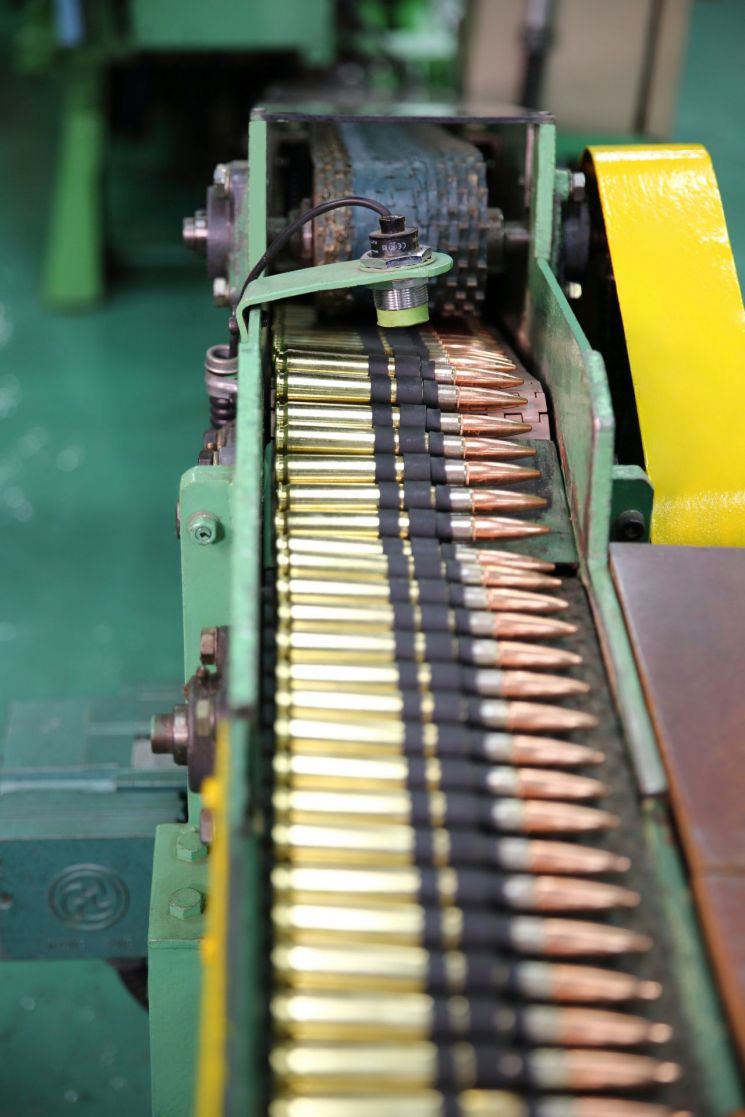
The completed bullets had to pass through the cartridge inspection machine once again. As the final external inspection, it was more meticulous. There were nine cameras installed inside the cartridge inspection machine. According to the company, defective bullets that fail inspection occur at a rate of about 15 per million rounds. When producing up to 3 million rounds per day, defective bullets number fewer than 50. After inspection, the bullets lined up in front of a robot, waiting to be packaged. The robot began stacking boxes containing 10 bullets each.
On the way out of the factory, the phrase “Equipment cared for with sincerity, rewarded with first-class quality” caught my eye. It reflected the pride of being the world’s second-largest bullet manufacturer after the United States.
© The Asia Business Daily(www.asiae.co.kr). All rights reserved.
![Clutching a Stolen Dior Bag, Saying "I Hate Being Poor but Real"... The Grotesque Con of a "Human Knockoff" [Slate]](https://cwcontent.asiae.co.kr/asiaresize/183/2026021902243444107_1771435474.jpg)
















