Monetary Policy and Interest Rate Volatility as Key Variables
Market Watches for Secondary Decline
Stronger Measures if 2700 Support Breaks
"Ukraine Has Passed the 80% Mark" Counterarguments Also Raised
[Asia Economy Reporter Ji Yeon-jin] The domestic stock market is staggering due to the 'Ukraine risk.' As the geopolitical conflict between Russia and Ukraine continues, the market experiences sharp declines when war tensions escalate, and slight rises when tensions ease, resulting in a repeated bearish trend. The Ukraine crisis has further dampened investor sentiment in a market already experiencing increased volatility since last year. Moreover, with the more significant core variable of the U.S. interest rate hikes still looming, voices warning to prepare for further declines are growing louder.
On the 21st, the KOSPI opened 1.38% lower than the previous trading day, breaking below the 2700 level during the session. This was the first time in a week (five trading days) since February 14, when foreigners dumped sell orders ahead of Russia's announced Ukraine attack date (February 16). This month, the KOSPI has fallen below 2700 three times: on the 14th, 15th, and the 21st. U.S. President Joe Biden convened the White House National Security Council (NSC) on the 20th (local time) regarding the Ukraine situation, signaling that the Russia-Ukraine war is imminent, which dragged the index down. Additionally, the U.S. Embassy in Russia urged its citizens to prepare evacuation plans due to threats of attacks not only in the Russia-Ukraine border area but also in public places in major Russian cities, further fueling war fears and significantly weakening investor sentiment.
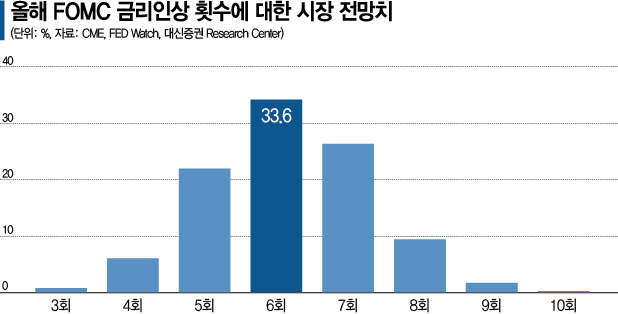
Since the beginning of the year, the stock market has undergone significant corrections due to fears of inflation accelerating U.S. interest rate hikes, and the Ukraine crisis has amplified the negative impact. Furthermore, concerns arise that if poor economic indicators coincide with the geopolitical risks in Ukraine, market anxiety could escalate rapidly.
Lee Kyung-min, a researcher at Daishin Securities, stated, "What currently increases downward pressure on global stock markets is the addition of economic uncertainty amid ongoing monetary policy burdens." He added, "The Ukraine crisis acts as an additional factor increasing market volatility, but it is unlikely that the stock market will resume an upward trend even if the Ukraine situation is resolved." He emphasized, "In a situation where monetary policy burdens and interest rate volatility are increasing, caution is needed against a secondary decline in global markets, including the KOSPI, due to tightening and economic uncertainty. Risk management should be strengthened if the KOSPI falls below the 2700 level." Chae Hyun-gi, a researcher at Cape Investment & Securities, said, "This week will also be difficult to determine the market direction due to uncertainties such as a full-scale war in Ukraine," adding, "While low-price buying related to reopening can be considered, maintaining a generally conservative view is advisable."
However, some analysts argue that these negative factors have already been priced into the market. Shin Seung-jin, a researcher at Samsung Securities, said, "January saw concerns over U.S. tightening, and February highlighted geopolitical risks, both burdening the market," adding, "These negative factors are reflected in market prices, and if the Ukraine-related uncertainties are resolved, a rapid rebound is possible. Now is the time to consider what portfolio to build when the market rebounds rather than focusing on additional downside risks." Park So-yeon, a researcher at Shin Young Securities, stated, "It is a significant gain that the probability of a 50bp rate hike at the March U.S. Federal Open Market Committee (FOMC) meeting has decreased due to the Ukraine crisis," and added, "The market correction has passed the 80% mark, and at the current level, there is no benefit in selling."
In fact, the market quickly reduced its losses after news spread that French President Emmanuel Macron proposed a U.S.-Russia summit, and both sides accepted. The KOSPI, which had widened its losses to around 1.7% early in the session, narrowed to a 0.4% decline by 10:40 a.m., and the KOSDAQ index, which had fallen about 1.5%, reversed to an increase.
© The Asia Business Daily(www.asiae.co.kr). All rights reserved.
![Clutching a Stolen Dior Bag, Saying "I Hate Being Poor but Real"... The Grotesque Con of a "Human Knockoff" [Slate]](https://cwcontent.asiae.co.kr/asiaresize/183/2026021902243444107_1771435474.jpg)















