Expert: "Expansion of PCR Testing Capacity Needed"
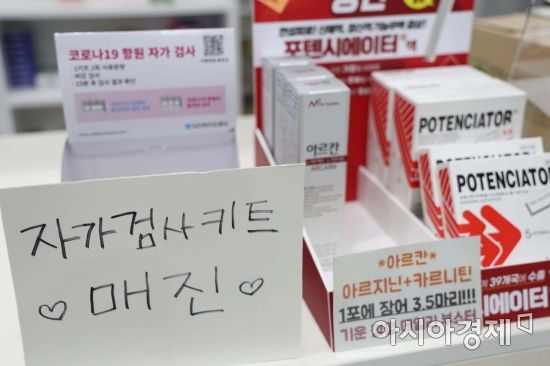 On the 10th, a self-test kit sold-out notice was posted at a pharmacy in downtown Seoul. The photo is not related to any specific part of the article.
[Asia Economy Reporter Na Ye-eun] As the demand for self-test kits has increased recently due to the COVID-19 pandemic, cases of 'false negatives' are rapidly emerging, raising doubts about their accuracy.
According to the Central Disease Control Headquarters (CDCH) on the 17th, the average number of rapid antigen tests conducted daily at public health center screening clinics since the 3rd is 300,000. Including self-test kits using the rapid antigen test method, the actual number of tests is expected to be much higher.
Currently, PCR tests at screening clinics are only available for △elderly aged 60 and above △those requested for close contact testing by public health centers △those with a doctor's opinion △workers in vulnerable facilities △and those who test positive on rapid antigen tests or emergency screening tests.
In other cases, individuals must first use self-test kits at screening clinics or receive professional rapid antigen tests at local respiratory clinics. If a 'positive' result is confirmed here, a PCR test is conducted.
Self-test kits and professional rapid antigen test kits are essentially the same product. The only difference is whether the individual collects the specimen from inside the nose themselves or a professional inserts a swab deep inside the nasal cavity to collect the specimen. The professional rapid antigen test kit is considered slightly more accurate.
This is because medical personnel collect specimens by inserting the swab deep into the nasal cavity to obtain nasopharyngeal swabs (from the back of the nose and throat), whereas the general public usually collects specimens from the nasal cavity (inside the nose) during self-testing. The virus survives more in the nasopharyngeal swab area than in the nasal cavity.
Kim Gap-jeong, head of the CDCH diagnostic team, stated, "It is true that the accuracy of rapid antigen tests is slightly lower compared to PCR tests." The Korean Society for Laboratory Medicine also said, "The sensitivity of rapid antigen tests is below 50% even when performed by medical personnel, and below 20% when performed as self-tests." Sensitivity refers to the probability that the test correctly identifies a person infected with COVID-19 (i.e., shows a positive result).
However, the government maintains that using rapid antigen tests as a 'supplementary tool' to PCR tests during the surge in confirmed cases is inevitable. PCR testing capacity is limited to about 800,000 tests per day. Since the 3rd, PCR tests have averaged about 500,000 per day, reaching nearly 700,000 on busy days, effectively reaching capacity.
Meanwhile, experts point out that the government lacks interest and support in expanding PCR testing capacity. Professor Lee Hyuk-min of Yonsei University's Department of Laboratory Medicine said, "Diagnostic experts have been continuously emphasizing the need to secure capacity for the past two years," adding, "Since PCR tests are most widely used for infectious disease diagnosis, it is necessary to expand capacity to prepare for other infectious diseases after COVID-19."
© The Asia Business Daily(www.asiae.co.kr). All rights reserved.
![Clutching a Stolen Dior Bag, Saying "I Hate Being Poor but Real"... The Grotesque Con of a "Human Knockoff" [Slate]](https://cwcontent.asiae.co.kr/asiaresize/183/2026021902243444107_1771435474.jpg)















